
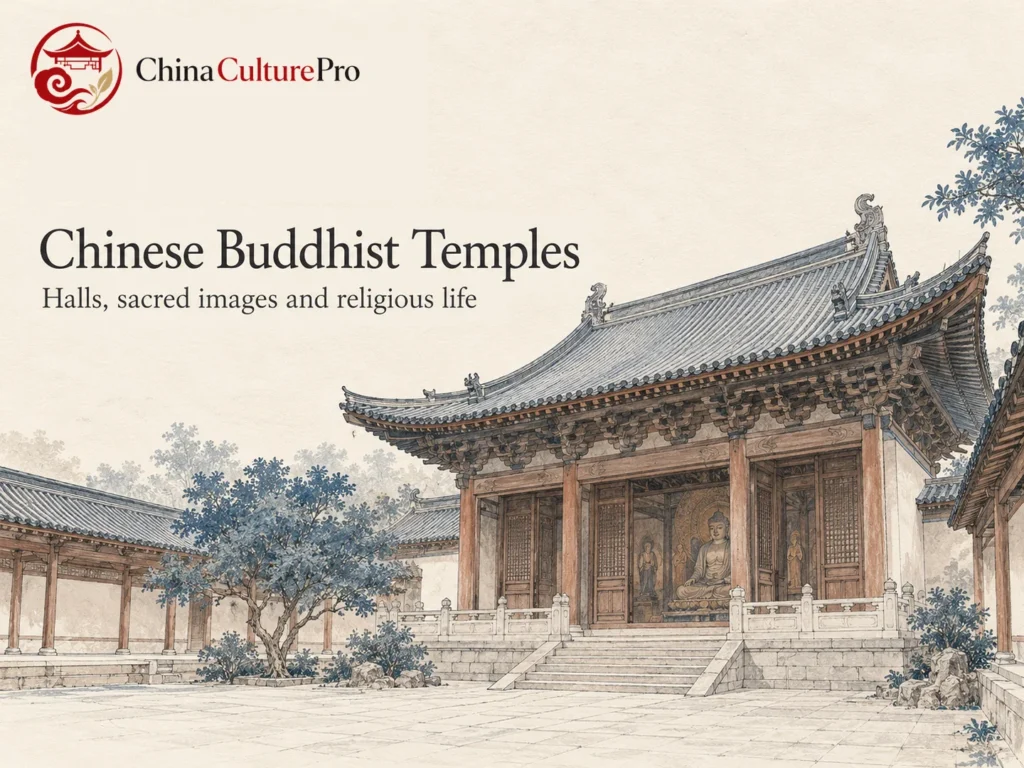

Quick Answer: What Is a Chinese Buddhist Temple?
A Buddhist temple (佛寺, fósì) is a place for Buddhist images, worship, teaching and religious practice. Many Chinese examples organize halls and courtyards along a central axis, with supporting spaces around them. The building complex and the religious community are related, but they are not the same thing.
- Spaces: entrances, Buddha halls, teaching areas and living quarters have different functions.
- Images: Buddhas, bodhisattvas and guardians represent different religious roles.
- Community: monastics, lay supporters and visitors participate in different ways.
This guide focuses mainly on Han Chinese temple traditions within Chinese Buddhism. Regional traditions and modern buildings do not all follow one architectural model.

A temple courtyard can look like an architectural monument while serving a living religious community. Reading the halls, images and activities together helps explain why one room welcomes public worship, another houses teachings, and others belong to monastic work or residential life.
Courtyards, Halls and the Logic of the Central Axis
In many traditional complexes, successive halls face open courtyards along a main axis. Side buildings complete enclosures, while secondary areas accommodate residences and supporting work. Moving inward changes the relationship between entry, worship and more specialized spaces. The broader Chinese temple architecture tradition supplies shared building forms, without making every religious site identical.
The surviving architecture of Beijing’s Zhihua Temple (智化寺, Zhìhuà Sì) offers a documented Ming example: principal halls occupy a north–south axis, while courtyards and subsidiary buildings organize the complex. Its sutra hall stands beside the main Buddha hall, showing why scripture space need not always be the final building at the back. A historical plan also cannot by itself establish how a site operates today.[1]
A Guide to Common Temple Spaces
| Common name | Función | Límite interpretativo |
|---|---|---|
| Shanmen (山门, shānmén) | Entrance or mountain gate | Marks entry into the complex; the physical form varies |
| Hall of Heavenly Kings (天王殿, Tiānwáng Diàn) | An entrance hall associated with protective figures | Protective figures and their positions should be identified locally |
| Mahavira Hall (大雄宝殿, Dàxióng Bǎodiàn) | Principal Buddha hall in many complexes | Its images and assembly use need to be read locally |
| Dharma Hall (法堂, Fǎtáng) | A place for teaching the Buddhist Dharma | Teaching function differs from simply storing scriptures |
| Sutra repository (藏经楼, Cángjīnglóu) | A building for scriptures | Repositories may differ in name, placement and public access |
At Hangzhou’s Lingyin Temple (灵隐寺, Língyǐn Sì), the main Buddha hall stands behind the entrance hall, while its Dharma Hall lies farther uphill beyond another major hall. These are useful relationships to recognize, not a mandatory sequence for every temple.[2][3][4]
A pagoda is a different kind of structure, historically related to the Indian stupa and the enshrinement of relics. Chinese pagodas may form part of a religious complex, but the word does not mean the whole temple or its main worship hall.[11]
Who the Images Represent
Buddhas represent awakening; bodhisattvas have roles associated with helping others on the religious path. Guanyin (观音, Guānyīn), the bodhisattva of compassion, is one important example. The guide to Chinese Buddhist bodhisattvas explains why sacred figures should not all be called the historical Buddha.[5]
At Lingyin, the entrance image of Maitreya (弥勒, Mílè) takes the form of Budai (布袋, Bùdài), the cloth-bag monk commonly called the Laughing Buddha. This is a different identity from Shakyamuni, the historical Buddha honored in the main hall. Weituo (韦驮, Wéituó) and the Four Heavenly Kings (四大天王, Sì Dà Tiānwáng) have protective roles; an armored figure is not automatically another image of Shakyamuni.[2][3]
Read a figure’s name, attributes, companions and placement together. Guanyin’s images have varied forms, so one pose, costume or gender presentation is not a universal identification key. Local explanations can resolve an arrangement that differs from a familiar guidebook example.[5]
Religious Life Beyond the Public Halls
Halls accommodate actual religious events. Lingyin’s record of its 2026 summer retreat ceremony places monastics in the Mahavira Hall, while its Buddha-bathing observance describes chanting and participation by the congregation. These examples show the same architectural setting supporting distinct occasions, rather than functioning only as a statue gallery.[6][8]
Monastic life also requires kitchens, dining spaces, residences and organized work. Lingyin describes its dining hall as a place for monastic meals and reflection, with kitchen duties divided among different responsibilities. That religious setting should not be confused with automatic public restaurant access. Buddhist vegetarian cuisine has its own culinary and institutional context.[7]
Bells and drums can signal gatherings and organize communal activity. Temple sound therefore has a practical and religious role beyond atmosphere. A bell tower’s presence does not give visitors permission to sound its instrument.[12]
Regional Traditions and Modern Buildings
Architectural research on Inner Mongolian temples identifies Mahavira halls that integrate Buddha worship with assembly and chanting space. This regional evidence complicates the idea that every function must occupy a separate building in one fixed courtyard sequence.[9]
Modern Chinese Buddhist institutions can also adopt different forms. At Nung Chan Monastery (农禅寺, Nóngchán Sì) in Taipei, a Main Buddha Hall, a Chan (禅, chán) meditation hall and a concrete corridor participate in a modern architectural composition. A traditional tiled roof is not a prerequisite for Buddhist religious life. The common hall vocabulary is an aid to interpretation, not a test that excludes other buildings.[10]
Reading a Temple Respectfully
Start with the community’s own signs and explanations: identify the main hall, read the images’ names and observe which areas are for public worship. A meditation hall may require prior arrangements; residential rooms and kitchens are not automatically visitor spaces.
Follow local temple etiquette for photography, clothing, entry and participation. Rules concerning incense offerings and access vary. Ask before joining a service, touching an image or using an instrument, and allow worshippers and monastics to carry out their activities without interruption.
FAQs About Chinese Buddhist Temples
Are all statues in a Buddhist temple images of the Buddha?
No. Images can depict different Buddhas, bodhisattvas, guardians and other figures. Their names, attributes and local arrangement matter more than a general label such as Buddha statue.
Must every Buddhist temple have a pagoda?
No single tower is a requirement for every complex. Pagodas have a history associated with relics and religious commemoration; the temple’s halls perform other functions.
Is every temple open for meditation or meals?
No. Public visiting, religious services, retreats and monastic meals have different conditions. Check the institution’s own arrangements rather than assuming every space or activity is open.
Do all Chinese Buddhist temples follow the same layout?
No. A courtyard axis is common in traditional Han Chinese examples, but historical period, religious tradition, local terrain and modern design all affect the arrangement.
Fuentes
[1] Wei-Cheng Lin, University of Chicago, original architectural research. A Ming Buddhist Temple and Its Architecture
[2] Lingyin Temple, official temple description. The Hall of Heavenly Kings
[3] Lingyin Temple, official temple description. The Grand Hall
[4] Lingyin Temple, official temple description. The Dharma Hall
[5] Denise Patry Leidy, Metropolitan Museum of Art. Chinese Buddhist Sculpture
[6] Lingyin Temple, official religious-life record. Sangha of Lingyin Temple in Hangzhou Commence Summer Retreat in 2026
[7] Lingyin Temple, official temple description. Dining Hall
[8] Lingyin Temple, official religious-life record. Buddha Bathing Ceremony Held at Lingyin Temple on Buddha Shakyamuni’s Birthday
[9] Enkehaoribao and coauthors, Architectural Institute of Japan, original research. The Planar Compositions of Mahavira Halls in Inner Mongolian Buddhist Temples
[10] Dharma Drum Mountain, own monastery account. The Nung Chan Monastery Unveils a New Page
[11] The Walters Art Museum, collection record. Incense Burner in the Form of a Pagoda
[12] Lingyin Temple, official temple description. Bell and Drum Tower