
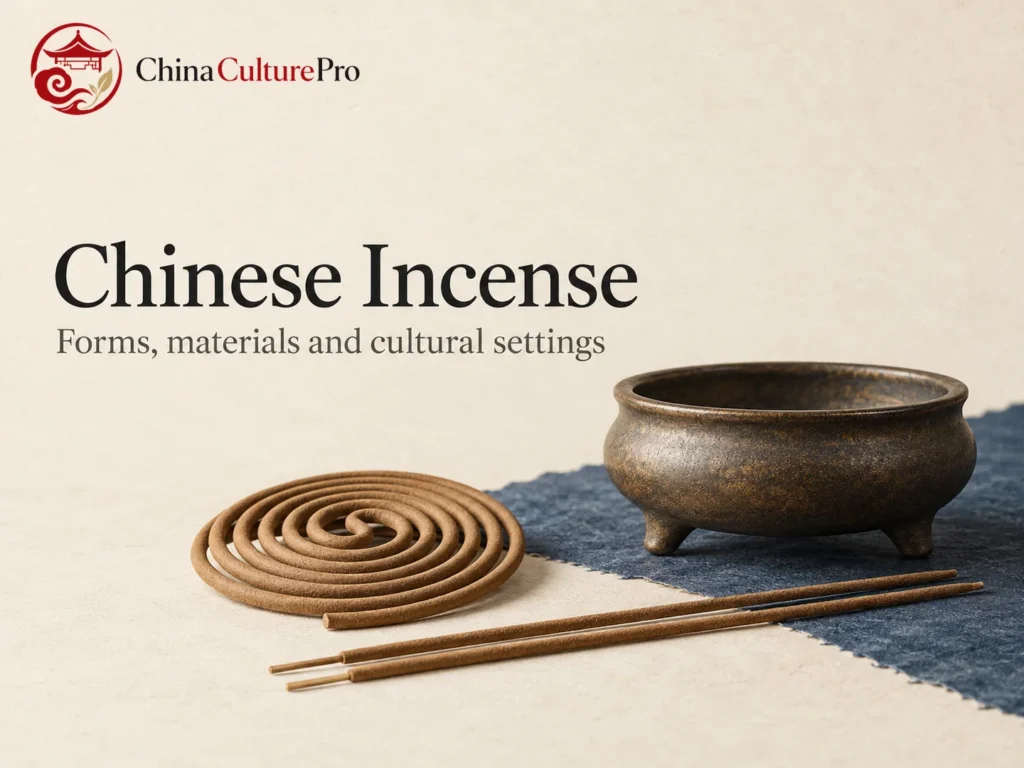

Quick Answer: What Is Chinese Incense?
Chinese incense, broadly discussed under xiang (香, xiāng), includes aromatic preparations used in religious offerings and cultivated everyday settings. A stick is only one form: coils, cones and powders also occur. To understand what you see, separate the substance, its shape and the occasion.
- Form: the physical preparation determines how it is supported.
- Material: fragrant ingredients and binding materials perform different jobs.
- Context: a temple offering, household rite and fragrance appreciation need different explanations.
No single ingredient, number of sticks or explanation defines every Chinese incense custom.[7]
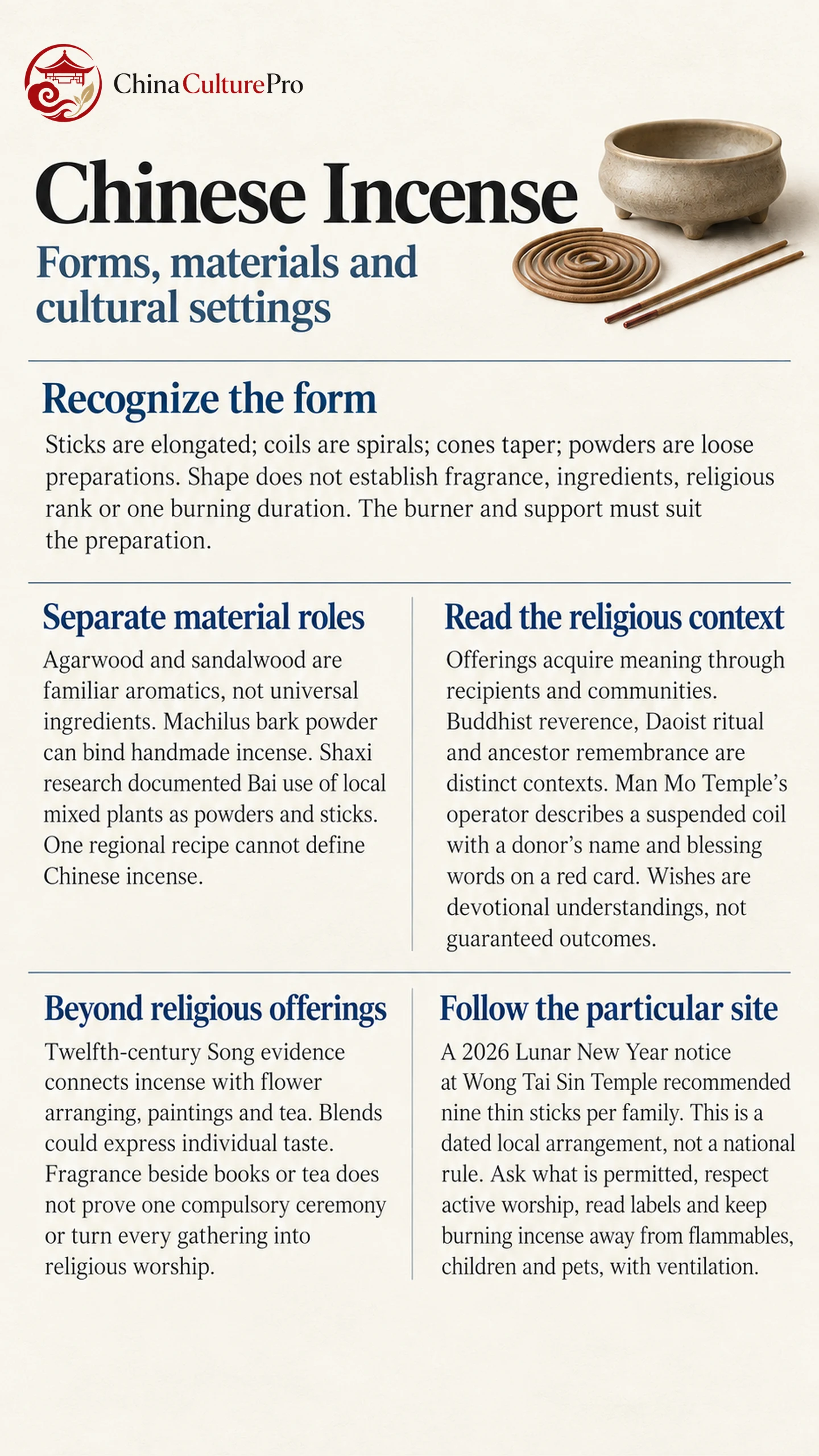
A hanging coil, a bundle of thin sticks and powder in a burner may all be incense, yet they reveal different things. Shape helps you recognize the object; ingredients and the surrounding activity help explain its fragrance and cultural purpose.
Sticks, Coils, Cones and Powder
Start with visible form rather than assuming that every preparation contains the same wood. These categories describe what the material looks like, not an exclusive religious affiliation.[7]
| Forma | Qué conviene reconocer | What the shape cannot establish |
|---|---|---|
| Stick incense (线香, xiànxiāng) | A narrow, elongated preparation | Its fragrance or whether it contains a supporting core |
| Coil incense (盘香, pánxiāng) | A continuous spiral, sometimes suspended | One standard size or duration |
| Cone incense (塔香, tǎxiāng) | A compact tapering form | A special religious rank or purpose |
| Incense powder (香粉, xiāngfěn) | Loose prepared material used in a suitable vessel | One fixed blend of plants |
An incense burner (香炉, xiānglú) is the receptacle. Its support, depth and arrangement must suit the incense form. A coil suspended from a temple ceiling and powder contained in a censer use different arrangements; neither is simply an oversized version of an upright stick.[1][5]
Materials: Fragrance Is Not the Same as Form
Agarwood (沉香, chénxiāng) and sandalwood (檀香, tánxiāng) are familiar aromatic materials, but they do not exhaust the range. Recognizing an incense shape does not establish its ingredients. A product’s color or a seller’s evocative name is not a botanical identification.[1]
A useful distinction is fragrance versus structure. A Taiwanese botanical museum describes powder from the bark of Machilus zuihoensis as a traditional adhesive for handmade incense. Its binding role helps shape the preparation; that does not make it the principal desirable scent. Ingredients can perform different jobs within one stick.[3]
Field research in Shaxi (沙溪, Shāxī), Yunnan, documented incense among Bai (白族, Báizú) participants using local plant mixtures, including cypress and other species, as powders or joss sticks. This concrete case challenges a luxury-wood-only picture of Chinese incense. It describes the studied community, rather than proving one recipe for the province or country.[2]
Worship, Ancestors and Local Meanings
Offering incense (上香, shàngxiāng) takes its meaning from the religious setting and recipient. In Chinese Buddhist practice, incense can express reverence and devotion. Dharma Drum Mountain (法鼓山, FǎgǔShān) explains it as an offering to the Buddha; its guide describes that institution’s practice, not instructions binding every temple.[1]
Incense also belongs to Daoist ritual life and local religious traditions. The Shaxi study records use at temples, graves and household stoves, with different spiritual recipients and occasions. Recuerdo de los antepasados therefore should not be collapsed into worship of a temple deity merely because incense appears in both.[2]
At Hong Kong’s Man Mo Temple (文武庙, WénwǔMiào in Mandarin), the temple operator describes a suspended coil accompanied by a red card bearing a worshipper’s name and blessing words. The coil belongs to a devotional relationship, rather than serving only as atmospheric decoration. Wishes communicated through incense are religious understandings, not outcomes this guide can guarantee. The familiar English temple name reflects Cantonese usage.[5]
Incense Beyond the Temple
Incense appreciation also has a documented place in cultivated leisure. Evidence from twelfth-century Song China connects fragrance with flower arranging, displaying paintings and tasting tea. Historical preparations could express individual taste through different recipes; the setting was not restricted to a public temple altar.[4]
This association explains why incense sometimes appears beside books, flowers or tea implements in cultural displays. It does not mean that every scholar burned incense, or that a single formal ceremony governed every household. Likewise, Chinese tea practices have their own hospitality and ceremonial histories: the presence of fragrance does not turn all tea drinking into a religious rite.[4]
Observing Incense Customs Respectfully
Ask what is permitted at the particular site before bringing or lighting incense. A documented local rule can be precise without being universal. Wong Tai Sin Temple (黄大仙祠, HuángdàxiānCí in Mandarin) recommended nine thin sticks per family across three offering points in its 2026 Lunar New Year notice. That dated arrangement is not a required number for all temples or every later visit.[6]
Respect active worship and the staff responsible for burners and suspended offerings. Temple etiquette includes following posted access and photography guidance, rather than moving devotional objects for a better view. Observing quietly does not require copying a ritual you do not understand.
For permitted use, read ingredient and manufacturer information and follow the site’s fire arrangements. Taiwan’s standards bureau advises ventilation, separation from flammable materials, and keeping children and pets away from burning incense. Smoke volume alone cannot establish the ingredients or meaning of an offering.[7]
FAQs About Chinese Incense
Is all Chinese incense made from agarwood?
No. Agarwood is one aromatic material among many. Some documented local traditions use mixed powders from other plants, while binding ingredients have a separate structural role.
Must everyone offer three incense sticks?
No. Counts depend on the institution, occasion and local practice. One dated Wong Tai Sin notice recommended nine thin sticks per family; it cannot establish a national rule.
Is incense used only in religion?
No. Alongside offerings, historical evidence places incense in cultivated leisure and fragrance appreciation. Religious and nonreligious settings can share materials without sharing exactly the same meaning.
Are incense and joss paper the same thing?
No. Incense is an aromatic preparation; joss paper comprises paper offerings in particular ritual traditions. Their recipients, permitted use and handling require separate explanations.
Fuentes
[1] Dharma Drum Mountain, practitioner guide. Incense and Incense Burner
[2] Staub and colleagues, original ethnobotanical study. Incense and Ritual Plant Use in Southwest China: A Case Study among the Bai in Shaxi
[3] National Museum of Natural Science. Machilus zuihoensis
[4] National Palace Museum. Four Leisure Activities: Arranging Flowers, Burning Incense, Hanging Paintings, Tasting Tea
[5] Tung Wah Group of Hospitals, own temple service. Man Mo Temple: Large Coil Incense
[6] Sik Sik Yuen, own dated notice. Wong Tai Sin Temple: 2026 Lunar New Year Arrangements
[7] Taiwan Bureau of Standards, Metrology and Inspection. Incense Product Inspection and Consumer Guidance