


Quick Answer: What Are Chinese Almond Cookies?
Chinese almond cookies, often labeled xingren bing(杏仁饼,xìngrén bǐng), include more than one style of sweet. A golden baked cookie topped with an almond is familiar in Chinese American restaurants, while Macao has a distinct molded biscuit tradition.
- Texture: crisp and crumbly rather than chewy like a rice-flour sweet.
- Ingredients: almonds or almond flavoring may accompany wheat flour, mung bean flour, fats and other ingredients, depending on the style.
- Setting: bakeries, restaurant meals, tea tables and Lunar New Year gifts.
The English name does not establish one recipe or a gluten-free, dairy-free or vegetarian product. [1]
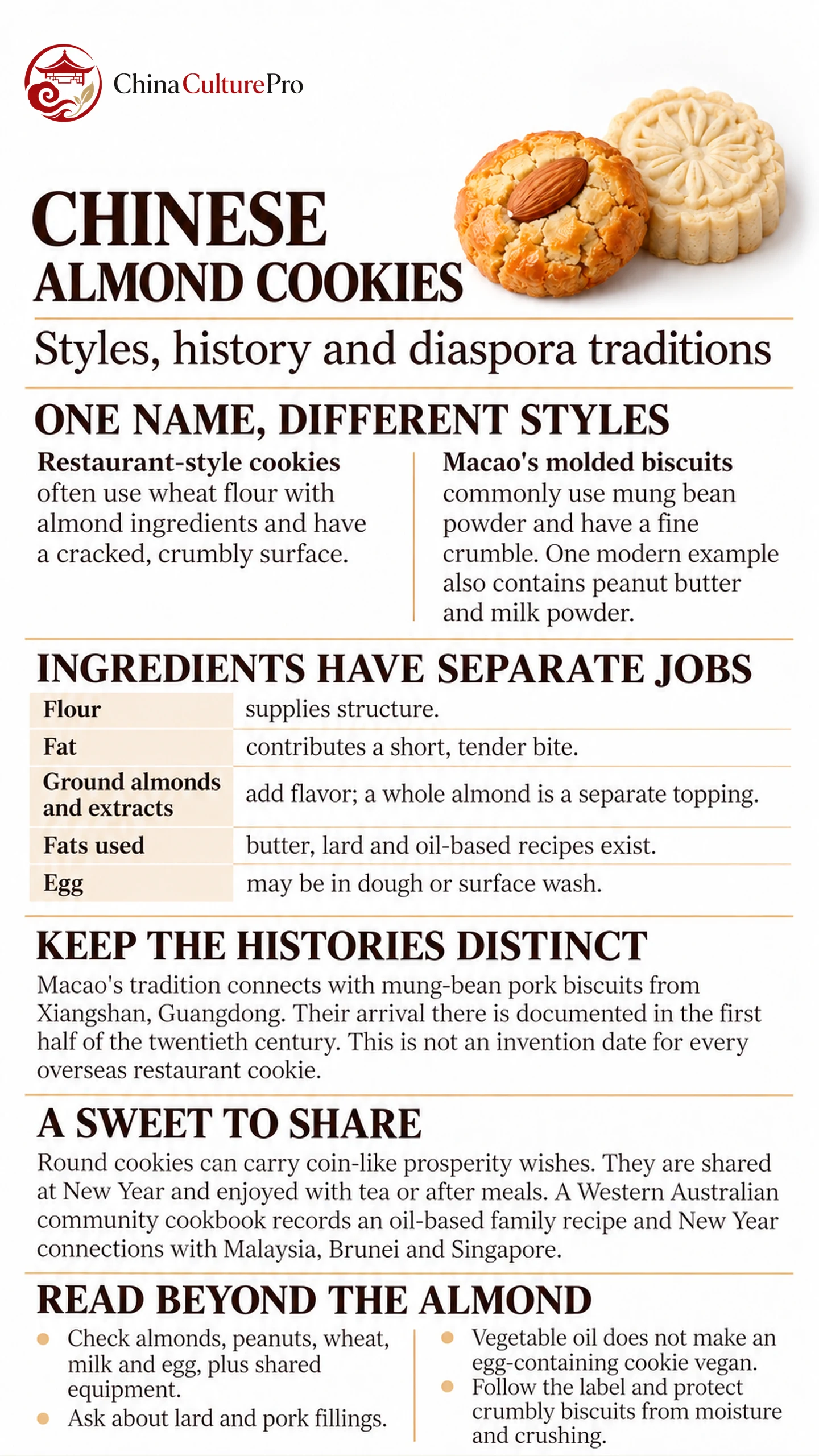
A golden cookie crowned with a single almond can look quite different from a pale, patterned biscuit pressed in a wooden mold. Both may be sold as Chinese almond cookies. Within traditional Chinese desserts, their shared name conceals useful differences in flour, shaping, texture and regional history.
Two Styles Behind the English Name
The restaurant-style cookie is usually a small baked round with a short, crumbly bite. Its surface may crack as it spreads, and an egg wash can give it a golden sheen. A whole almond is a familiar finishing detail. This style is closely associated with Chinese American bakery and restaurant memories, but individual recipes differ. [2]
Macao almond biscuits commonly use mung bean powder and can contain sugar-preserved pork. A molded shape and fine crumble distinguish them from a spread-out bakery cookie. [3]
| Style or example | Base and shaping | Qué lo distingue |
|---|---|---|
| Restaurant-style almond cookie | Often wheat-based dough with almond ingredients, shaped into rounds and baked | Cracked surface, crumbly bite and a familiar almond garnish. |
| Macao molded almond biscuit | Commonly mung bean powder with other ingredients, pressed before baking | Defined pattern and fine, dry crumble; fillings and fats vary. |
| Modern mixed-ingredient Macao biscuit | A documented example combines mung bean powder, almonds, peanut butter, milk powder and vegetable oil | The label reveals ingredients that appearance and the word “almond” cannot. |
The last row is one actual product formulation, not a rule for all Macao bakeries. [4]
Ingredients, Shaping and the Crumbly Texture
In wheat-based versions, flour gives the cookie its structure, while fat contributes to a tender, short bite. Ground almonds add nut flavor and another texture within the dough; a whole almond on top is a separate component. Almond extract can contribute aroma without replacing the flour or fat.
Recipes may use butter, lard or a combination. That changes both flavor and dietary suitability. Egg can appear in the dough or as a surface wash, so a golden top is worth asking about when eggs are excluded. An all-butter version exists alongside lard-containing preparations; neither should be declared the only possible Chinese almond cookie. [1][2]
Macao’s documented traditional craft uses wooden molds and charcoal baking. A stamped surface comes from shaping; a restaurant cookie’s cracks develop as its dough bakes. [3]
History: Regional Records and Migration
The clearest historical approach is to separate the styles. Macao’s almond-biscuit tradition is linked with mung-bean-powder pork biscuits from Xiangshan in Guangdong. The documented account places their arrival and popularity in Macao in the first half of the twentieth century. It also describes the development from an almond-like shape to the round biscuits familiar today. [3]
That regional history should not be used as the exact invention date of every wheat-based restaurant cookie overseas. Nor does a resemblance to another Chinese nut pastry prove a single line of descent. The English category brings together sweets that can have different ingredient bases and local histories.
For understanding the wider setting, Cantonese cuisine provides useful southern Chinese context. Bakery traditions travel through families and businesses, but recipes can change as ingredients, equipment and customers change. A familiar almond decoration can persist even when the dough’s fat or flour mixture is different.
Lunar New Year, Tea and Diaspora Tables
Round almond cookies are often shared at Lunar New Year, with their coin-like shape associated with wishes for prosperity. This is a festive interpretation, not a promise of material gain. The sweet can also be eaten at other times of year, with tea or at the end of a meal. [1][2]
A community cookbook from Western Australia offers a specific diaspora example. Its contributor, Jane Hung, describes family connections with Malaysia and Brunei and identifies almond cookies with Chinese New Year in Malaysia, Brunei and Singapore. Her recipe uses almond meal, wheat flour, vegetable oil and egg yolk. This shows how a shared festive name can accommodate a formulation different from either an all-butter cookie or a traditional pork-containing molded biscuit. [5]
On a Chinese New Year food table, cookies can be one part of a larger selection of sweets. They make a convenient gift or something to offer visitors alongside other sweets.
Buying, Storing and Dietary Checks
Choose by style first. If you want a light, cracked cookie with a nut on top, a molded mung bean biscuit may not deliver the texture you expect. For a gift box, photographs and ingredient lists are more useful together than either one alone. Ask whether mixed flavors contain different fillings or fats.
Read the full ingredient list for almonds and other nuts, peanuts, wheat, milk and egg. Shared equipment also matters for allergies. A mung bean base does not guarantee that a product contains no wheat, and almond flour does not cancel wheat flour elsewhere in a recipe. [6]
For vegetarian or vegan needs, check lard, pork fillings, butter, milk powder and egg separately. A vegetable-oil recipe may still contain egg or dairy. The Chinese vegetarian food guide explains why the absence of visible meat is only a starting point.
Keep packaged biscuits according to their label, with seals and dates checked before gifting. Crumbly cookies need protection from crushing as well as moisture. Do not assume every homemade, loose bakery and factory-packed version has the same storage life.
FAQs About Chinese Almond Cookies
Do Chinese almond cookies always contain almonds?
Many do, as ground nuts, pieces or a topping. The name is not a complete ingredient list; check the actual product and any flavoring.
Are Chinese almond cookies gluten-free?
Not automatically. Wheat flour is common in restaurant-style cookies, while molded products also need their complete ingredients and handling checked.
Do almond cookies contain lard?
Some do. Others use butter, vegetable oil or mixed fats. Ask about the specific recipe, including any pork-containing filling.
Are Macao almond biscuits the same as restaurant cookies?
They share an English name but often differ in flour base, shaping and texture. Macao’s molded mung bean biscuits are a distinct style.
Fuentes
[1] King Arthur Baking. Chinese Almond Cookies
[2] Sarah Leung, The Woks of Life. Chinese Almond Cookies
[3] Macao Cultural Affairs Bureau. Confection of Almond Biscuits
[4] Macao Ideas, IPIM. Mini Almond Cookies
[5] Shire of Katanning, Jane Hung. Cooking to Connect: Almond Cookies
[6] U.S. FDA. Food Allergies: What You Need to Know