

Quick Answer: What Are Chinese Rice Cakes?
Chinese rice cakes are a varied family of foods made from rice or rice flour, including niangao(年糕,niángāo)and ciba(糍粑,cíbā).
- Texture: Commonly chewy, sticky or resilient, rather than light like a sponge cake.
- Preparation: Ground rice, flour mixtures or steamed grains are cooked and shaped in different ways.
- Use: Sweet festival cakes, filled snacks and savory slices for meals all belong within the wider picture.
There is no single national recipe. Rice varieties, added ingredients and regional methods change the result. “Rice cake” here usually means a moist, substantial food, not the dry puffed disc familiar from some supermarket snack aisles.
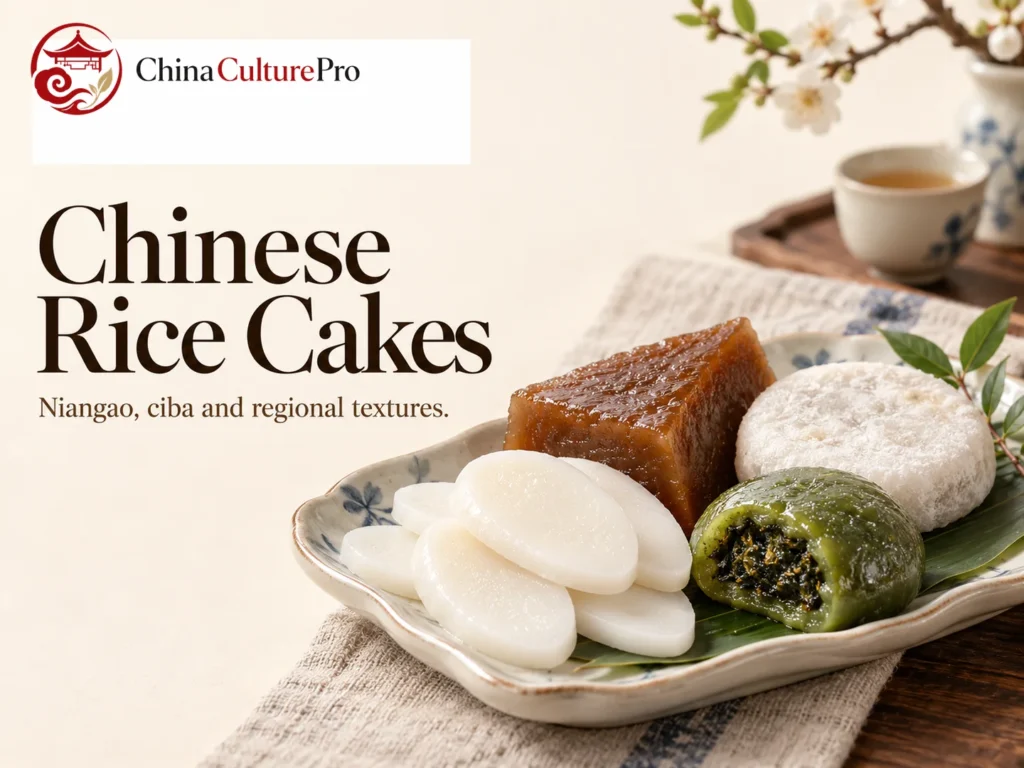
White oval slices in a savory stir-fry look very different from a brown sugar cake or a green filled dumpling. Yet all can lead an English-speaking diner to the words “rice cake.” This guide connects those names to their textures and uses, from everyday Chinese rice dishes to seasonal sweets.
Niangao, Ciba and Other Regional Forms
Niangao is often translated as “New Year cake,” but it includes more than a sweet brown block. Zhejiang preparations can combine ordinary rice and glutinous rice, producing cakes that are sliced for meals or enjoyed with a sweet accompaniment. Some are ground, steamed and then pounded before shaping.[1]
Ciba commonly begins with steamed glutinous rice that is pounded into a cohesive mass. A village photo record from Hunan shows this work as part of New Year preparations. The name is associated with southern and southwestern traditions, but it does not impose one shape or topping on every community.[2]
Another recognizable form is qingtuan(青团,qīngtuán), a green filled rice-flour sweet or snack associated with Jiangnan. Herbal ingredients can color and scent its wrapper. Sweet bean paste is familiar, while savory meat fillings also exist.[3]
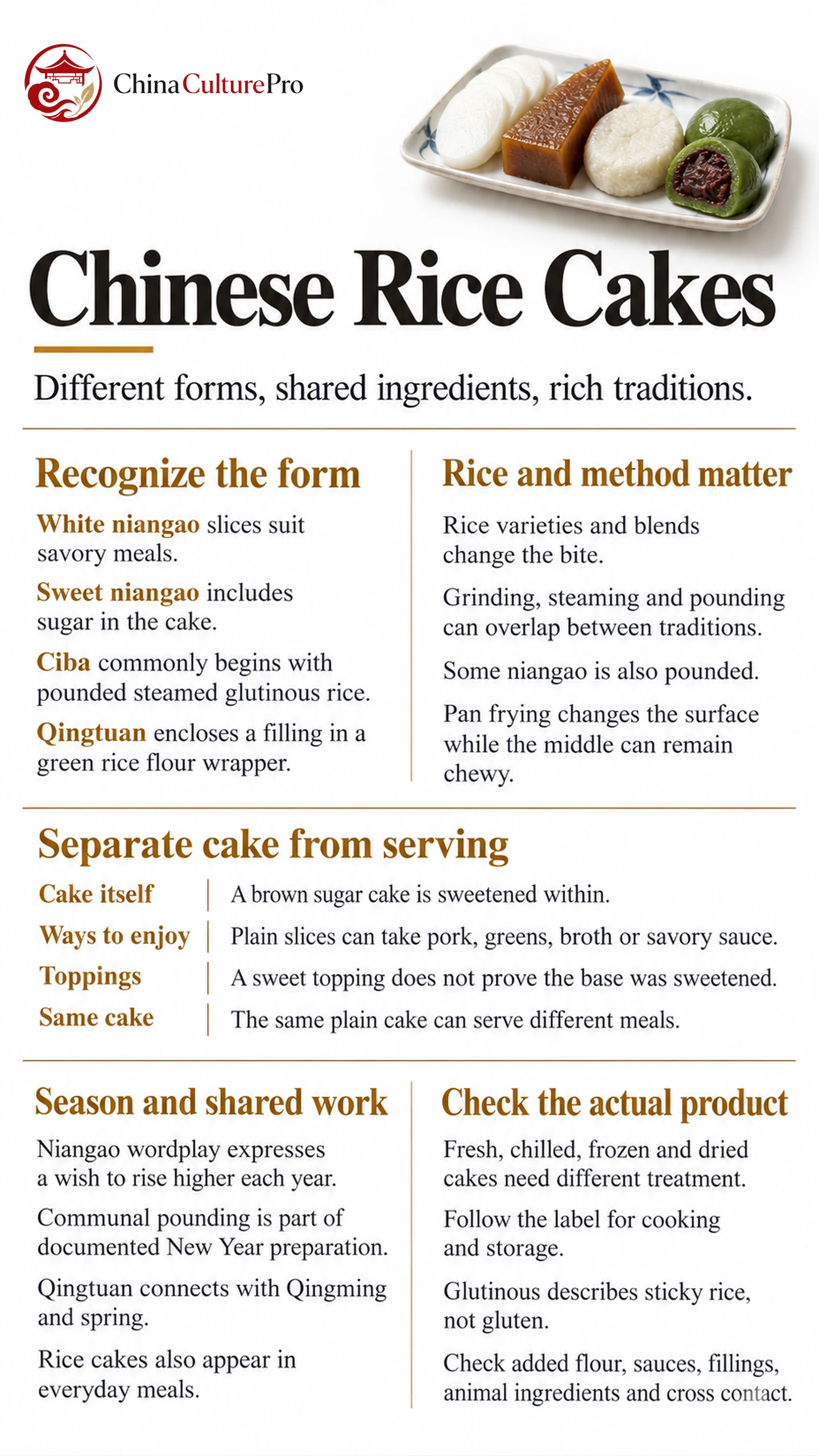
| Forma | Typical identity | Common serving direction |
|---|---|---|
| White niangao slices | Plain, chewy rice cake cut into ovals or strips | Stir-fries, soups and other savory meals |
| Sweet niangao | A dense steamed cake with sugar in the mixture | Sliced as a sweet, sometimes pan-fried |
| Ciba | Pounded glutinous-rice cake | Shaped pieces with regional sweet or savory accompaniments |
| Qingtuan | Green rice-flour wrapper enclosing a filling | A small filled springtime snack |
These examples organize a broad family; they are not mutually exclusive manufacturing standards. Pounding, for example, occurs in more than one named tradition.
Rice, Flour and the Making of Chewiness
The choice of rice matters. Ordinary rice and glutinous rice do not behave identically, and a blend can produce a different bite from either alone. Even among glutinous rice varieties, starch behavior and the finished cake’s texture vary. That helps explain why “made from sticky rice” is an incomplete description of softness, springiness or firmness.[1][4]
There are also different routes from grain to cake. One begins with grinding rice, moistening the flour or paste and cooking it. Another starts with whole steamed grains and pounds them together. Some regional niangao combines grinding, steaming and pounding, so it is misleading to say that all niangao is flour-based while only ciba is pounded.[1][2]
Cooking turns the rice mixture into a cohesive structure that can be shaped, sliced or wrapped around a center. Later treatment changes the surface again: a pan-fried slice can develop a firmer browned exterior while retaining a chewy middle. A cooled sweet cake may become easier to cut than the soft, sticky cake just out of the steamer.[5]
These stages explain texture more usefully than the English word “cake.” A rice cake need not rise like a baked wheat cake.
Sweet Desserts and Savory Meals
Sweet niangao incorporates sugar into the cake itself. Brown sugar gives a familiar version its color and flavor, while other additions vary by household. Once cooled and sliced, it may be pan-fried for a contrast between the surface and the center. This is a different starting point from a plain white slice later coated in a savory sauce.[5]
In Shanghai cuisine, rice-cake slices can form a substantial meal with pork and leafy greens. Soups and hot pot offer other uses for plain cakes. The rice supplies chew and body, while stock, vegetables, meat and seasoning determine much of the finished flavor.[6]
A sweet coating does not necessarily mean the rice base was sweetened, just as a savory sauce does not reveal the cake’s rice blend. To understand a menu item, separate the cake from its filling, topping and cooking liquid. A plain cake can move in several culinary directions.
Festival Meanings and Communal Making
Niangao carries an auspicious New Year association through wordplay: the word for cake sounds like “high,” supporting a wish to rise higher from year to year. The meaning is a cultural expression of hope, rather than a claim that eating the cake causes prosperity.[7]
Making the cake can also be a shared event. Hunan’s documented village preparations show people working on ciba before Spring Festival, while Zhejiang accounts describe neighbors helping with pounding. The work connects an ordinary grain with family preparation and collective memory.[2][7]
The calendar connection varies by food. Qingtuan is closely associated with Qingming and spring in Shanghai, while niangao is especially visible among Chinese New Year foods. Neither association makes every rice-cake dish a festival-only food: savory slices also belong to everyday meals.[6][8]
Choosing, Storing and Checking Ingredients
When ordering, ask whether the cake is sweetened, filled or plain, and how it is served. For a New Year gift, the dedicated niangao guide provides a narrower festival context. For a meal, the sauce and accompaniments are more immediately useful clues.
Packaged rice cakes may be fresh, chilled, frozen, vacuum-packed or dried. Each preparation state can require different treatment. Some dried products require rehydration, while other cakes are prepared directly according to their label. Do not assume that a shaped product is ready to eat or apply one soaking method to every package.[6]
Rice itself does not contain wheat gluten, and “glutinous” describes its sticky quality. The complete dish still needs checking: flour blends, soy sauce, fillings and shared equipment can introduce relevant allergens. Meat, lard, egg or dairy additions also change its dietary suitability. A white rice-cake slice is not a guarantee that the finished dish is vegan or gluten-free.[9]
Store and prepare the specific product as directed. Texture alone cannot establish safe storage, and a cake becoming firmer on cooling does not supply a universal expiry rule.
FAQs About Chinese Rice Cakes
Are all Chinese rice cakes sweet?
No. Plain rice cakes are widely used in savory dishes, while sweetened cakes and sweet toppings belong to other preparations.
Are niangao and ciba the same?
They overlap within the wider rice-cake family but have distinct regional names and traditions. Their methods cannot be separated by one simple flour-versus-pounding rule.
¿El arroz glutinoso contiene gluten?
Rice itself does not contain wheat gluten. Check the finished product’s other ingredients and cross-contact information when gluten avoidance matters.
Can you cook rice cakes straight from the package?
It depends on the product. Dried, chilled, frozen and ready-to-eat cakes can require different treatment; follow the particular label.
Fuentes
[1] Zhejiang Provincial Department of Culture and Tourism. Niangao
[2] Hunan Provincial Government. Chinese New Year Festive Vibe Spreads in Yao Township
[3] Shanghai Municipal Government. Xuhui’s Qingtuan Tasting Route
[4] Qingyun Lyu and colleagues. Evaluation Method of Texture of Glutinous Rice Cakes
[5] Judy Leung. Nian Gao: Chinese New Year Sweet Rice Cake
[6] Sarah Leung. Stir-Fried Rice Cakes
[7] China Daily, via ChinaCulture. Chewy Rice Cakes Embody Wishes for Good Fortune
[8] Shanghai Municipal Government. Qingtuan
[9] U.S. Food and Drug Administration. Food Allergies: What You Need to Know