


Quick Answer: Who Was Chien-Shiung Wu?
Chien-Shiung Wu (吴健雄, Wú Jiànxióng, 1912–1997) was a Chinese-born experimental physicist best known for the cobalt-60 experiment that demonstrated a failure of mirror symmetry in beta decay.[1]
- Training: She studied physics in China and completed her doctorate at Berkeley.
- Measurement: The experiment found that electrons preferentially emerged opposite the nuclear spin.
- Credit: Wu and four colleagues published the experimental paper in 1957.[4]
The finding concerns the weak interaction responsible for the decay. Its scope is specific to the process tested.
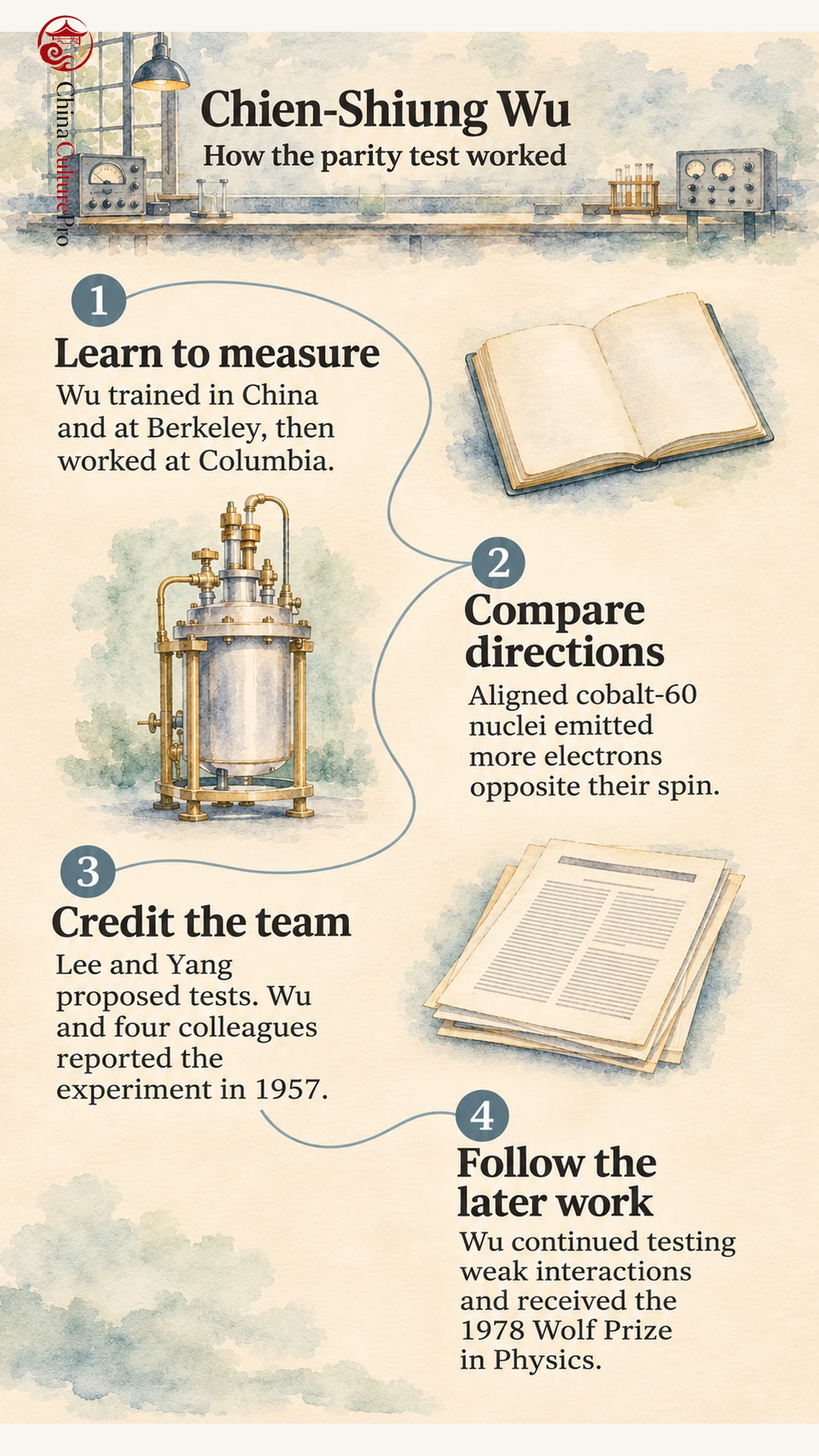
Wu’s career connects the precision of laboratory instruments with a basic question about physical law. In her best-known experiment, the direction of an electron mattered as much as the fact that it was emitted.
From China to the Columbia Laboratory
Wu grew up in Liuhe near Shanghai, where her father ran a school that admitted girls. She attended the Shanghai Public School, where Hu Shi (胡适, Hú Shì) was president, before studying mathematics and then physics at National Central University in Nanjing. She moved to the United States in 1936 and completed a doctorate on uranium fission products at Berkeley in 1940.[1]
In 1944 she joined the Manhattan Project at Columbia University, working on gaseous diffusion for uranium isotope separation. Her later beta-decay experiments used thin samples to reduce the energy lost by electrons scattering on their way out of the source. That attention to how an instrument could change the signal was central to her research.[1]
What the Cobalt-60 Experiment Measured
Beta decay is a process in which an unstable nucleus changes and emits a beta particle. Cobalt-60 emits electrons. If parity held in this decay, the electrons would show no preference for traveling along or against the spin of the emitting nucleus. A preference in either direction would distinguish the process from its spatial mirror image.[2]
The team cooled a cobalt-60 sample to about 0.003 kelvin and aligned the nuclear spins with a magnetic field. They reversed the alignment while keeping the electron detector fixed. Gamma-ray counts monitored the alignment. More electrons traveled opposite the spin direction.[2]
That directional difference established parity violation in cobalt-60 beta decay. Results emerged in late 1956.[2]
Who Proposed, Tested and Published the Result?
In 1956, Tsung-Dao Lee (李政道, Lǐ Zhèngdào) and Chen Ning Yang (杨振宁, Yáng Zhènníng) examined the evidence for parity conservation in weak interactions and proposed experiments to test it.[3]
The paper appeared on February 15, 1957. It lists Wu of Columbia University first, followed by Ernest Ambler, Raymond Hayward, Dale Hoppes and Ralph Hudson of the National Bureau of Standards.[4]
Recognition and Work Beyond Parity
Wu went on to compare beta decays in boron-12 and nitrogen-12 as part of a test of the conserved vector current hypothesis. Her group’s 1963 measurements helped clarify the relationship between weak and electromagnetic currents.[1]
Her honors included the 1975 National Medal of Science and the 1978 Wolf Prize in Physics.[2][6] Her career offers a modern example for readers tracing women in Chinese history through professional institutions and public recognition.
FAQs About Chien-Shiung Wu
Did Chien-Shiung Wu win a Nobel Prize?
No. The 1957 Nobel Prize in Physics went to Lee and Yang for their investigation of parity laws. Wu’s experimental role is recorded in the separate research paper.[4][5]
Why was the experiment carried out at the National Bureau of Standards?
Its laboratory could reach the very low temperatures needed to align the cobalt nuclei. The staff also had experience measuring and controlling nuclear orientation.[2]
Does the Wu experiment mean every physical law violates parity?
The observation establishes a counterexample in a weak decay. Other interactions must be assessed with evidence from the processes they govern.[2]
Fuentes
[1] Noemie Benczer-Koller. Chien-Shiung Wu, Biographical Memoirs
[2] National Institute of Standards and Technology. Reversal of the Parity Conservation Law in Nuclear Physics
[3] T. D. Lee and C. N. Yang. Question of Parity Conservation in Weak Interactions
[4] C. S. Wu, E. Ambler, R. W. Hayward, D. D. Hoppes and R. P. Hudson. Experimental Test of Parity Conservation in Beta Decay
[5] Nobel Prize Outreach. The Nobel Prize in Physics 1957
[6] Wolf Foundation. Chien-Shiung Wu, 1978 Wolf Prize in Physics