

Quick Answer: What Is Bian Embroidery?
Bian embroidery, or bianxiu (汴绣, biànxiù), is a hand embroidery tradition associated with Kaifeng in Henan. Makers work in silk thread on designs that include birds and flowers, portraits and versions of paintings. A documented example is a white satin scroll embroidered in 1959 after a Northern Song painting.[2][3][4]
- Place: The name Bian points to Kaifeng’s historical name.[4]
- Material: The documented Qingming scroll uses a white satin ground.[2]
- Technique: The makers translated a painted cityscape into colored threads, outlines and textures.[3][4]
Check the date of the embroidery and the date of its pictorial model separately.

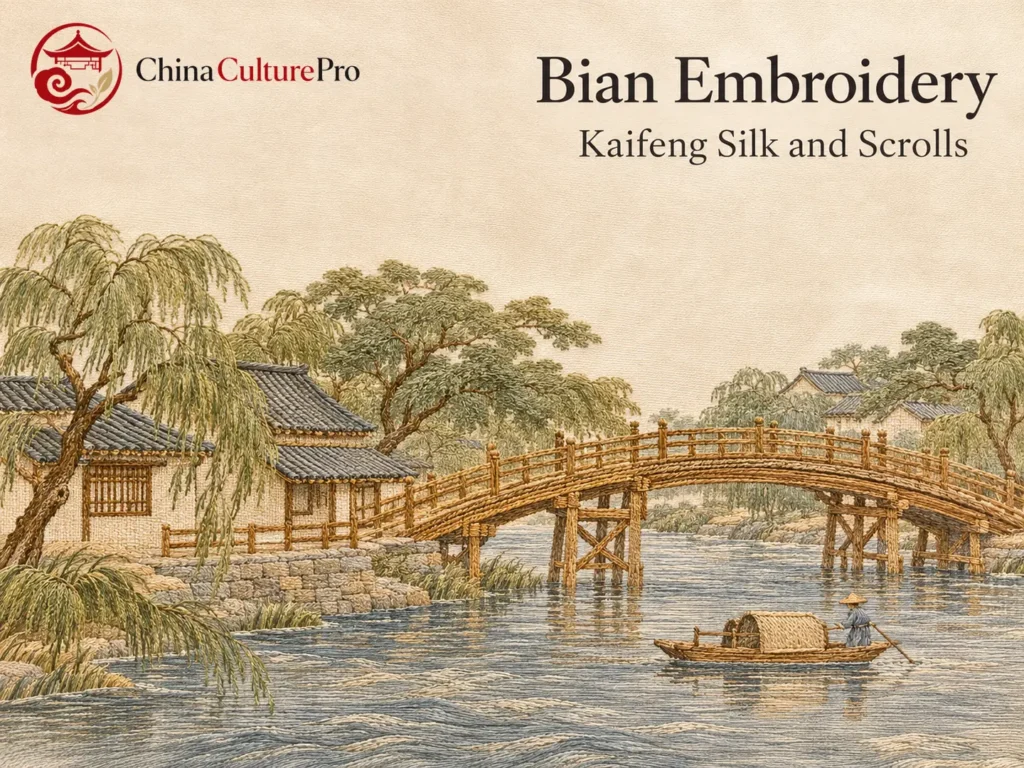
A bridge can look like a few dark lines from across a gallery. Up close, a stitched bridge becomes rows of thread whose direction changes at the rail, deck and people standing on it. Bian embroidery is especially well suited to this kind of comparison between a painting and the choices made to recreate it in thread.
Where the Kaifeng Tradition Takes Its Name
Bian is an old name associated with Kaifeng, capital of the Northern Song dynasty. The national heritage entry also records the name songxiu (宋绣, sòngxiù), or Song embroidery. It connects the tradition to Kaifeng’s historical embroidery and describes later periods of decline and renewed workshop development. Bian embroidery entered the national representative list in 2008.[1]
A traditional name can preserve the relationship to a place and an artistic past. The date, maker and materials on an individual museum label tell you when and where that object was made. That distinction is especially important when the image comes from a much older painting.
How Silk Stitches Carry a Painted Design
Look first at the ground, the fabric supporting the design. The 1959 Qingming scroll in the Tsinghua University Art Museum is embroidered on white satin. In a close view, distinguish the sheen of the background from the direction of the threads that form the image.[2]
An embroidered line can follow a small contour, such as a window frame, while stitches across a larger field can give a coat or tree canopy a different texture. Look at where the threads change direction. The Chinese satin stitch guide shows how closely spaced stitches can fill a surface. Satin stitch is a method and satin is a woven ground. A label that names one leaves the other open.
A back view of an unmounted embroidery can show how threads travel between details. On a mounted scroll, use the visible surface and any stitch names in the museum record. The guide to Chinese embroidery traditions gives other regional comparisons.
Look Closely at the 1959 Qingming Scroll
The museum’s embroidered Along the River During Qingming Festival was made in 1959. The embroidered picture area measures 30.5 centimeters high by 680 centimeters long. It takes Zhang Zeduan’s Qingming handscroll as its model. Tsinghua reports that the inscription credits 22 embroiderers. A museum event account says they finished it in 35 days.[2][3][4]
Start with a small passage. Pick out a roof, a boat or a market figure and follow its outline. Then check where the makers used thread to mark light and shadow or set one form apart from another. Compare the same section in the painting if you can. The guide to Chinese painting techniques gives context for the lines and washes that needle and thread translate.
How the Craft Changes Through Workshop Practice
The national listing describes modern Kaifeng embroiderers compiling a repertoire of 36 stitch types while learning from other traditions, including Suzhou embroidery. Treat that count as a record of the repertoire they described. Look for a separate object record to see which stitches were used on a particular scroll.[1]
Wang Suhua, a recognized inheritor, worked at the Kaifeng embroidery factory and developed named stitch variations. Reports on a later Kaifeng workshop also describe embroidered versions of other well-known paintings.[5][6]
Modern works include flowers, animals and portraits alongside city scenes. The guide to Chinese embroidery motifs offers context when a subject carries a conventional association.[1]
FAQs About Bian Embroidery
Does the name Song embroidery mean a piece is from the Song dynasty?
It is another name for the Kaifeng tradition. An embroidery may be recent even when its subject or stylistic reference comes from the Song period.[1][3]
Is the 1959 scroll the original Qingming painting?
The 1959 work is an embroidered version on satin. Its model is the Northern Song painting attributed to Zhang Zeduan.[2][3]
Is Bian embroidery the same as Jingxiu?
Bian embroidery is associated with Kaifeng. Beijing embroidery has its own heritage listing and a strong association with the court textiles of Beijing and surrounding areas. Both can use silk, so check the object’s place and workshop record.[4][7]
Fuentes
[1] China Intangible Cultural Heritage Network. Bian Embroidery, Kaifeng
[2] Tsinghua University Art Museum. Woven and Embroidered Painting and Calligraphy Exhibition
[3] Tsinghua University. Reading Woven and Embroidered Paintings
[4] Wei Kangqi, China Federation of Literary and Art Circles. Why Spend Time Embroidering a Painting by Hand?
[5] China Intangible Cultural Heritage Network (Red del Patrimonio Cultural Inmaterial de China). Wang Suhua, Representative Inheritor of Bian Embroidery
[6] Xinhua. Craft Transmission in a Kaifeng Workshop
[7] China Intangible Cultural Heritage Network. Jingxiu, Fangshan, Beijing