

Quick Answer: What Happened at the Battle of Talas?
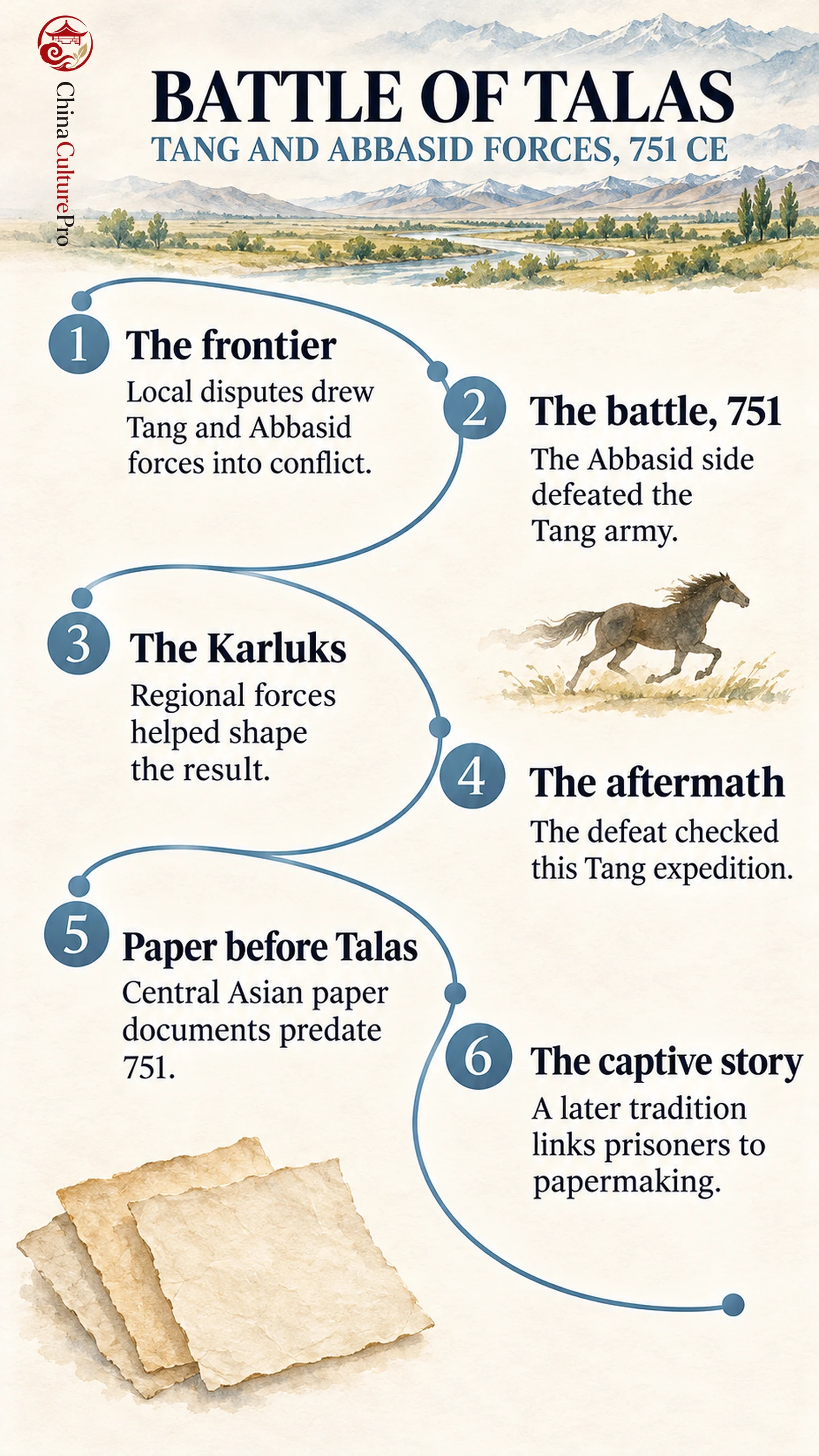
The Battle of Talas (怛罗斯之战, Dáluósī zhī zhàn) was an Abbasid victory over a Tang (唐, Táng) force in 751 CE in the Talas River region of Central Asia. The two armies met amid conflict among local rulers and competing regional powers. [1][2][3]
- Campaign: Tang intervention in the western frontier brought its army into conflict with Abbasid forces.
- Result: The Abbasid side prevailed and the Tang force withdrew after a major defeat.
- Paper: The familiar story about Chinese captives teaching the craft comes from a later tradition. [1][2][5]
The military defeat and the history of papermaking answer different questions and depend on different evidence. [2][5][6]
Talas is remembered both as a battle and as a supposed turning point in the history of paper. One story follows armies through the frontier. The other follows a technology across cities and workshops. The date 751 matters to both stories, but surviving evidence connects it to them in different ways.
Why Tang and Abbasid Forces Met in Central Asia
The Tang dynasty maintained military and political interests far to the west of its capital. The general Gao Xianzhi (高仙芝, Gāo Xiānzhī) intervened in the affairs of Chach (石国, Shíguó), around modern Tashkent. The Chinese account connects the capture of its ruler and the appeal of a surviving prince to the escalation. A reconstruction based on regional histories places the clash amid disputes involving Chach and Ferghana. [1][2]
The place where an army fights need not be its original destination. A modern reassessment of the campaign points to Suiye (碎叶, Suìyè), or Suyab, as a possible focus of Gao’s expedition. That reading draws on evidence beyond the familiar chronicle, including a document from Turfan dated to 751 and an epitaph. It helps explain why historians can agree on the battle near Talas while disagreeing about the purpose of the campaign that brought the army there. [1][3]
What the Sources Say About the Fighting
The Zizhi Tongjian (资治通鉴, Zīzhì Tōngjiàn) presents several days of fighting followed by an attack involving the Karluks (葛逻禄, Gěluólù), also spelled Qarluqs. In that account, the Karluks turned against the Tang force and attacked alongside the Abbasid side. Other descriptions emphasize their assistance to the Abbasid army. Both make local forces important to the outcome. [1][2][4]
The Abbasid commander is identified as Ziyad ibn Salih, an officer connected with the Abbasid governor of Khorasan. The Chinese chronicle follows Gao’s force and the difficult retreat after its defeat. These points can be compared across regional histories without treating reported force sizes or losses as verified rolls. [1][2]
The frontier included interests and alliances that crossed political boundaries. Local rulers could seek support from more than one power, and the sides relied on forces drawn from the region. The battle is easier to understand once those actors appear alongside the names Tang and Abbasid. [1][2][3][4]
How Much Did the Victory Change the Region?
The victory checked the Tang expedition and strengthened the Abbasid position in the region. The longer changes in Tang power took place across several fronts. The An Lushan Rebellion began in 755, four years later, and changed what the court could commit to distant commands. Treat the defeat and the later pressures as related parts of a sequence, with different causes and dates. [3][4][7]
Regional politics did not turn into a fixed line between two states. The Silk Road networks continued to carry goods and knowledge through multiple centers. Later political and cultural changes had their own histories, even in places where the defeat reduced Tang influence. [4][7]
Did Talas Bring Papermaking to the Islamic World?
A later tradition says Chinese prisoners taught papermaking at Samarkand after Talas. The account is associated with the writer al-Thaʿalibi, who lived centuries after the battle. The account shows that the story circulated centuries later. [5]
The capture of people is itself documented. Du Huan (杜环, Dù Huán) was taken prisoner and later returned to China in 762. Parts of his account survive in the Tongdian (通典, Tōngdiǎn). His experience shows how a military encounter could produce new knowledge of distant places. The surviving account is evidence of captivity and travel. It cannot identify the unnamed papermakers in the later story. [8][9]
Paper was already used in Central Asia. The Mount Mugh archive, associated with events around 722, includes Sogdian documents written on paper. That is direct evidence of use decades before Talas. The presence of a sheet tells us that somebody had access to it. On its own, it does not tell us where it was made or how a particular local workshop learned its technique. [5][6]
Material differences offer another line of evidence. Chinese makers commonly used plant bast fibers such as paper mulberry. In the Islamic lands, paper made from rag fibers became characteristic. Those regional materials show how manufacturing could change as the technique spread. That makes the history of manufacturing a question about workshops and materials as well as the movement of people. [5]
Keep three claims separate when reading about Talas: paper reached a place, people there manufactured it, and specific prisoners taught a specific process. Paper use is documented before 751. The last is the most difficult to prove and should be reported as a later tradition. [5][6]
FAQs About the Battle of Talas
Where was the Battle of Talas fought?
The battle took place in the Talas River region of Central Asia, near the area associated with historical Taraz in present-day Kazakhstan. The evidence supports the region more firmly than a precise modern battlefield location. [2][3]
Who won the Battle of Talas?
The Abbasid army, assisted by the Karluks, defeated Gao Xianzhi’s Tang force. [1][2][4]
Does the paper story come from a contemporary eyewitness?
The familiar account of Chinese captives teaching papermaking was recorded long after the battle. Earlier paper documents establish use, while leaving the specific teaching story unverified. [5][6]
Fuentes
[1] Sima Guang. Zizhi Tongjian, Volume 216
[2] Encyclopaedia Iranica. Khorasan V: History in the Abbasid Period
[3] Toyo Bunko. The Battle of Talas and Suiye: The Aim of the Tang Campaign
[4] Cambridge University Press. Tang China and the Rise of the Silk Roads
[5] Jonathan M. Bloom. Paper in the Iranian World Prior to Printing
[6] Iranian Studies. The Frontier Pushes Back: Scribal Practices in Eighth-Century Central Asia
[7] Encyclopaedia Iranica. Chinese–Iranian Relations II: Islamic Period to the Mongols
[8] Brill. Qarakhanid Roads to China
[9] Florence University Press. Navigating the Mediterranean Through the Chinese Lens