
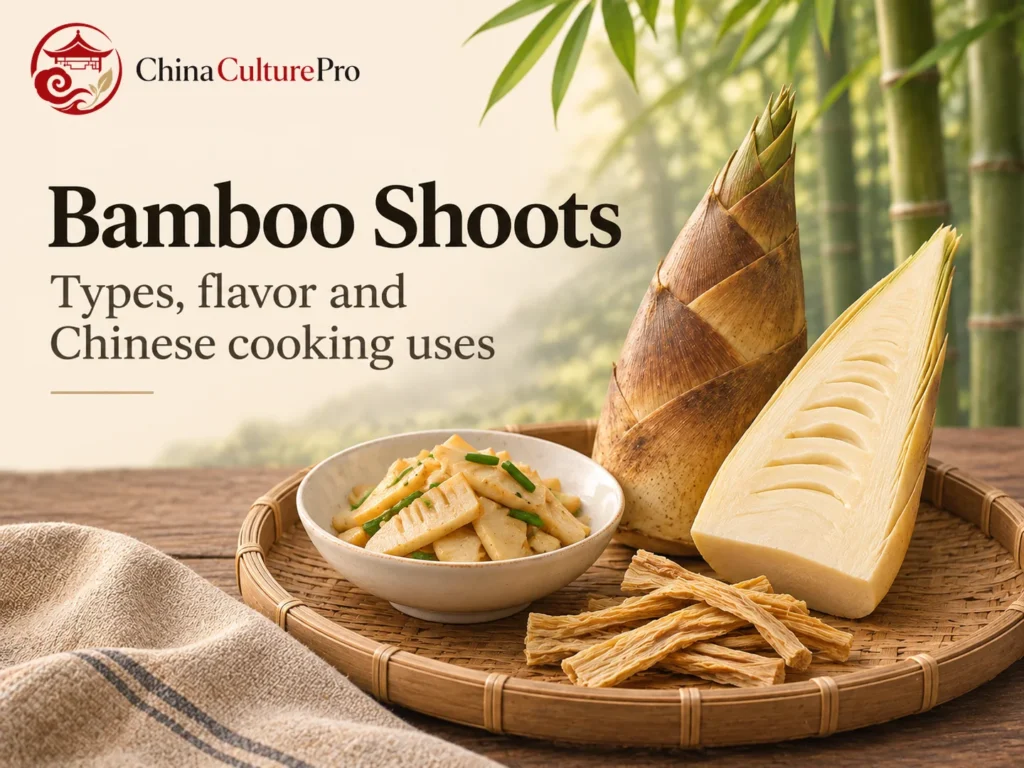

Quick Answer: What Are Bamboo Shoots?
Bamboo shoots(竹笋,zhúsǔn)are the young shoots of edible bamboo, harvested before they develop into mature, woody stems. In Chinese cooking, they contribute a tender-crisp bite and a mild vegetable flavor. [2]
- Fresh: Seasonal shoots require proper preparation before eating.
- Canned or water-packed: Processed shoots offer convenient slices, strips or larger pieces.
- Dried: Dehydrated shoots need rehydration and preparation suited to the product.
- Sour: Fermented shoots bring acidity and a distinctive aroma.
Harvest season and preservation are different classifications: a winter shoot can later be canned or dried. None of these labels alone tells you that an unfamiliar product is ready to eat. [1][3][4][5]
A pale slice in a stir-fry, a firm strip in a braise and a pungent topping for noodles may all be bamboo shoots. Their differences come from the plant, harvest and processing. This guide places them within Chinese vegetables and explains which distinctions matter at the table.
Young Bamboo, Different Seasons and Species
The edible portion is a developing shoot, not a piece cut from a mature bamboo pole. Tough outer sheaths surround the younger interior. Several bamboo species supply food; the familiar seasonal terminology should not be treated as a list of botanical species. [2]
Winter shoots(冬笋,dōngsǔn)and spring shoots(春笋,chūnsǔn)describe harvest categories. For moso bamboo, winter shoots develop underground and are generally compact, while spring shoots are more visibly elongated as growth advances. Summer and autumn rhizome shoots are another category described in Chinese produce guidance. [1][2]
Climate, species and growing practices affect availability, so these names do not promise identical market dates everywhere. The separate comparison of winter and spring bamboo shoots explores that seasonal distinction.
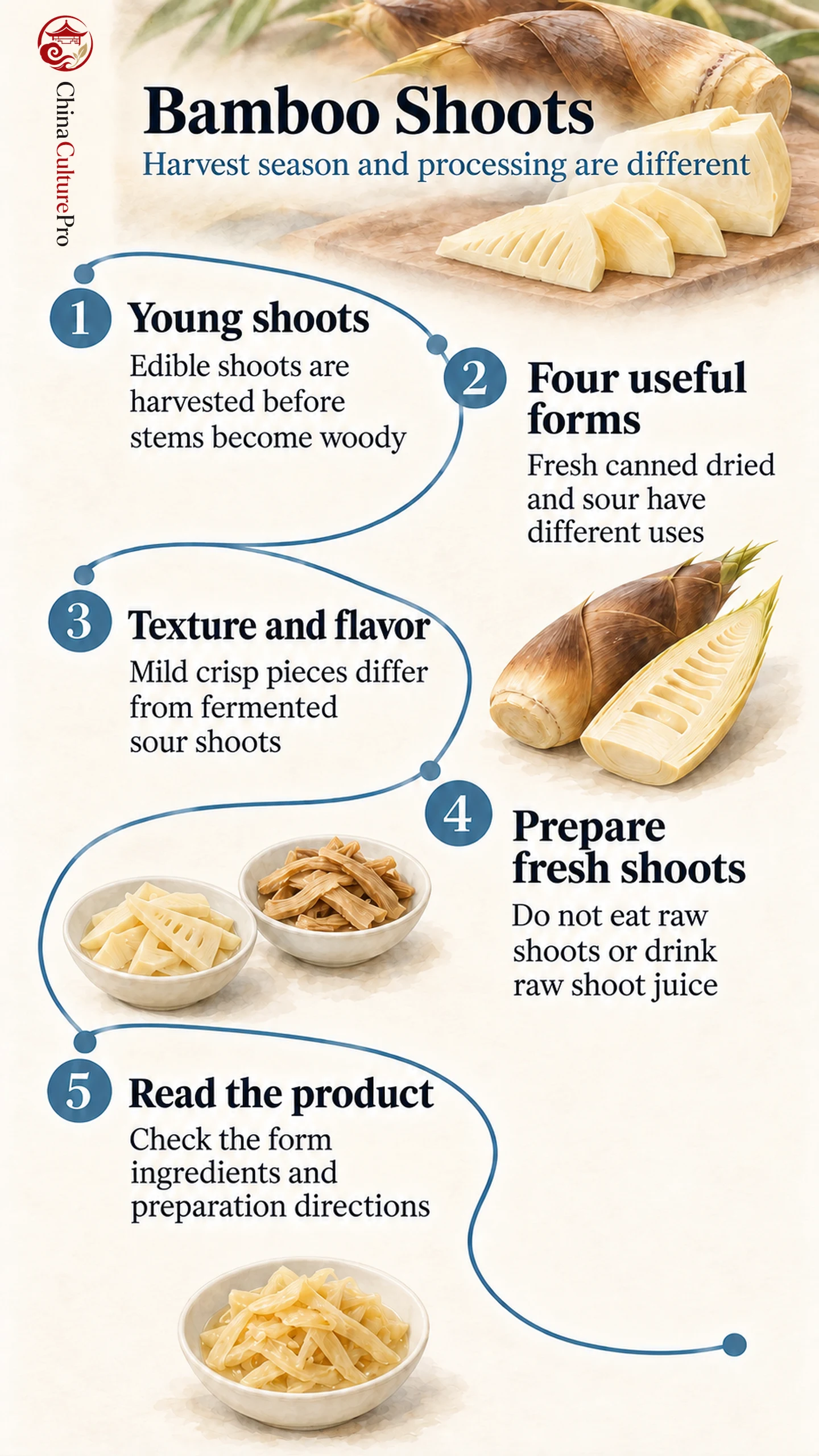
Fresh, Canned, Dried and Sour: Four Useful Forms
| Forma | Qué lo distingue | Practical cooking role |
|---|---|---|
| Fresh shoots | Young shoots with a fresh vegetable character; outer sheaths and preparation matter | Prepared pieces for stir-fries, soups and braises |
| Canned or water-packed shoots | Processed pieces, often sold whole, sliced, stripped or diced | Convenient texture for a range of cooked dishes |
| Dried shoots | Sungan(笋干,sǔngān)has been dehydrated and must be prepared before use | A firmer, more concentrated presence after rehydration |
| Sour shoots | Suansun(酸笋,suānsǔn)has a fermented sour flavor and characteristic aroma | Acidity and aroma in regional dishes |
Drying is not the same process as sour fermentation. A Ningguo product description, for example, records cooking and drying steps and a firm texture after rehydration. It describes that local product, rather than one method for every dried shoot. [3]
Likewise, “canned” describes a packaged form rather than a flavor. A manufacturer’s range includes several cuts with bamboo, water and citric acid among its listed ingredients. Plain water-packed shoots should not automatically be treated as fermented sour shoots. [4]
These forms illustrate the different jobs of food preservation.
Flavor and Texture in Chinese Dishes
Properly prepared fresh shoots can be crisp and delicately sweet or vegetal. Thickness, maturity and cooking affect the bite; an older fibrous base will not become identical to a tender tip simply because both came from one shoot. [1][2]
Chinese dishes use that texture in different ways. Oil-braised shoots emphasize the vegetable under a glossy seasoning, while stir-fried shoots contrast with meat or mushrooms. Yan du xian(腌笃鲜,yān dǔ xiān), a soup associated with Jiangnan cooking, combines shoots with fresh and salted pork. These are examples, not a required seasoning list for bamboo. [1][9][10]
The Chinese cooking methods involved therefore matter as much as the ingredient name: a slice in a stir-fry and a piece softened in soup need not have the same texture. [9]
Fermented sour bamboo shoots have another role. In Guangxi’s luosifen, they contribute a recognizable sour aroma. That flavor comes from processing; it is not the normal taste of every bamboo shoot. [5]
Fresh Shoots Need Proper Preparation
Do not eat fresh bamboo shoots raw or press them into raw juice. They contain cyanogenic compounds that can release hydrogen cyanide. Official advice calls for cutting the edible portion into smaller pieces, soaking it and cooking it thoroughly in boiling water before consumption. [6][7]
This preparation is separate from the final dish. Do not assume the final stir-fry replaces the preparation needed for raw shoots. The necessary handling depends on the product and its condition; a universal brief blanch is not a reliable rule.
Laboratory research supports boiling as a way to reduce cyanide, but its tested conditions are not a guarantee for every species, size or home preparation. Use established guidance for the actual ingredient rather than judging readiness by pale color or a pleasant smell. [6]
Processed shoots are a different starting point. Follow their preparation instructions instead of automatically applying either a raw-shoot procedure or a ready-to-eat assumption. [1]
Buying and Checking Packaged Bamboo Shoots
For fresh shoots, look for a firm, intact specimen without visible decay. Avoid damaged or decaying specimens, and expect mature fibrous portions to be less tender. Fresh shoots also become woody as they age, so tenderness is partly a matter of condition rather than simply a winter-versus-spring label. [1]
For a packet or can, identify the form first. Is it plain, seasoned, dried or sour? Check the ingredient list, preparation directions and instructions after opening. Some processed products contain additives, and sulphite sensitivity is a reason to check this category carefully. [8]
Bamboo itself is a plant ingredient, but the complete dish may contain pork, seafood, stock or wheat-containing sauces. A vegetable-looking bowl is not enough to establish vegetarian status or suitability for someone avoiding gluten.
FAQs About Bamboo Shoots
Can You Eat Fresh Bamboo Shoots Raw?
No. Fresh shoots need appropriate preparation and thorough boiling before eating. Raw juice is not a safe alternative. [6][7]
Are Canned Shoots the Same as Sour Bamboo Shoots?
No. Canning and sour fermentation describe different things. Read the product description and ingredients rather than assuming all packaged shoots have the same flavor. [4][5]
Can One Form Replace Another in a Dish?
Sometimes, with a change in texture, preparation and seasoning. Plain canned pieces may provide a convenient vegetable bite; sour shoots introduce acidity, while dried shoots need their own preparation.
Are Bamboo Shoot Dishes Vegetarian or Gluten Free?
The shoots alone do not determine the whole dish. Check sauces, stocks, meat, seafood and packaged seasonings, especially when dietary restrictions or allergies matter.
Fuentes
[1] Beijing Administration for Market Regulation. Consumer Guidance on Bamboo Shoots
[2] National Forestry and Grassland Administration. Recognizing Spring Bamboo Shoots
[3] Xuancheng Administration for Market Regulation. Ningguo Dried Bamboo Shoots
[4] Fujian Haishan Foods. Canned Bamboo Shoot Product Information
[5] National Forestry and Grassland Administration. Guangxi Edible Forest Products and Quality Control
[6] Centre for Food Safety. Natural Toxins in Food Plants: Risk Assessment Study
[7] Centre for Health Protection. Suspected Raw Bamboo Shoot Poisoning Investigation
[8] Centre for Food Safety. Prepackaged Bamboo Shoots and Undeclared Sulphur Dioxide
[9] Institute of Botany, Chinese Academy of Sciences. Bamboo Shoots in Spring
[10] Zhou Tong. The Flavor of Yan Du Xian, excerpt from The Secrets of Shanghai Cuisine