
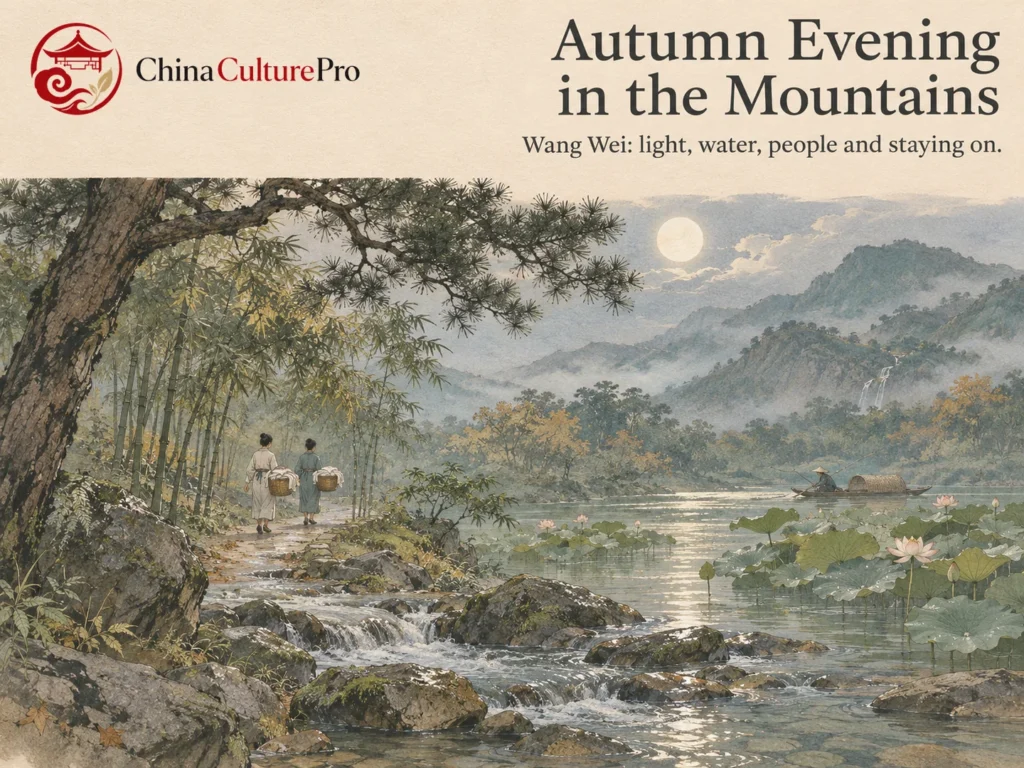

Quick Answer: Why Can the Speaker Stay in the Mountains?
Autumn Evening in a Mountain Dwelling (山居秋暝, Shān Jū Qiū Míng) by Wang Wei (王维, Wáng Wéi) finds a mountain evening worth remaining in. Rain-washed air, moonlight, running water and ordinary human activity prepare the final choice to stay.
- Follow the senses: Light among pines and water over stones make the place vivid.
- Keep the people: Returning washerwomen and a fishing boat belong within the quiet.
- Hear the allusion: The ending answers an older poem’s call to leave the mountains.
Empty mountains here do not mean a landscape without human activity. The poem’s tranquility accommodates both natural movement and everyday work.
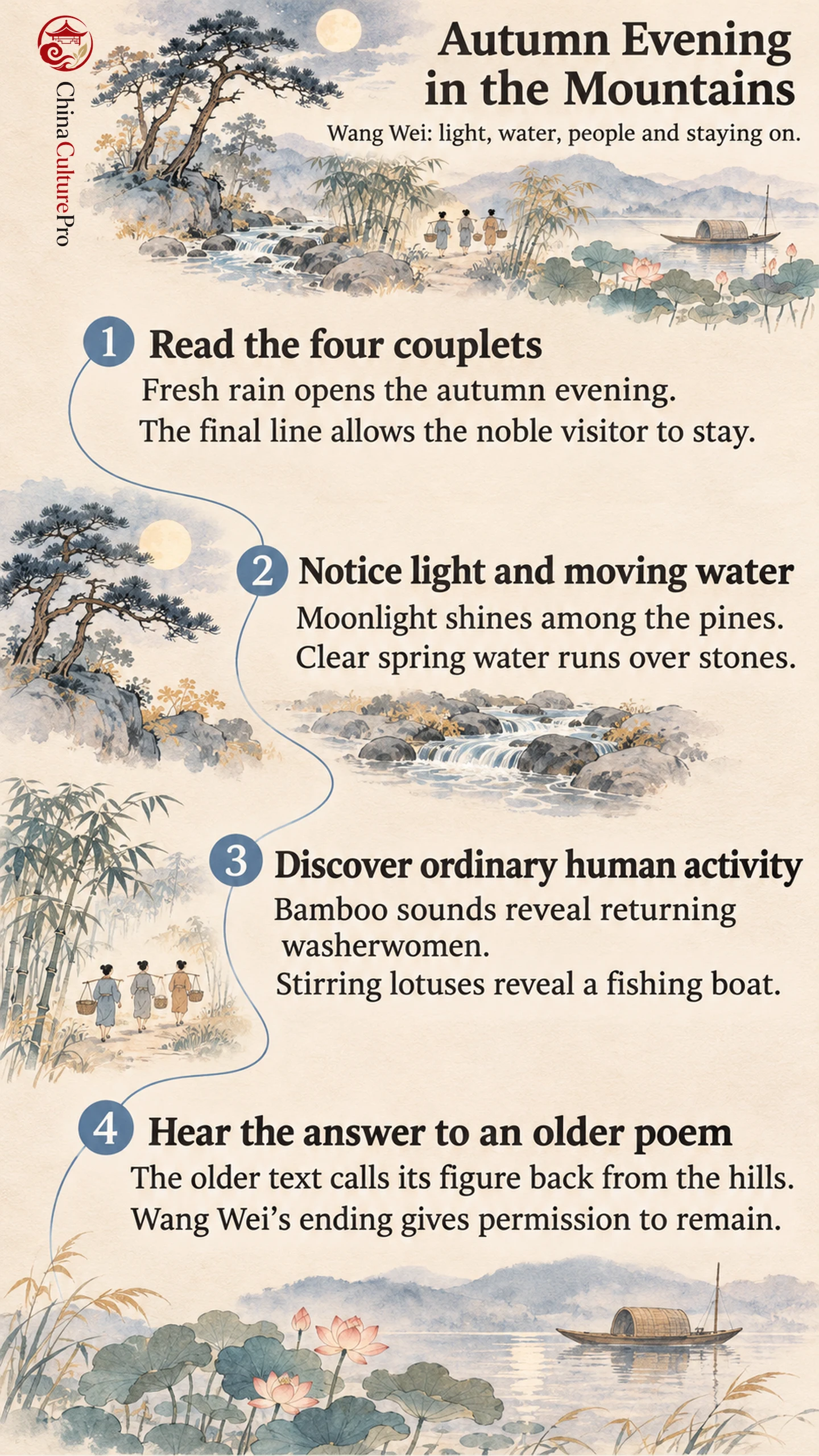
The scene grows clearer as the reader discovers it. An evening that begins with apparently empty hills comes to include sounds, moving leaves and people returning. The final couplet then makes remaining in this setting a meaningful choice.
Read the Eight Lines from Fresh Rain to Staying On
The complete poem has eight five-character lines. This original, unrhymed English rendering groups them into four couplets. [1]
| Chinese couplet | Plain English rendering |
|---|---|
| 空山新雨后,天气晚来秋。 | Empty hills after fresh rain; the evening air turns autumnal. [1] |
| 明月松间照,清泉石上流。 | Bright moonlight shines among pines; clear spring water runs over stones. [1] |
| 竹喧归浣女,莲动下渔舟。 | A clamor in bamboo: washerwomen return; lotuses stir as a fishing boat comes downstream. [1] |
| 随意春芳歇,王孙自可留。 | Let spring’s fragrant growth fade as it will; this noble visitor may stay on. [1] |
The Wang Wei reading guide provides wider context. Use the regulated verse guide for the form and Tang poetry for the broader tradition.
Notice Moonlight and Moving Water Together
The second couplet balances a view above with water below. Moonlight shines among pines while the spring runs across stones. Neither half needs to erase the other: the place can feel tranquil while water continues moving through it. [1]
Read the paired phrases slowly. The trees give the light a setting; stones give the water a surface to pass over. Specific relations between things make the scene more than a list of beautiful natural objects.
Following the opening’s fresh rain, those clear details also give the evening definition. Try replacing the couplet with the general phrase peaceful scenery, then return to the actual light and water. What disappears in that summary is the process of attending to a place.
The Chinese nature poetry guide explores the wider tradition of such closely observed landscapes.
Discover the People through Sound and Movement
The third couplet lets effects arrive before their causes. Noise among bamboo precedes the identification of returning washerwomen; movement among lotuses reveals a fishing boat coming down. The reader discovers human activity through what it does to the surroundings. [2]
That sequence is worth keeping in English. Beginning with a full explanation of who is walking where would lose some of the discovery. The Chinese first makes the bamboo and lotuses perceptible, then reveals the people and boat. [1]
The opening’s emptiness therefore cannot be a literal ban on human presence. Nor is quiet the same as absolute silence. Ordinary work returns within the mountain scene rather than breaking it apart.
For another short Wang Wei landscape poem, continue with Deer Enclosure.
Hear the Older Call to Return—and Wang Wei’s Answer
The final figure is an allusive prince (王孙, Wáng Sūn), not a securely identified royal visitor. The earlier Summoning the Recluse (招隐士, Zhāo Yǐn Shì), collected in Songs of Chu (楚辞, Chǔ Cí), ends by calling that figure back from a threatening wilderness. [3]
Its closing words are 王孙兮归来,山中兮不可以久留: in an original English rendering, Prince, return; one cannot remain long in the mountains. Wang Wei’s own closing permission to stay reverses that earlier pressure to leave. [3][2]
Read the Songs of Chu guide and literary allusions guide for this practice of answering an older text.
The spring reference now has a purpose. Even if spring’s fragrant growth has faded, the autumn scene just presented remains sufficient. The last line is not merely a compliment added after the scenery; it is a response earned by the poem’s account of the place. [1]
FAQs About Wang Wei’s Autumn Evening in the Mountains
Are the mountains completely uninhabited?
No. The poem includes returning washerwomen and a fishing boat. Its emptiness suggests the setting’s spaciousness and quiet, not the absence of everyone.
Does the final line refer to an identified royal prince?
The wording draws on an older literary address. It does not establish a particular prince’s documented visit.
Why does an autumn poem mention spring flowers?
The ending allows spring’s attractions to fade while affirming that this autumn mountain scene is still worth staying in.
Fuentes
[1] Wang Wei, via Wikisource. Autumn Evening in a Mountain Dwelling
[2] Pauline Yu, Indiana University Press. The Poetry of Wang Wei: New Translations and Commentary, Nature Poetry Chapter
[3] Songs of Chu, via Wikisource. Summoning the Recluse