

Quick Answer: What Are the Nine Songs?
Jiu Ge (九歌, Jiǔ Gē), or Nine Songs, is an eleven-piece cycle in the Songs of Chu (楚辭, Chǔcí), traditionally attributed to Qu Yuan (屈原, Qū Yuán). It draws on a world of ritual song, divine encounters and human longing.[1][2]
- The contents: Nine of the pieces concern divine figures; the final two honor fallen warriors and conclude the rite.
- The setting: Offerings, music, dance and imagined journeys shape the poems’ encounters.
- The emotion: Welcome and attraction repeatedly coexist with departure, uncertainty and sorrow.
The cycle preserves literary representations of ritual; its words do not establish one complete, recoverable performance script.
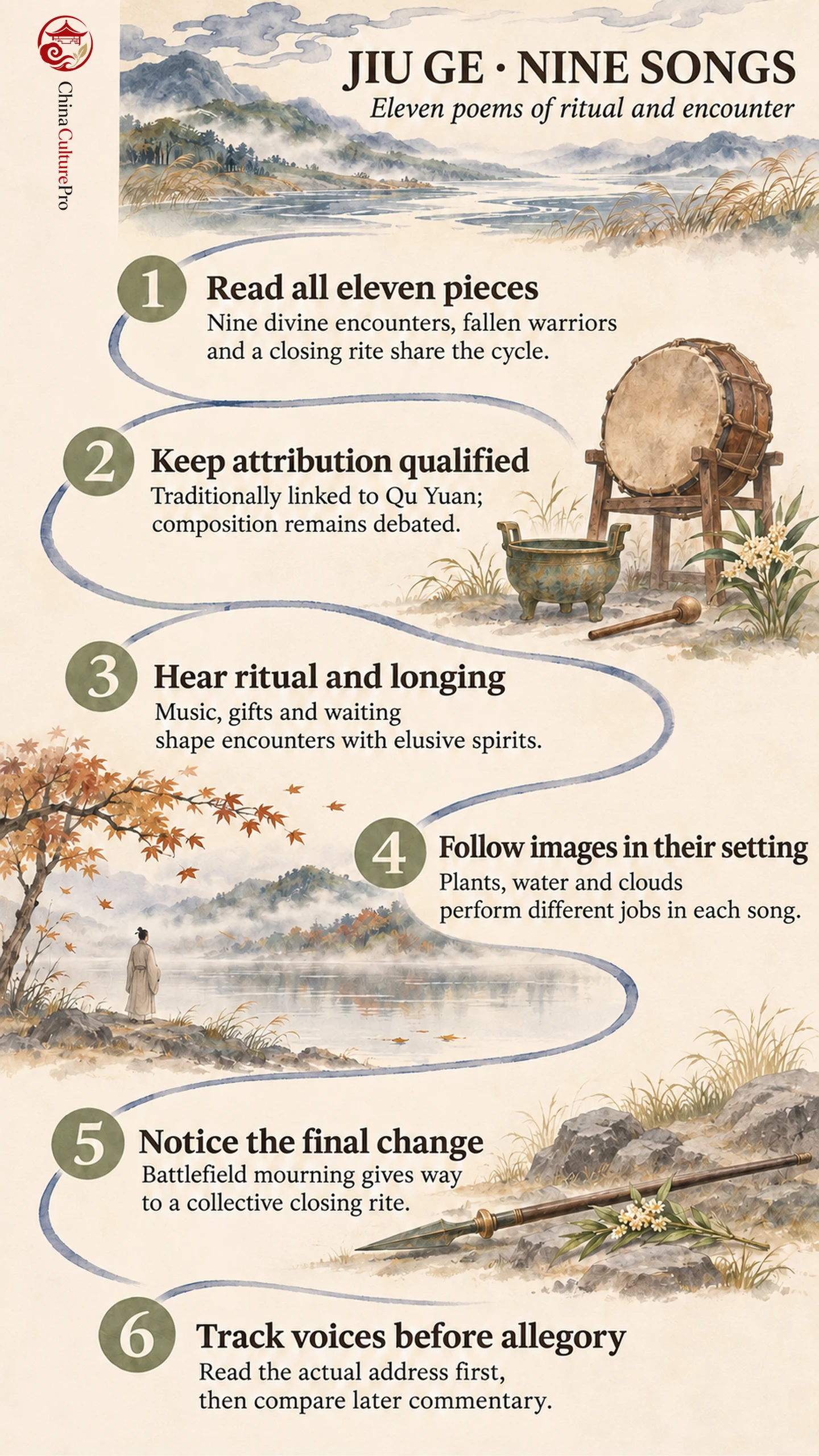
An offering fills a hall with fragrance; a river meeting is delayed; wind gathers around a waiting mountain figure. The changing scenes of this cycle reward reading each encounter in its own setting before looking for a single explanation of the whole.
Why Nine Songs Contains Eleven Pieces
“Nine Songs” is the inherited title, not an accurate count of the surviving pieces. Traditional commentary connects it with older musical titles and traditions in which nine already carried significance. The discrepancy has long been recognized.[2]
One helpful way to understand the received collection is to distinguish its nine deity-centered pieces from the fallen-warrior hymn and the closing ritual song. That describes its contents; it does not prove why the title originally took this form.
For reading and comparing translations, retain all eleven pieces. The larger Songs of Chu anthology also contains works outside this cycle, so Nine Songs and the anthology are not interchangeable titles.
The Eleven Pieces and What to Notice
The following follows the order listed in the traditional commentary. English titles vary across translations; the Chinese names provide a reliable point of comparison. The brief descriptions identify reading interests rather than assign a definitive cast of ritual performers.[1][2]
| Piece and pronunciation | Main focus | En qué fijarse |
|---|---|---|
| Donghuang Taiyi (東皇太一, Dōnghuáng Tàiyī) | The Great One; an opening divine offering | Fragrance, ceremonial objects and music gathering together |
| Yunzhong Jun (雲中君, Yúnzhōng Jūn) | The Lord amid the Clouds | Divine descent, radiance and departure |
| Xiang Jun (湘君, Xiāng Jūn) | The Lord of the Xiang | Waiting, river travel and disappointed expectation |
| Xiang Furen (湘夫人, Xiāng Fūrén) | The Lady of the Xiang | Autumn waters, anticipation and a dwelling made of fragrant plants |
| Da Siming (大司命, Dà Sīmìng) | The Greater Arbiter of Fate | Lifespan, separation and powers beyond human control |
| Shao Siming (少司命, Shào Sīmìng) | The Lesser Arbiter of Fate | Youth, children, a meeting gaze and sudden departure |
| Dong Jun (東君, Dōng Jūn) | The Lord of the East, associated with the sun | Light, celestial movement and musical spectacle |
| He Bo (河伯, Hé Bó) | The River Earl | Water travel, a magnificent divine dwelling and parting |
| Shan Gui (山鬼, Shān Guǐ) | The Mountain Spirit | Plant adornment, waiting and gathering storm |
| Guo Shang (國殤, Guó Shāng) | Those who fell fighting for their land | Battle, bodily destruction and the praise of enduring spirit |
| Li Hun (禮魂, Lǐ Hún) | Honoring the spirits; the closing rite | Drums, passed plants, dance and continuing observance |
When comparing Chinese mythology versions and sources, keep each poem’s portrayal in view. A title shared with another religious tradition does not automatically give the early figure all of that tradition’s later stories and attributes.
Qu Yuan, Chu Ritual and the Limits of Attribution
The state of Chu (楚, Chǔ) provides the cycle’s cultural setting. The traditional account associates its songs with regional rites and explains them as Qu Yuan’s adaptation of existing religious performances. This account comes through the later commentator Wang Yi (王逸, Wáng Yì), rather than a surviving statement by Qu Yuan himself.[2]
Modern scholarship has questioned the traditional attribution and proposed different dates and origins. It is therefore useful to say “traditionally attributed to Qu Yuan,” while treating the exact composition history as unsettled.[4]
Ritual specialists often called wu (巫, wū) belong to this interpretive background. “Spirit medium” or “shaman” can orient an English reader, but neither word supplies the missing details of every singer, costume or movement. The Qu Yuan guide gives broader biographical and reception context; the poems still require attention to their own voices.[2]
Why Divine Encounters Sound Like Love Poems
The songs address divine beings through attraction, expectation, gifts and the pain of departure. Read on this level, longing helps express the difficulty of bringing a powerful, elusive presence close. An arriving figure can be intensely desired without becoming an ordinary human lover.
Political readings have also shaped the cycle’s history. Later commentary can connect disappointed encounters with the loyal poet’s relation to a ruler. Such readings matter, but they should not erase the religious beings and ritual situations that the poems explicitly present.[3]
For comparison, Li Sao (離騷, Lí Sāo) combines journeys and divine imagery on a much larger scale, while the Nine Pieces (九章, Jiǔ Zhāng) more directly develop a wronged speaker’s complaints. The separate guides to Li Sao and the Nine Pieces explain those works without turning them into interchangeable versions of Nine Songs.[3]
Fragrance, Water and Clouds in Selected Lines
The following are selected excerpts, with original English sense translations, not the complete text of the eleven poems. In the second example, Dongting (洞庭, Dòngtíng) names the lake landscape within the poem.[1]
| From | Chinese excerpt | English sense and reading point |
|---|---|---|
| Donghuang Taiyi | 揚枹兮拊鼓 | Raise the drumstick and beat the drum. Sound is an action within the offering, not merely background atmosphere. |
| Xiang Furen | 嫋嫋兮秋風,洞庭波兮木葉下。 | Softly stirs the autumn wind; Dongting ripples, and tree leaves fall. Movement in the landscape gives waiting a season and texture. |
| Shao Siming | 悲莫悲兮生別離,樂莫樂兮新相知。 | No sorrow exceeds parting while alive; no joy exceeds newly knowing one another. The paired claims place encounter and separation beside each other. |
| Shan Gui | 風颯颯兮木蕭蕭,思公子兮徒離憂。 | Wind rustles, trees murmur; thinking of you brings only sorrow. The ending lets the surrounding sounds accompany frustrated expectation. |
Elsewhere, fragrant plants become clothing, gifts and building materials. Water provides routes and barriers; clouds accompany arrival and withdrawal. Their meanings emerge from those uses. A universal symbol chart would lose the difference between preparing an offering and waiting for an absent figure.
Fallen Warriors and the Closing Rite
Guo Shang changes the emotional register. Weapons, chariots and an overwhelming enemy replace the intimate atmosphere of expectation. The poem honors warriors whose bodies are destroyed but whose courage remains worthy of praise. Its claim for powerful spirits belongs to its religious and commemorative language.[1]
Li Hun then turns to collective action: drums, passed plants and successive dancers. Its brief ending imagines observance continuing through time. Keeping these last two pieces in view prevents the cycle from becoming only a sequence of unfulfilled divine romances.[1]
The warriors are not presented as Qu Yuan himself, and the closing rite is not a narrated account of his death. Each piece has its own subject within the collection.
How to Read the Cycle without Fixing Every Voice
- Choose one named piece: Use its Chinese title to locate the same song in different editions.
- Mark changes of address: Notice when a speaker says “I,” speaks to “you,” or describes a divine figure.
- Track the encounter: Follow preparation, approach, waiting or departure wherever the particular poem supports them.
- Compare interpretive layers: Distinguish what the lines say from identities and political meanings supplied by commentary.
The repeated particle xi (兮, xī) often marks a rhythmic pause within a line. In an English sense translation it need not become an identical word every time. Read the two sides of the pause together before deciding who speaks.
FAQs About Jiu Ge Nine Songs
Is Nine Songs one long poem?
It is a cycle of eleven separately titled pieces within a larger anthology. Reading one song closely is useful, but a single excerpt does not represent the complete cycle.
Are the Xiang deities a single historical married couple?
Their identities, genders and relationships have been interpreted differently. Familiar later stories can guide a reading, but they should be identified as traditions of interpretation rather than a fully specified historical cast.[3]
Is this a guide to performing an ancient ritual?
No. The words preserve offerings, music, dance and encounters with spirits, while much of the original staging remains uncertain. This is a reading guide to the poems and their interpretive context.
Fuentes
[1] Songs of Chu. Nine Songs: received Chinese text
[2] Wang Yi and Hong Xingzu. Supplementary Commentary on the Songs of Chu, volume two
[3] Monica E. M. Zikpi. Wanton Goddesses to Unspoken Worthies: Gendered Hermeneutics in the Chu Ci Zhangju
[4] David Tze-Yun Chen. The Nine Songs: A Reexamination of Shamanism in Ancient China, dissertation abstract