


Quick Answer: What Is Auspicious Cranes?
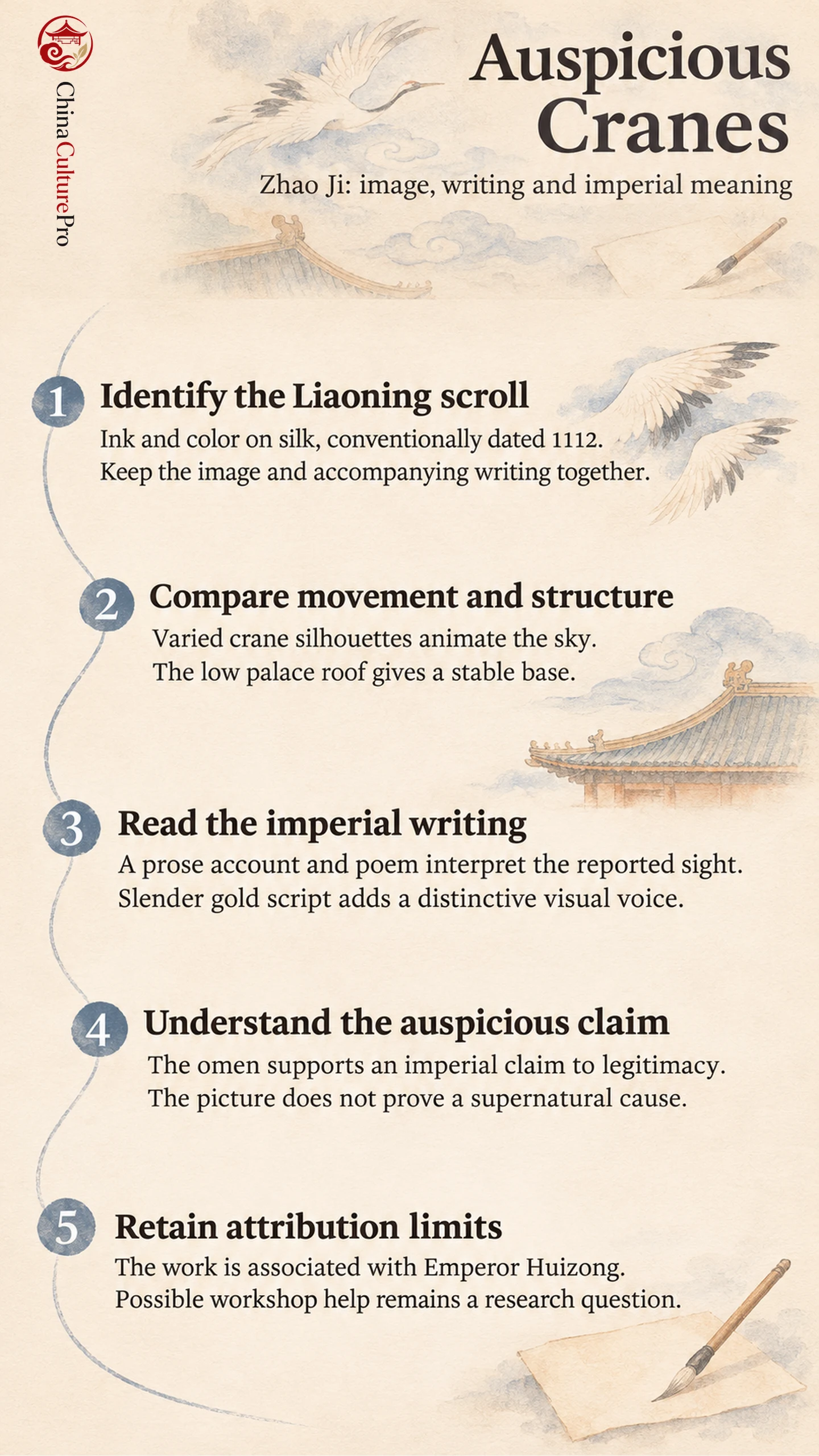
Auspicious Cranes (瑞鹤图, Ruì Hè Tú) is a Northern Song handscroll associated with Emperor Huizong, whose personal name was Zhao Ji (赵佶, Zhào Jí). It combines a crane-filled sky, a palace roof and imperial writing.
- Collection: Liaoning Provincial Museum, Shenyang.
- Look first: Compare the birds’ varied positions with the roof’s stable geometry.
- Read next: The accompanying text interprets the sight as an auspicious sign.
- Attribution: Keep the emperor’s association distinct from certainty about every painted stroke.
The scroll expresses a claim about imperial good fortune; that claim requires historical interpretation.
White birds punctuate a broad blue-green field. Below them, clouds gather around the upper part of a monumental roof. The broad sky and low roof concentrate attention on the birds above the imperial gate.
The writing that follows the image changes its meaning. This is more than a study of cranes in flight: it presents their appearance as an event worth recording and interpreting for the court.
Identify the Scroll, Date and Collection
The handscroll is conventionally dated 1112. [3] The Liaoning work is ink and color on silk, published as 51 × 138.2 cm. The painted image lies to the right of the accompanying writing. Keep that combined format in mind when a reproduction shows only the birds and roof. [1]
A museum exhibition resource gives a probable attribution to Emperor Huizong. This guide retains that qualification alongside the established association with Zhao Ji. The Song dynasty guide supplies period context, while scroll formats explains how image and writing can be encountered successively. [3]
Identify what a reproduction includes before analyzing it. The painted field can support a reading of birds, architecture and clouds; the accompanying text supplies another kind of evidence about the event’s interpretation.
Compare the Moving Cranes with the Stable Roof
The full painted field shows cranes facing different directions and turning their bodies through the blue-green space. Some spread their wings broadly; others appear in profile or at an angle. Dark flight feathers and thin trailing legs make each pale silhouette more distinct against the background.
Compare two neighboring birds rather than treating the flock as one repeated emblem. A change in wing angle, neck direction or spacing can redirect the eye. The open intervals keep the silhouettes separate even where several birds form a cluster.
Two cranes stand on the ornaments at opposite ends of the main roof ridge. Their placement connects the airborne flock with the architecture. The roof gives the picture a stable lower structure, while the birds activate the much larger area above it.
Ruled-line painting (界画, Jiè Huà) describes the controlled architectural method associated with such precise building forms. The museum curator identifies that approach in the depicted gate. [2]
Look at the contrast between straight structural lines, curved roof edges and rounded cloud contours. They organize different parts of the image: construction, transition and atmosphere. The bird-and-flower painting guide places the birds within a wider subject tradition, but the architectural setting remains crucial here.
The guide to cloud motifs adds context for the surrounding forms. In this painting, the clouds partly conceal the building’s lower extent, leaving the viewer looking upward toward the cranes.
Read the Inscription and Slender Gold Script
The accompanying prose dates the reported appearance to the sixteenth day of the first lunar month in 1112, the evening after the Lantern Festival. [2]
A poem follows. Its language presents the birds as bearers of good news and associates them with immortality. These are the work’s own celebratory terms, not an independent modern verification of the sighting. [3]
Slender gold script (瘦金体, Shòu Jīn Tǐ) is the writing style associated with Huizong: thin, firm strokes, emphatic points and sharp turns give it a taut, angular character. The curator discusses the preface, poem and signature as parts of the work’s imperial presentation. [2]
The calligraphy guide explains why writing can contribute more than verbal information. Here, the script also makes the statement visually distinctive. Its relation to the painting is both textual and formal.
When consulting a translation, separate the prose account from the poem. One gives the reported circumstances; the other develops a celebratory response. The inscriptions-and-seals guide provides a broader framework for reading such evidence.
Understand the Omen’s Political Meaning
The Mandate of Heaven (天命, Tiān Mìng) concerns the legitimacy of rule. The curator interprets Huizong’s auspicious imagery as part of his claim to heavenly authorization. In this setting, cranes and clouds participate in a political statement, beyond their familiar associations with long life. [2]
The Mandate of Heaven guide develops that concept; crane symbolism addresses the bird’s wider meanings. Keep the specific owner of the claim visible: an emperor interprets an appearance over the imperial gate as favorable.
That reading does not depend on accepting the omen as supernatural fact. A historian can ask how a natural-looking sight was framed, recorded and given significance. The architecture, the written account and the auspicious language together explain why this flock mattered in a courtly setting.
Keep Imperial Authorship and Workshop Questions Distinct
The curator suggests a palace painter may have contributed the architecture. This unproven hypothesis leaves the work’s imperial purpose intact while questioning whether the emperor painted every component unaided. [2]
Retain the catalogue’s attribution qualifier when using that identification. It keeps the name attached to its historical and artistic context without claiming more technical certainty than the evidence provides.
- Visible image: Describe the birds, roof and clouds you can actually inspect.
- Written account: Identify how the reported event is dated and interpreted.
- Attribution: Preserve the collection’s or catalogue’s qualification when labeling the work.
In a viewing note, connect each interpretation to the image, the writing or the attribution record that supports it.
FAQs About Auspicious Cranes
How many cranes are shown?
There are twenty: eighteen in flight and two perched on the roof ornaments.
Does the picture prove a supernatural event occurred?
It records an auspicious interpretation of a reported appearance. The image and inscription do not establish a supernatural cause.
Did Zhao Ji paint every part himself?
That is not certain. Qualified cataloguing and questions about possible workshop participation should remain visible rather than being resolved by assertion.
Fuentes
[1] Liaoning International Communication Center, reporting museum digitization. Liaoning Provincial Museum Digitizes Famous Ancient Chinese Paintings
[2] Dong Baohou, Liaoning Provincial Museum, interviewed by Han Hong. What Makes Emperor Huizong’s Auspicious Cranes Distinctive?
[3] Victoria and Albert Museum. Masterpieces of Chinese Painting 700–1900: Teachers’ Image Bank, pages 9–10