
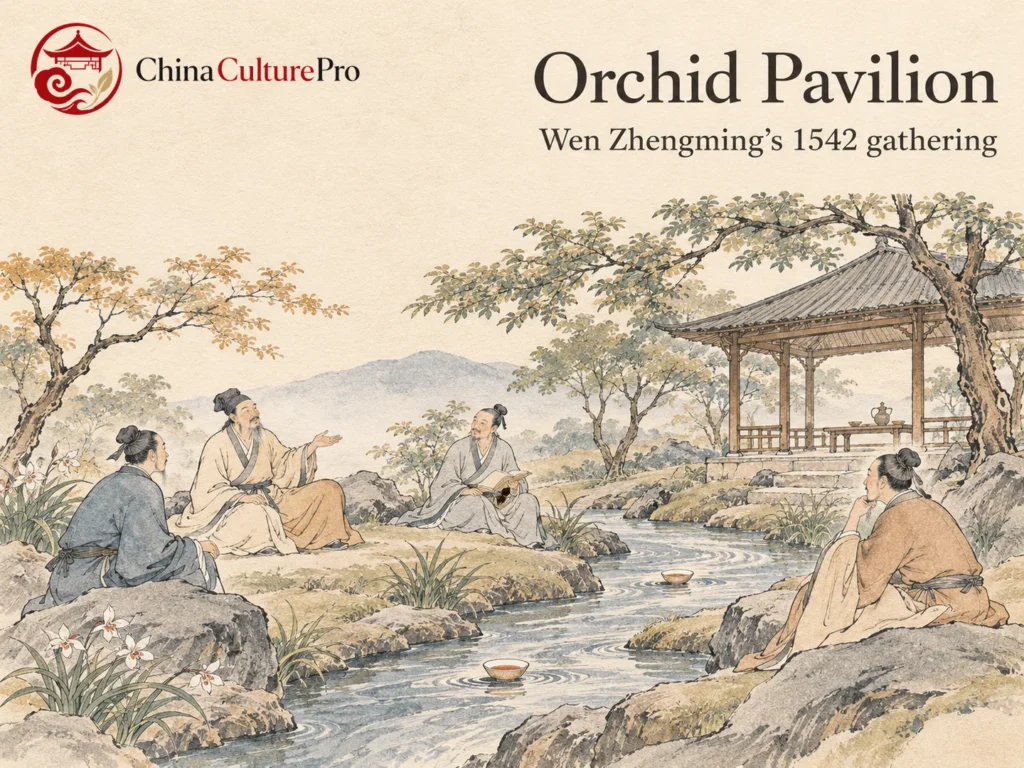

Quick Answer: Which Orchid Pavilion Painting Is This?
This guide concerns the 1542 handscroll Orchid Pavilion Gathering (兰亭修禊图, Lán Tíng Xiū Xì Tú) by Wen Zhengming (文徵明, Wén Zhēng Míng), in the Palace Museum, Beijing. It depicts scholars beside winding water and a pavilion, reimagining a celebrated gathering from 353 CE.
- Object: Ink and color on gold paper; the painting measures 24.2 × 60.1 cm.
- Subject: Poetry, floating wine cups and cultivated companionship.
- Viewing: Follow the water, compare the small figures with the landscape and then consider the written additions.
- Distinction: A separate 1524 hanging scroll in Taipei has a similar subject.
The date of the painting, the date of the event and the date of a later inscription answer different questions.
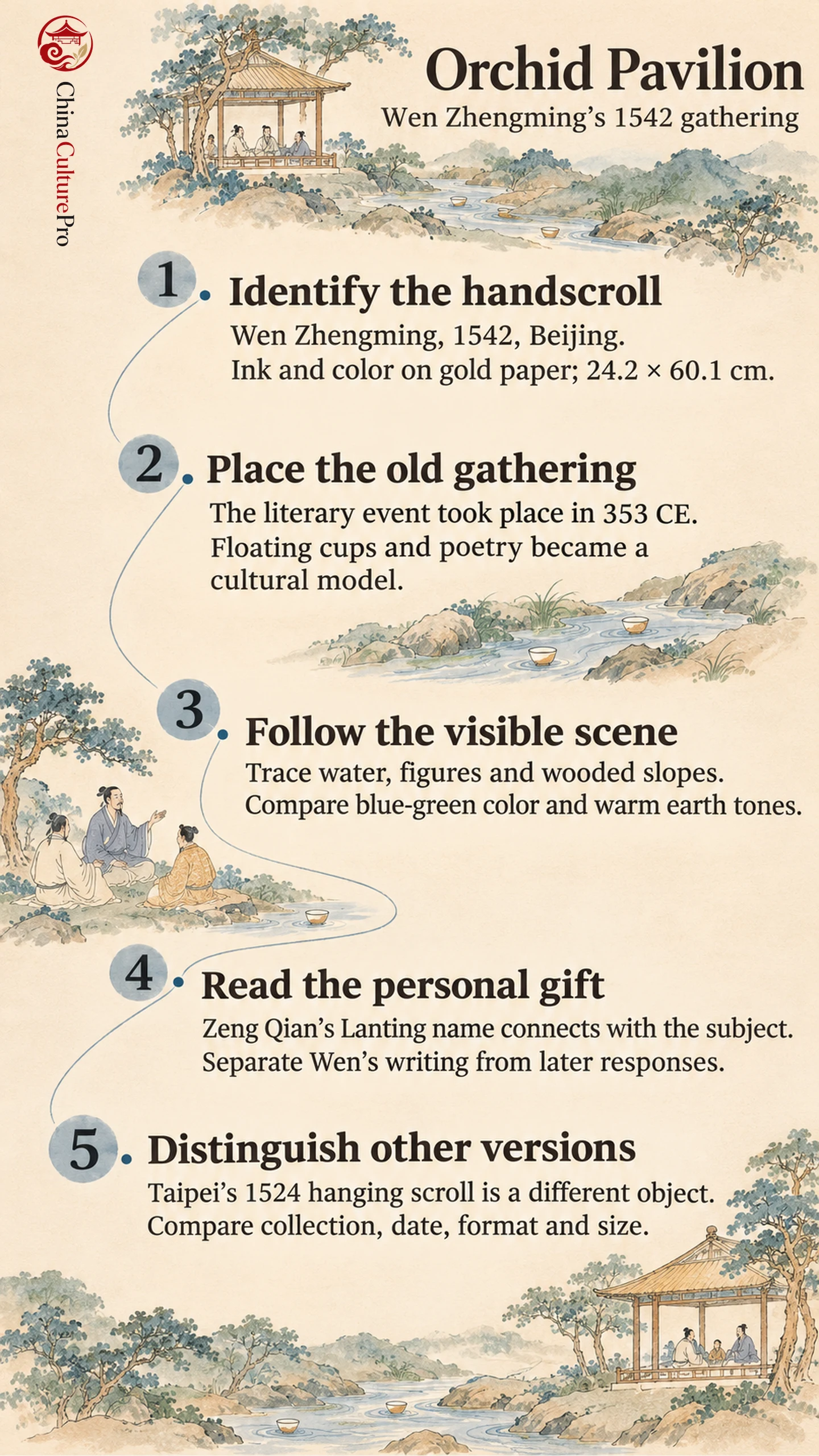
A Graceful Gathering at the Orchid Pavilion is one English rendering of this subject. The scene combines a wooded retreat with a literary gathering, but its meaning also depends on the particular handscroll. Identifying the work first prevents a familiar title from obscuring its material and social history.
Identify the 1542 Handscroll
Gathering at the Orchid Pavilion is catalogued as a 1542 handscroll, made with ink and color on gold paper. The painting measures 24.2 cm high by 60.1 cm wide; that is the painted image, not a measurement of every later mounted addition. Its collection registration is 新00179081. [1]
Keep the gold-paper support in mind when interpreting the reproduction. A small digital reproduction does not reproduce its surface or lighting conditions exactly, so avoid treating a screen’s brownish background as a reliable color sample for the original.
Notice how compact the painted field is. Its breadth accommodates figures, water, trees and mountains without requiring the enormous length associated with some other handscrolls. Keep the measurements beside the image when comparing reproductions at different screen sizes.
The Gathering That Became a Cultural Model
In the third lunar month of 353, Wang Xizhi gathered friends at the Orchid Pavilion in present-day Zhejiang. Wine cups floated along a winding stream, and participants composed poems, with drinking as the penalty for failing to produce one. The Orchid Pavilion Preface (兰亭序, Lán Tíng Xù) emerged from that occasion. [2]
The meeting became a model for later cultivated companionship and poetic competition. An elegant gathering (雅集, yǎ jí) joined sociability with artistic or literary activity. Wen’s painting belongs to this later life of the subject, rather than to the fourth-century event itself. [2]
The Wang Xizhi guide develops the calligrapher’s wider importance. Here, the connection explains why the stream is more than scenery: it organizes the activity that gives this landscape its literary subject.
Follow the Stream, Figures and Color
The museum image places a pavilion among dense trees on the right, while pale water bends between seated figures and blue-green rocky slopes. The eye can move between the roofed gathering and the dispersed participants outside. These observations concern the visible composition; they do not identify each tiny face as a named historical guest.
Use this four-part sequence on a reproduction:
- Begin with the whole scene: Locate the pavilion, winding water and surrounding wooded slopes.
- Trace the stream: Follow its bends and notice how seated figures occupy the banks.
- Compare large and small forms: Set the abbreviated figures against the densely worked trees and rocks.
- Return to color: Compare blue-green passages with warmer earth tones, then look at the whole scene again.
The blue-green landscape (青绿山水, qīng lǜ shān shuǐ) approach combines outlined forms with applied color. Here, blue and green dominate, with light ochre in slopes and rocks; the figures are described with relatively few lines. [1]
The overview of Chinese landscape painting provides the wider vocabulary. In this image, focus on the difference between detailed vegetation and economical human forms. The small figures and curving banks distribute the gathering across the landscape.
Why the Painting Was a Personal Gift
Wen made this work for Zeng Qian, whose sobriquet was Lanting, or Orchid Pavilion. His own written explanation connects the subject with that name. The scroll’s trailing paper includes his copy of the Preface and his inscription and poem, followed by responses from other writers. [1]
This turns the old gathering into a personal exchange. Read the image, artist’s explanation and subsequent responses as different contributions, each with its own speaker. Keep later responses distinct from Wen’s painting and his own explanation.
Such additions are important to the handscroll format. Inscriptions and colophons can preserve circumstances of creation and responses from friends, collectors or later viewers. They make a scroll both an image and a record of encounters over time. [3]
The relationship between calligraphy and painting is especially useful here: copying an admired text and painting its subject are connected activities with different visual demands.
Keep Other Orchid Pavilion Versions Separate
The National Palace Museum, Taipei, holds Spring Ablution at the Orchid Pavilion, dated 1524. It is a paper hanging scroll measuring 140.3 × 73.2 cm, with Wen’s transcription of the Preface on the painting and a later imperial inscription. It is not the compact 1542 Beijing handscroll. [4]
Compare the collection, date, format and dimensions whenever another image appears under an Orchid Pavilion title. Similar subject matter alone cannot establish that two reproductions show the same object.
For the 1542 work, begin with the whole painted scene and then move to a detail and its written context. The general handscroll convention is progressive viewing from right to left, with pauses along the way. A digital panorama offers an overview, while controlled zooming can restore some sense of successive attention. [3]
FAQs About Wen Zhengming’s Orchid Pavilion Gathering
Was Wen Zhengming present at the original gathering?
No. The gathering occurred in 353 CE; this painting dates to 1542. It is a much later artistic engagement with the celebrated occasion.
Is this Wang Xizhi’s original Orchid Pavilion Preface?
No. Wen’s scroll includes a later transcription. Wang Xizhi’s original calligraphy has been lost; transmitted copies and rubbings belong to its subsequent history. [2]
Does a handscroll have to be viewed as one panoramic image?
No. Traditional viewing proceeds through sections. A whole-image reproduction is useful for orientation, but details and accompanying texts need separate attention.
Fuentes
[1] The Palace Museum. Wen Zhengming: Lanting Gathering handscroll
[2] National Palace Museum. The Model for Elegant Gatherings
[3] The Metropolitan Museum of Art. Chinese Handscrolls
[4] National Palace Museum. Spring Ablution at the Orchid Pavilion