


Quick Answer: What Is Star Anise?
Star anise(八角,bājiǎo)is the dried, star-shaped fruit of Illicium verum. The brown woody points are seed-bearing parts of the fruit, not dried flower petals. Its strong, sweet-smelling aroma makes it a familiar seasoning in Chinese cooking. [1][2][3]
- Flavor character: Anise-like or licorice-like fragrance can accompany savory food as well as sweets.
- Whole form: Recognizable pieces flavor cooking liquids and can be removed or set aside.
- Ground form: Fine spice disperses through a mixture rather than remaining as a whole star.
- Blend use: Star anise can be one component among several spices.
The spice is not the same plant as ordinary anise seed, and a sweet aroma does not mean that the dish contains added sugar. [1][5]
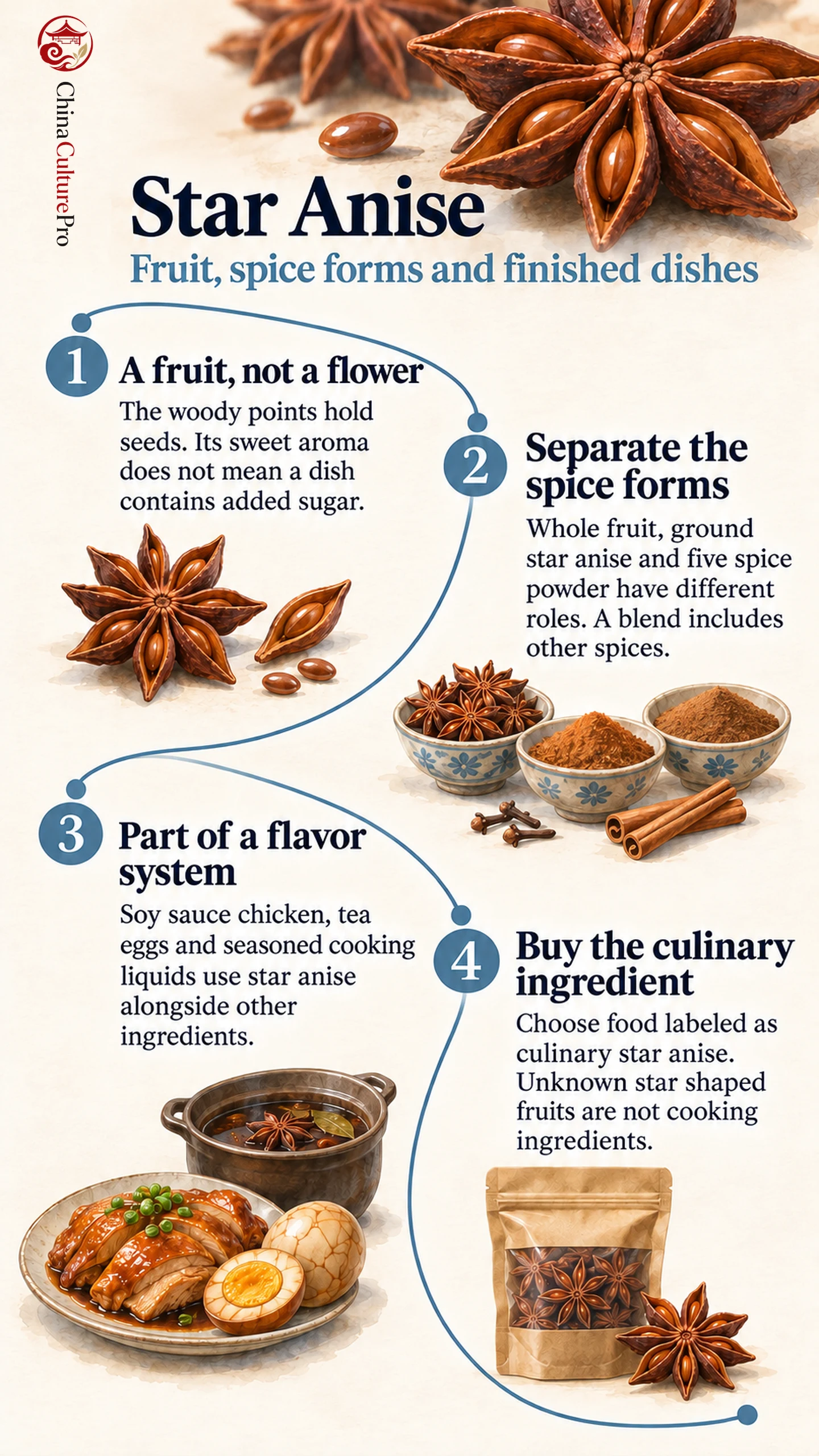
A brown star in a chicken braise is a flavoring ingredient rather than a decorative flower. Its aroma can remain in the sauce after the visible piece has been removed. Understanding the fruit, its ground form and its place in a blend makes Chinese menu descriptions easier to interpret.
A Star Shaped Fruit with a Sweet Aroma
Each point of a star-anise fruit is a small seed-bearing compartment arranged around the center. The fresh fruit becomes woody and wrinkled as it dries. The shape helps describe a culinary product; it should not be used to identify unknown fruits for eating. [1][2]
The aroma has a botanical explanation. Star anise and anise seed both contain anethole in their aromatic oils, despite coming from different plants. Ordinary anise, Pimpinella anisum, belongs to the parsley family; star anise comes from an evergreen tree in a different family. [1]
A shared aromatic compound does not make the two ingredients identical. Their physical forms and the rest of their flavor profiles differ, so an English word like “anise” should be read carefully on a recipe or package.
In food descriptions, “sweet” can refer to fragrance rather than sugar. Star anise adds that fragrant note to pork, duck and other savory preparations. Sugar, when present in a braise or sauce, is a separate ingredient with its own role. [3][4]
Whole Fruit, Ground Spice and Five Spice Powder
Five spice powder(五香粉,wǔxiāngfěn)is a blend, not another name for star anise. A commercial formula, for example, lists anise, cinnamon, star anise, cloves and ginger as separate ingredients. That is one formulation rather than a universal list for every product. [5]
| Forma | What it changes in cooking |
|---|---|
| Whole star anise | Remains visible while flavoring the surrounding liquid or food. |
| Ground star anise | Distributes as fine spice throughout a mixture. |
| Five spice powder | Combines star anise or related anise notes with other spices. |
This distinction matters when reading a dish description. A whole star in a pot does not prove that five spice powder was used. Likewise, a fine spice blend may contribute anise-like aroma without leaving a recognizable star on the plate.
The broader subject of Chinese five spice therefore involves more than the shape or flavor of one ingredient. Replacing a blend with a single spice changes the balance, even when their aromas overlap. [2][5]
Where Star Anise Appears in Chinese Cooking
Soy sauce chicken(豉油鸡,chǐyóujī) is one clear example. In a documented preparation, star anise joins ginger, scallion and shallot in a seasoned cooking liquid containing soy sauce, wine and sugar. The spice adds aroma; the soy sauce supplies a different savory and coloring contribution. [4]
The chicken is cooked in that liquid and served with sauce. Star anise is therefore part of a layered seasoning system, not the ingredient responsible for every aspect of the finished flavor. The particular choice of soy sauce matters separately. [4]
Tea eggs(茶叶蛋,cháyèdàn) show another use. One firsthand recipe combines cooked eggs with tea, soy sauce and star anise. Cracks in the shells allow the colored liquid to mark the whites, producing the marbled pattern seen after peeling. The star contributes fragrance, while the tea and soy liquid contribute other flavors and color. [6]
Lushui(卤水,lǔshuǐ), a seasoned cooking liquid discussed in the context of Chinese master stock, is a different category from a packet of dry spice. Star anise may belong to a liquid’s aromatic ingredients; the complete liquid also contains its own seasonings and takes on flavor from what is cooked in it. [8]
The same aromatic ingredient can therefore connect very different finished foods.
Buying Culinary Star Anise and Reading a Dish
Buy a food product identified for culinary use as star anise or Illicium verum. Japanese star anise, Illicium anisatum, is a different, poisonous species that can be mistaken for the culinary spice. Unknown ornamental or collected star-shaped fruits should not be treated as cooking ingredients. [7]
For a packet, distinguish a single spice from a blend. For a restaurant dish, ask about the surrounding sauce or liquid if ingredients matter to you. Star anise itself does not explain whether the preparation contains meat, egg, wheat-based soy sauce or other additions. [4][5][6]
Whole woody pieces are used to impart flavor and are generally removed or left aside when eating the main food. Ground spice behaves differently because it is already distributed through the preparation.
FAQs About Star Anise
Is Star Anise the Same as Anise Seed?
No. They come from different plants, although their aromatic oils share anethole. Similar fragrance does not make their botanical identity or culinary form the same.
Do You Eat Whole Star Anise in a Dish?
Whole woody pieces are generally removed or set aside after flavoring the food. Ground star anise is different: its fine particles are incorporated into the mixture.
Is Star Anise the Same as Five Spice Powder?
No. Star anise is a single spice. Five spice powder is a blend whose other ingredients also affect the flavor; check the particular formulation.
Fuentes
[1] Royal Botanic Gardens Kew. Illicium verum: Species Profile
[2] Spices Board India. Star Anise
[3] S and B Foods. Star Anise Spice Profile
[4] Daddy Lau. Soy Sauce Chicken
[5] McCormick Culinary. Chinese Five Spice: Original Formula
[6] Pat Tanumihardja with Smithsonian Asian Pacific American Center. Marbled Tea Eggs
[7] Tokyo Metropolitan Government. Illicium anisatum: A Poisonous Lookalike
[8] Kathy Yuan. Chinese Master Stock: Sichuan Lushui