
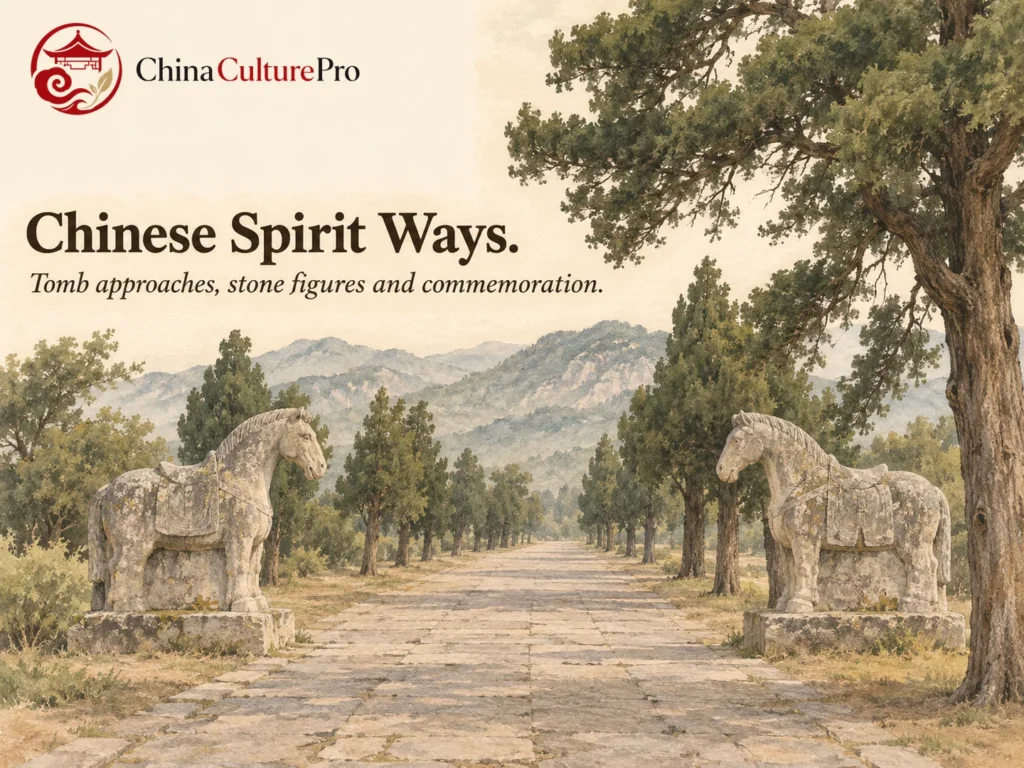

Quick Answer: What Is a Chinese Spirit Way?
A Chinese spirit way, shendao(神道,shéndào), is a ceremonial approach associated with a tomb or mausoleum. The route and its monuments form an ensemble.
- Spatial role: It leads toward the funerary complex and helps frame the approach.
- Stone monuments: Animals, human figures, columns and stelae may form parts of the ensemble.
- Historical variation: A particular tomb’s arrangement belongs to its period, patronage and setting; there is no single nationwide inventory.[1]
The spirit way is an aboveground approach. It should be distinguished from the passage entering an underground burial chamber and from the burial chamber itself.

Pairs of stone animals can make a tomb approach feel like a procession held still. Columns, inscribed monuments and officials extend the scene beyond the creatures themselves. Within Chinese architecture, these approaches connect sculpture with movement, commemoration and the larger arrangement of a burial landscape.
The Approach, the Tomb and the Stone Figures
Stone figures along these approaches are often called shixiangsheng(石像生,shíxiàngshēng). Their arrangement matters as much as an individual carving: paired forms turn the intervening space into a framed route. A close view reveals surface and posture; a wider view reveals whom the figures face and how the groups relate.
The authority responsible for Nanjing’s Ming Xiaoling describes its animal sculptures as ceremonial and symbolically protective, as well as expressions of imperial dignity.[2] Protection here describes the sculptures’ symbolic role in a funerary setting.
The approach is one component of a funerary complex. The route, the ceremonial buildings and the actual burial place have related purposes, but their names should not be used interchangeably.
Two Ming Tomb Approaches Compared
The Palace Museum describes Changling’s approach near Beijing as a main route from which approaches to several other Ming tombs branch. Its sculptural group dates to 1436–1438: twenty-four animals and twelve standing human figures. The latter include military and civil categories.[3]
Ming Xiaoling in Nanjing offers another arrangement. Its first section, Shixiang Road, has six animal types. The following Wengzhong Road has two pairs of military figures and two pairs of civil officials. The site authority describes the officials’ court dress and tablets held before the body.[2][4]
| Ming example | Recorded sculptural arrangement | What the comparison shows |
|---|---|---|
| Changling main approach, Beijing | Twenty-four animals and twelve human figures.[3] | A shared main approach has its own documented ensemble. |
| Xiaoling, Nanjing | Animal road followed by a section with eight military and civil figures.[2][4] | Even these two Ming examples differ in their human-figure totals. |
The numbers describe these sites. A count borrowed from one cannot identify every spirit way elsewhere.
Earlier Southern Dynasties Remains
The monumental tradition extends beyond Ming imperial settings. Earlier Southern Dynasties remains around Nanjing include large stone beasts whose interpretation depends on the surrounding burial evidence.
Xu Zhiqiang and Zhang Xuefeng’s study of the Shizichong tombs combines excavation, masonry, dated bricks, surviving imagery and historical records to propose the identities of the people buried there. Their discussion also notes that historical texts use differing names for stone beasts, sometimes applying different terms to the same monument.[5]
This makes the sculptures more interesting than a fixed creature-identification chart suggests. A useful catalogue entry therefore records both the visible carving and the basis for its identification. A conventional creature name and an attribution to a particular tomb are separate conclusions.
Columns, Inscriptions and Commemoration
An approach may also contain columns and stelae. These are different forms: a column emphasizes an upright shaft, while a stele presents an inscribed slab. Chinese ceremonial columns, huabiao(华表,huábiǎo), belong to a wider architectural tradition; huabiao columns should be compared with the particular markers documented at each tomb.
In his study of medieval funerary architecture, Shuishan Yu discusses columns carrying tablets with the deceased’s name and official titles. He interprets aspects of these monuments through exchanges between Buddhist and Chinese architectural conventions.[6] That is a scholarly interpretation of particular historical forms, rather than a rule that every spirit way is Buddhist.
An inscription can connect a monument to a commemorated person much more directly than an animal’s silhouette can. Its wording, date and physical relationship to the other remains still need to be considered together.
Reading a Surviving Funerary Landscape
Begin with scale: is an image showing one sculpture, an avenue of figures or a plan of the entire tomb complex? Each view answers a different question. Next distinguish what is physically present from what a caption reconstructs or attributes. An isolated museum object and an in-place group cannot provide identical spatial information.
Then ask which evidence supports the explanation. A site record may document an arrangement; an inscription may name someone; an excavation may establish relationships among structures. A mythological name can explain an image’s associations without settling its original commission. Using these kinds of evidence together preserves both the visual power of a spirit way and the historical questions it leaves open.
FAQs About Chinese Spirit Ways
Is a spirit way an underground tomb passage?
No. Here, the term refers to the ceremonial aboveground approach. The entrance passage and burial chamber are separate parts of the funerary complex.
Does every spirit way have thirty-six figures?
No. That total belongs to the documented Changling ensemble discussed above, rather than a standard for all Chinese tombs.
Are all stone beasts called the same thing?
No. Names vary with the monument, period and source, and some identifications remain debated.
Can a stone animal alone identify a tomb owner?
Usually it cannot. Attribution needs the broader evidence of location, inscriptions, excavation and historical records.
Fuentes
[1] Asian Art Museum. Tomb guardian, one of a pair: the approach and burial entrance
[2] Zhongshan Mountain National Park Administration. Shixiang Road at Ming Xiaoling
[3] Palace Museum. Changling and its ceremonial approach
[4] Zhongshan Mountain National Park Administration. Wengzhong Road in its account of Nanjing heritage
[5] Xu Zhiqiang and Zhang Xuefeng. A study of the occupants of the Southern Dynasties tombs at Shizichong
[6] Shuishan Yu. The Translation of Buddhism in the Funeral Architecture of Medieval China