
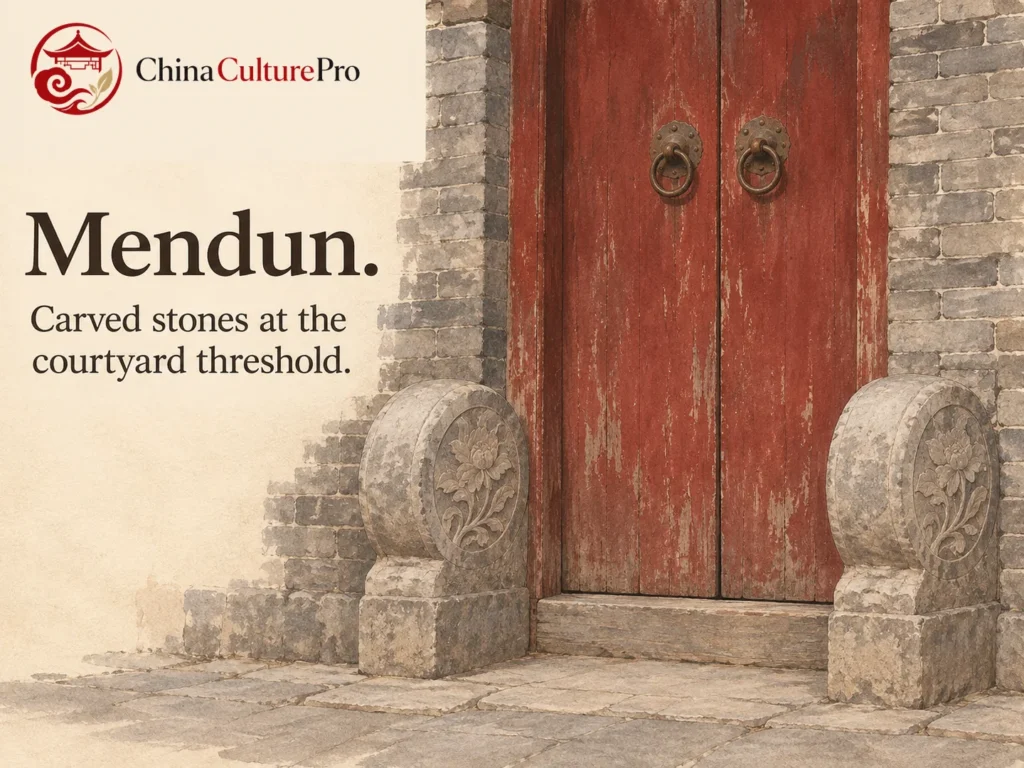

Quick Answer: What Are Mendun?
Mendun(门墩,méndūn)are the visible, often carved stone elements beside traditional doorways, especially familiar in accounts of Beijing courtyard houses.
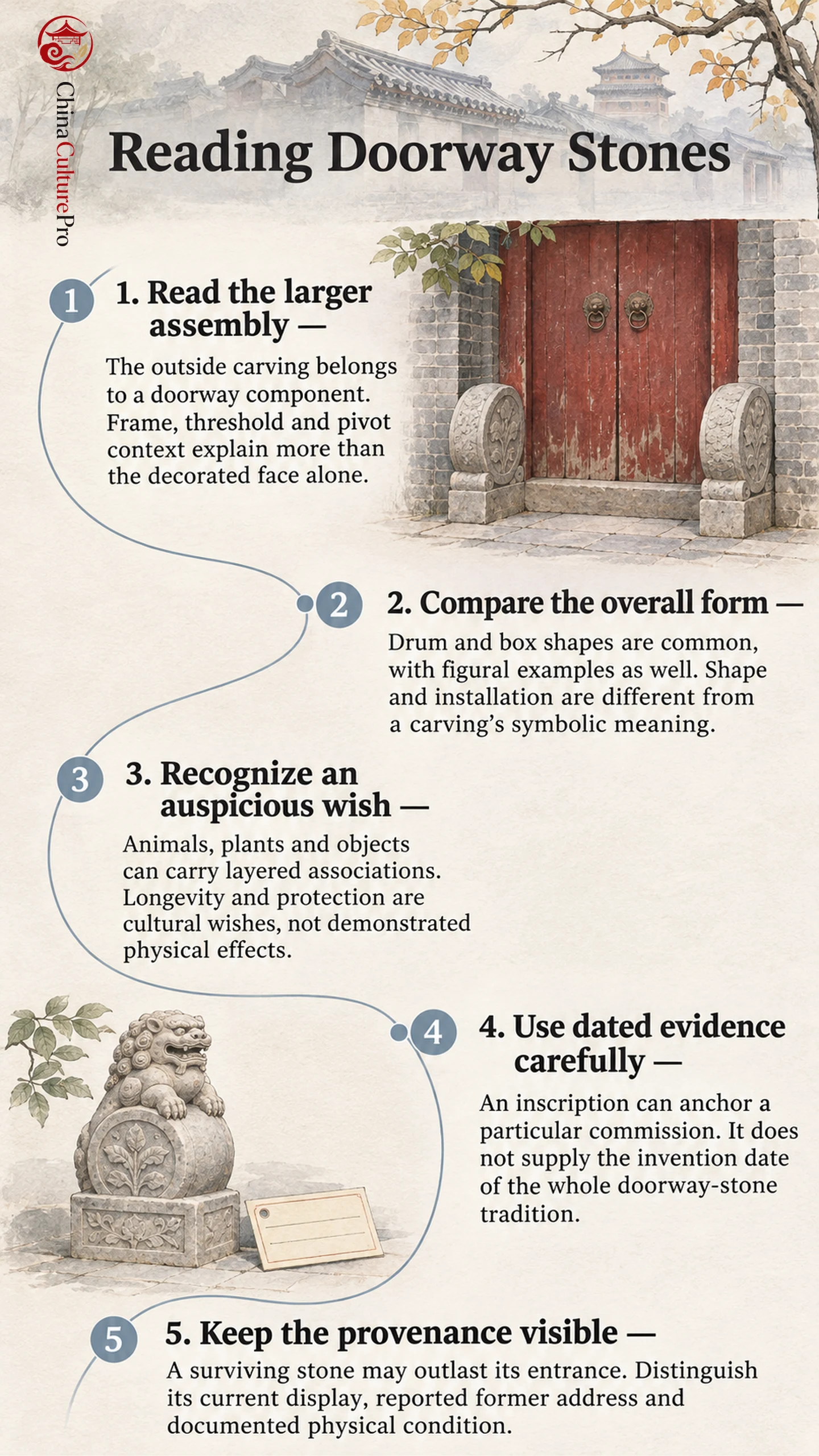
- Building role: They belong to a larger assembly associated with the door frame and pivot.
- Forms: Rounded drum-like and rectangular box-like examples are common, alongside figural treatments.
- Decoration: Carvings can express prosperity, auspiciousness and wishes for the household.
They should first be understood as doorway components. A carved animal does not automatically make one a freestanding guardian statue, and a shape alone cannot prove a former owner’s identity or precise rank.
Two carved stones flank a doorway, their surfaces worn by weather and everyday passage. Their drum shapes or small lions attract attention, but the entrance explains what they are. Reading form together with function offers a close view of Chinese architecture at the scale of an ordinary threshold.
The Doorway Stone and the Pivoting Door
A 2024 account from Beihai Park distinguishes the whole menzhen shi(门枕石,ménzhěn shí), or door-pillow stone, from the projecting outside portion. Its description places a groove at the door frame and a socket on the inside for the lower pivot. The lower socket and the upper fitting together hold the pivoting door in position.[1]
That arrangement helps explain why a carved projection outside can belong to a much longer architectural member. Looking only at its decorated face hides the relationship between the street-facing object, threshold and inside of the entrance.
The siheyuan(四合院,sìhéyuàn), or courtyard-house setting, is especially useful for understanding Beijing examples. A courtyard house contains a sequence of boundaries and entrances; the doorway stone sits within that arrangement rather than functioning as an independent ornament placed at random.
This is a description of a historical assembly, not an assumption that every surviving doorway retains its original pivots or complete stone members.
Drum, Box and Figural Forms
A Beijing University of Chinese Medicine museum account describes two common outside forms: the rounded drum and the rectangular box. The drum-shaped baogu shi(抱鼓石,bàogǔ shí)can include carved suggestions of a drum face and supporting stand. The box form gives its carver flatter faces for images and patterns.[2]
These common shapes do not exhaust the surviving forms. An animal figure can also be integrated into a door-pillow component, as the dated museum pair discussed below demonstrates.
For comparison, look at the whole profile before interpreting the carving. Is the stone rounded, rectangular or shaped around an animal? Does a longer member extend back through the doorway? Those questions distinguish form and installation from the symbolic reading of a surface motif.
Carved Wishes on the Outside Face
Chen Huizhan’s captioned photographic essay on Beijing doorway stones includes a qilin(麒麟,qílín)beside pine, as well as box-shaped examples bearing the attributes of immortals. The captions interpret the images as auspicious wishes, including prosperity and longevity.[3]
A wish for long life is cultural symbolism, not a health effect produced by the carving. Likewise, an animal understood as protective expresses a household aspiration rather than a demonstrated mechanism for keeping danger away.
Motifs can be layered within one composition. Identify the visible forms before assigning a complete message: a weathered animal, a fragment of foliage or a damaged object in a figure’s hand may not preserve enough information for certainty. A familiar interpretation can guide a question, but should not erase what remains ambiguous on the actual stone.
An Inscribed Pair from 1087
The Palace Museum catalogues a pair of stone lion door-pillows dated to 1087 in the Liao dynasty. Small crouching lions occupy their upper portions, with incised peony decoration on the front and outside faces. The museum reads the lions through protective associations and the peonies as wishes for prosperity.[4]
The inscription supplies a more precise historical anchor than appearance alone: it records a date, the person who commissioned the pair and the maker. [4]
It does not make 1087 the invention date of doorway stones, or establish the age of another pair that happens to look similar. A dated example and an origin claim are different kinds of historical statement. The distinction also prevents a broad “old Beijing” label from flattening objects belonging to different times and settings.
When a Doorway Stone Leaves Its Doorway
Beijing’s cultural heritage bureau recorded a donated pair in 2007 with a reported connection to a former mule-and-horse inn in Yongxing Hutong. The account describes damaged rear portions and carved drum faces, and preserves the donor’s explanation of the former property and the stones’ removal.[5]
That record matters because an entrance component can survive after its doorway disappears. The stone’s current location, its reported previous address and its physical condition answer different questions. A displayed pair may preserve the carving while leaving parts of the original installation undocumented.
The broader hutong setting helps connect such objects with neighborhood life. A useful account keeps the carving and its documented history together. It can acknowledge status associations without turning every drum or box into a reliable badge for a particular official office.
FAQs About Mendun
Are mendun the same as stone guardian lions?
No. A lion can decorate a doorway component, but freestanding guardian statues are a different architectural arrangement.
Are all mendun round drums?
No. Box-like and figural forms also occur.
Can the shape prove the owner’s official rank?
No. Shape needs supporting evidence about the property, date and owner.
Does a museum pair always show its original doorway?
No. Collection and provenance records may preserve context that the current display cannot show.
Fuentes
[1] Beihai Park Administration, Beijing Municipal Administration Center of Parks. Exhibition Account: Old Beijing Doorway Stones
[2] Beijing University of Chinese Medicine Museum. Doorway-Stone Culture and Appreciation
[3] Chen Huizhan, Beijing Municipal Government Photo Essay. Hutong Culture: The Art of Doorway Stones
[4] Palace Museum. Stone Lion Door-Pillows, Dated 1087
[5] Beijing Municipal Cultural Heritage Bureau. A Pair of Doorway Stones Collected in Haidian