
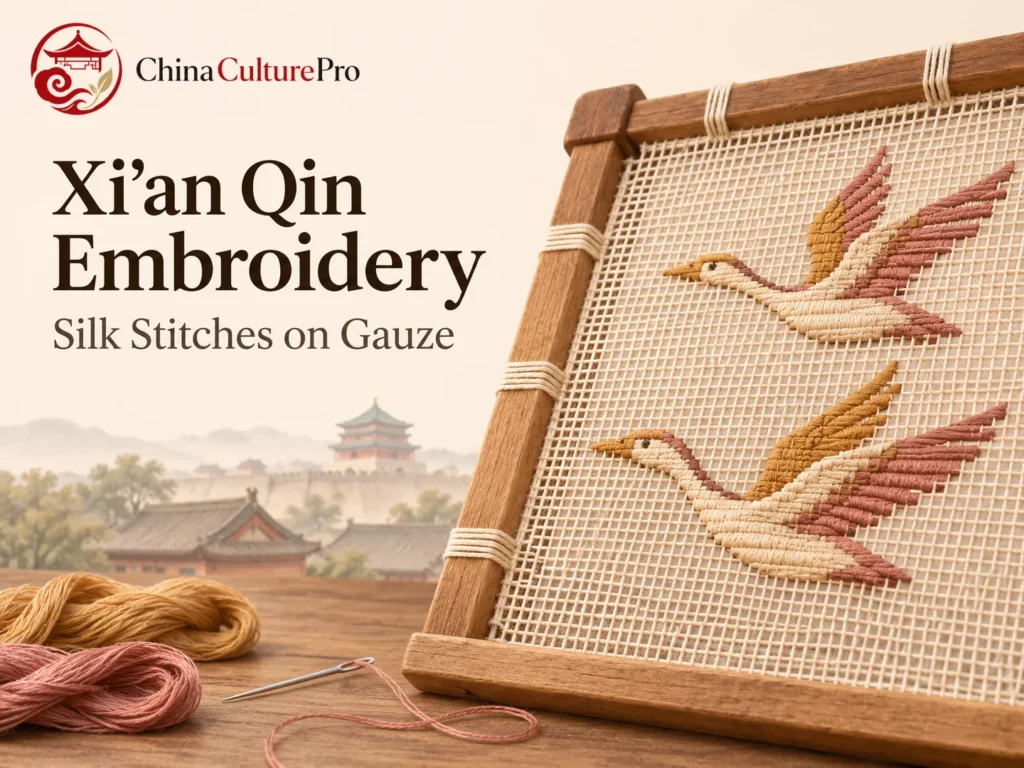

Quick Answer: What Is Xi’an Qin Embroidery?
Xi’an Qin embroidery (秦绣, Qínxiù) uses silk thread worked through the openings of a gauze ground. This specific form is known as gauze embroidery (穿罗绣, chuānluóxiù) in Shaanxi’s provincial heritage record. Zhang Yiyuan helped develop the documented Xi’an style in 1977. Later makers have adapted imagery from historical objects.[1][2]
- Materials: The ground has a visible grid. Silk thread supplies the design.[1]
- Technique: The openings give the embroiderer points at which to pass the needle.[1][2]
- Name: Qin is a name associated with Shaanxi. A motif inspired by the past can appear on a modern work.[1][2]
Look for the grid and the documented maker when reading a Qin embroidery label.
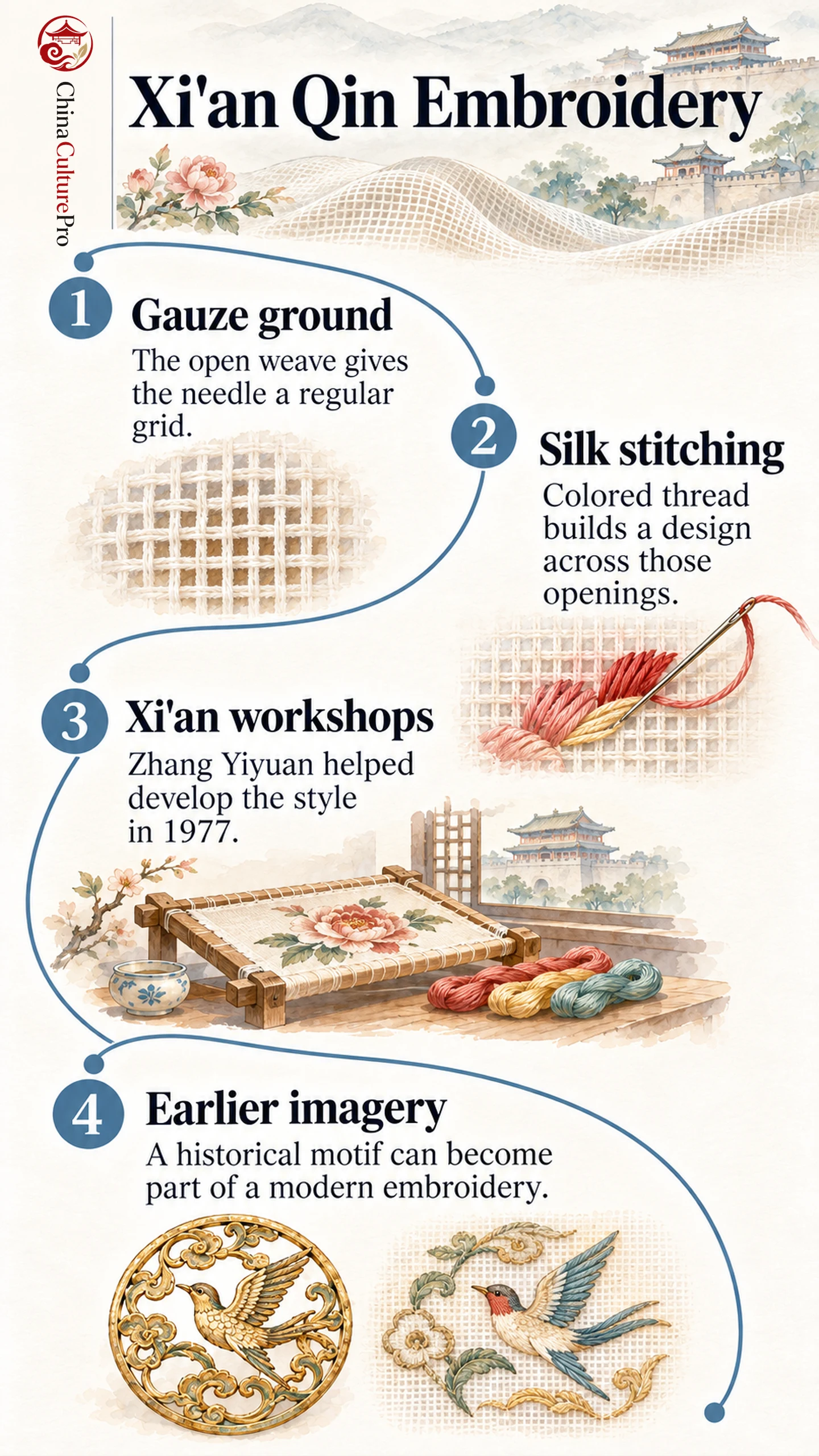
Two silk stitches can sit side by side with a square opening between them. Follow those openings and the way the needleworker has built a line becomes easier to see. In Xi’an Qin embroidery, that ground helps explain the technique.
How Gauze Openings Guide Silk Stitches
An account of Zhang Yiyuan’s work describes silk thread passed through the openings between the warp and weft of the ground. The existing grid gives the embroiderer a repeatable set of positions. A short span of silk can join nearby openings. Repeated stitches may create bands or follow the contours of a larger shape. To see how the cloth guides the design, look where the stitched area meets exposed gauze. The same openings continue into the unworked part.[1]
This is an application of needlework to finished cloth. The woven openings described in the guide to Chinese silk gauze belong to the ground itself. The added stitches of Chinese embroidery change how much of the ground shows and can draw a motif across it.[1]
A Xi’an Style Developed in the 1970s
A report on Zhang’s work dates the development of this particular style to 1977, as Shaanxi prepared work for a national arts and crafts exhibition. Xi’an’s Jinjiang embroidery factory later produced pieces, including work exported to Japan. A 2017 exhibition at the Shaanxi art museum displayed 149 works by Zhang. Xi’an Jiaotong University Museum organized another exhibition of her work in 2020. A notice for that exhibition dates the provincial heritage recognition to 2013.[1][3][6]
Inspiration can come from earlier objects. A report on a later Xi’an practitioner describes an embroidered pair of geese based on a motif on a Tang gilt-silver box. The historic model and the embroidered work belong to separate dates. A detail of the metalwork can serve as the source of a drawn design. The embroiderer then has to translate that line into stitches that fit the grid.[4]
Qin Embroidery and West Qin Folk Embroidery
The provincial heritage portal uses Qin embroidery in a wider description of needlework in northern Shaanxi, Guanzhong and southern Shaanxi. It lists examples from festival gifts to pouches, garments and household cloths. The gauze technique is one specific way of working within that wider story.[2]
West Qin folk embroidery (西秦刺绣, Xī Qín cìxiù) is a named national heritage project registered to Baoji in 2008. Its entry describes colored needlework used for dress and gifts. The wider Shaanxi heritage description also records flat work, chain stitching and other methods. Chinese tiger-head shoes show how needlework can also turn the toe of a cloth shoe into part of its design. The Baoji listing and the provincial Qin gauze embroidery entry have different names and scopes.[2][5]
FAQs About Xi’an Qin Embroidery
Does the word Qin date a piece to the Qin dynasty?
No. Qin is also a name associated with Shaanxi. The particular Xi’an gauze-ground style discussed here is documented from the 1970s.[1][2]
Is this technique worked on smooth satin?
The documented form uses a gauze grid. The open spaces between its warp and weft threads help guide the stitches.[1]
Does every Shaanxi embroiderer use this technique?
Shaanxi has multiple embroidery traditions, including the folk needlework recorded in Baoji. Check the ground, stitch, workshop and locality when describing an object.[2][5]
Fuentes
[1] China City News. Shaanxi Qin Embroidery Exhibition
[2] Shaanxi Intangible Cultural Heritage Digital Museum. Qin Embroidery: Chuanluoxiu
[3] Xi’an Jiaotong University. Zhang Yiyuan Qin Embroidery Exhibition
[4] China News Service. The Transmission and Adaptation of Qin Embroidery
[5] China Intangible Cultural Heritage Digital Museum. West Qin Folk Embroidery in Baoji
[6] Xi’an Jiaotong University. Exhibition Notice for Qin Embroidery