


Quick Answer: What Does Zhuang Zhou Meng Die Mean?
Zhuang Zhou Meng Die (庄周梦蝶, zhuāng zhōu mèng dié) means “Zhuang Zhou (庄周, Zhuāng Zhōu) dreams of being a butterfly.” In the Zhuangzi (庄子, Zhuāngzǐ), he wakes as a man and wonders whether the butterfly could be dreaming him. The phrase later became a literary allusion to a dreamlike or changeable experience of life.[1][2]
- The dream: As the butterfly, he experiences its life without thinking of himself as Zhuang Zhou.[1]
- The turn: On waking, the story reverses who might be doing the dreaming.[1]
- The later use: A writer can invoke the butterfly dream to suggest that a vivid experience or even a part of life now feels hard to grasp.[2][4]
The passage asks a question about perspective and ends by affirming a distinction between the man and the butterfly. Both details matter when reading it.[1][3]
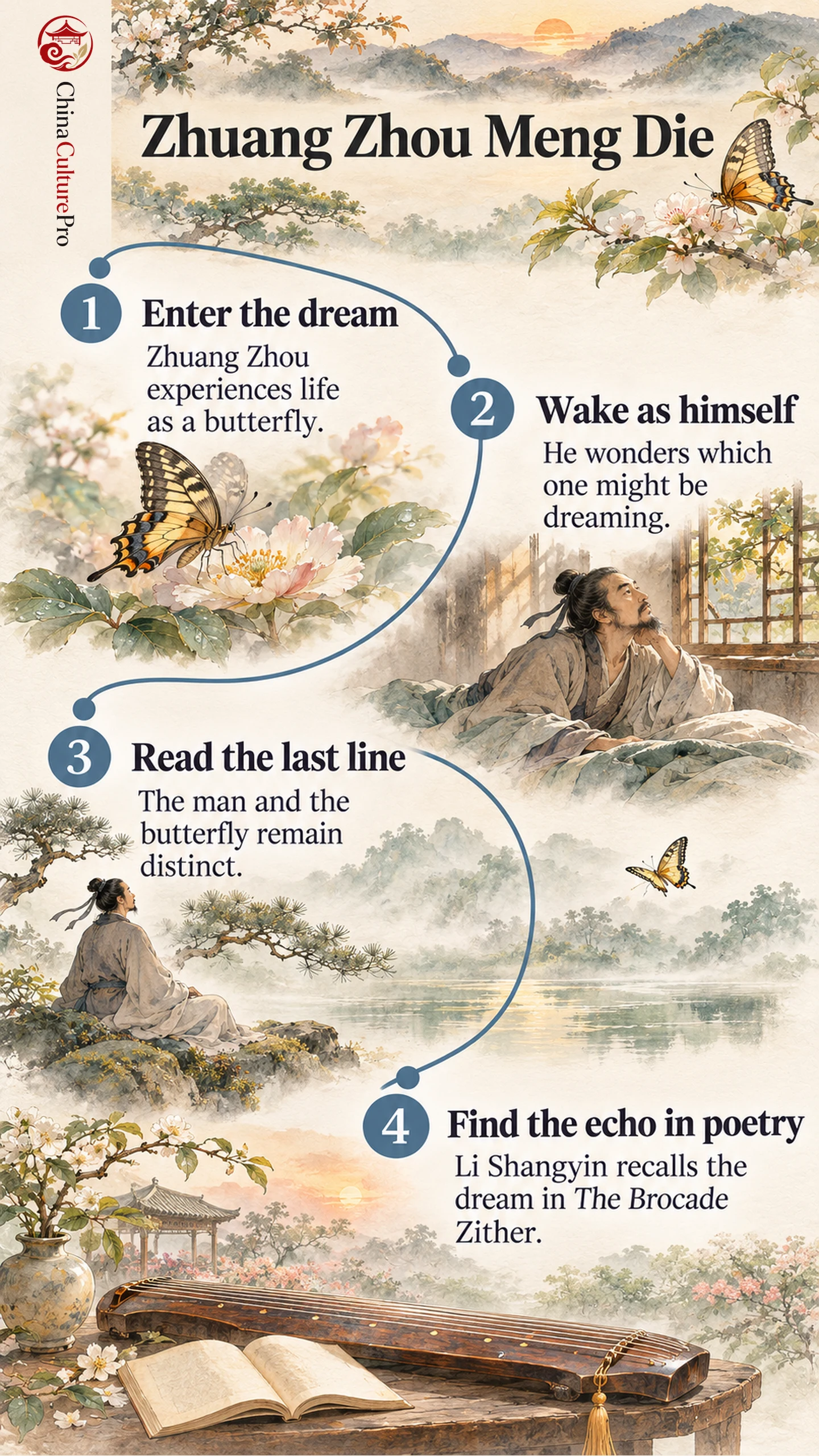
A short retelling can leave the impression that the story ends with a choice between dream and reality. The last sentence instead gives a name to what happens between the two.[1]
What changes when Zhuang Zhou wakes
The story closes Qiwulun (齐物论, Qíwùlùn), the second chapter of the Zhuangzi. Zhuang Zhou dreams that he is a butterfly, moving freely and enjoying itself. In that experience, he has no sense of being Zhuang Zhou somewhere else. Then he wakes suddenly and recognizes himself as Zhuang Zhou.[1]
The passage asks whether Zhuang Zhou dreamed that he was a butterfly or whether a butterfly is dreaming it is Zhuang Zhou. The familiar summary often stops at this reversal. The next sentence says that there must be a distinction between them. That sentence gives the reader more to account for than the question of which experience came first.[1][3]
Why the last line matters
The closing term is the transformation of things (物化, wùhuà). In this passage, the person and the butterfly differ, and the narration moves from the experience of being one to the experience of being the other. The change also alters which identity seems obvious from the inside.[1][3]
One philosophical reading treats awakening as a reason to be less certain that our present standpoint is final. Awakening changes his basis for judging the dream. The story then makes him consider whether the apparent waking standpoint could also be judged from elsewhere. The question turns that confidence around and asks what he can know from where he now stands. This reading keeps the distinction between two forms of experience while making room for doubt about which standpoint has the last word.[1][3]
How the butterfly dream became a literary allusion
The Tang poet Li Shangyin (李商隐, Lǐ Shāngyǐn) invokes the dream in The Brocade Zither (锦瑟, Jǐnsè). The poem brings a butterfly dream at dawn into a sequence of images about recollection. The final lines of the poem look back on feelings that were already hard to make sense of at the time. The dream supplies an image for that bewilderment. It does that work without retelling the whole philosophical passage.[4]
A contemporary writer can use the expression in that reflective sense. For example: 多年后想起那段日子,恍如庄周梦蝶。 “Years later, thinking back on those days feels like Zhuang Zhou’s butterfly dream.” In an English adaptation, “those days now feel like a dream” conveys the memory’s quality, while keeping the butterfly retains the allusion when readers can recognize it. The guide to Chinese chengyu gives more examples of literary references used this way.[2]
FAQs About Zhuang Zhou Meng Die
Who is dreaming in the story?
The first sentence identifies Zhuang Zhou as the dreamer. After he wakes, the text asks the reverse question and leaves it unanswered.[1]
What does the transformation of things mean here?
It is the name the text gives the shift between the two states. What seems immediately certain in one state can look different from the other.[1][3]
How can you use the phrase today?
Use it when an experience feels dreamlike in retrospect or a story deliberately unsettles the boundary between waking and dreaming. It has a literary tone.[2][4]
出典
[1] Wikisource. Zhuangzi, Qiwulun
[2] 台湾教育部。 Revised Mandarin Chinese Dictionary, Zhuang Zhou Meng Die
[3] Stanford Encyclopedia of Philosophy. Zhuangzi
[4] Li Shangyin, Wikisource. The Brocade Zither