
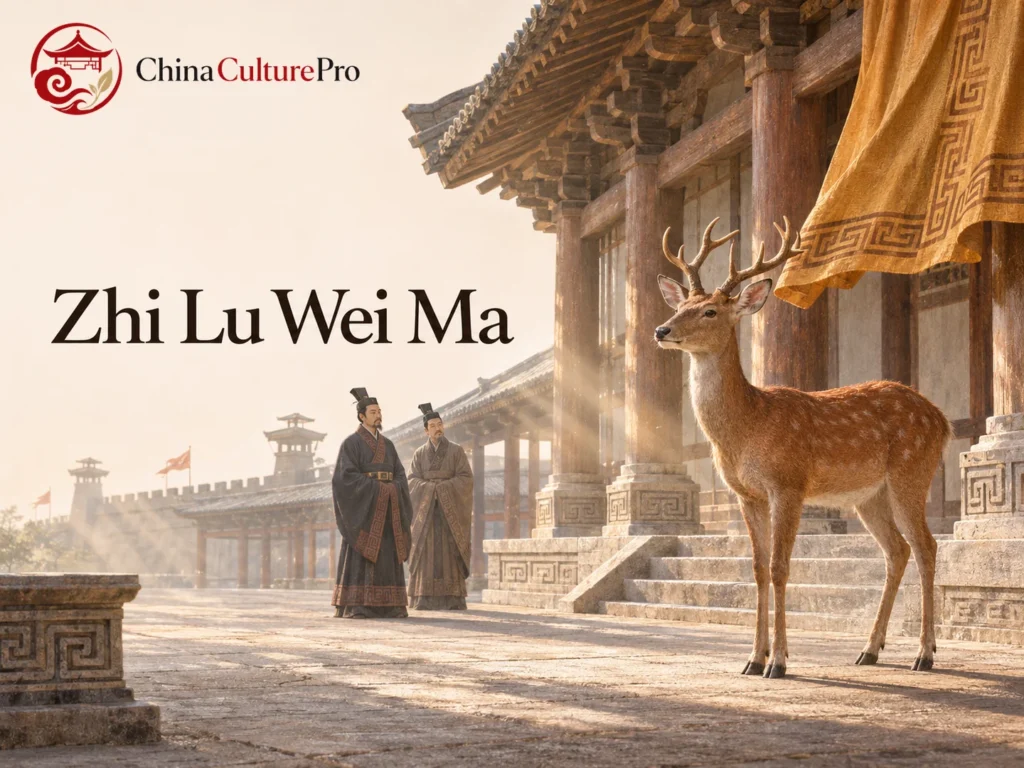

Quick Answer: What Does Zhi Lu Wei Ma Mean?
Zhi Lu Wei Ma (指鹿为马, zhǐ lù wéi mǎ) means “to point at a deer and call it a horse.” It describes deliberately turning the facts upside down. In the story behind it, the Qin chancellor Zhao Gao (赵高, Zhào Gāo) presents an obvious falsehood and the people around the emperor have to decide how to answer.[1][2][3]
- The literal claim: Zhao calls a deer a horse even when the emperor recognizes the deer.[2][3]
- The point of the scene: What people say reflects whom they are prepared to contradict.[2][3]
- The modern use: It is a sharp criticism of someone who knowingly denies or misrepresents a clear fact.[1]
The expression makes a claim about intent. In a dispute where the facts are still unclear, the idiom can make the accusation stronger than the evidence allows.
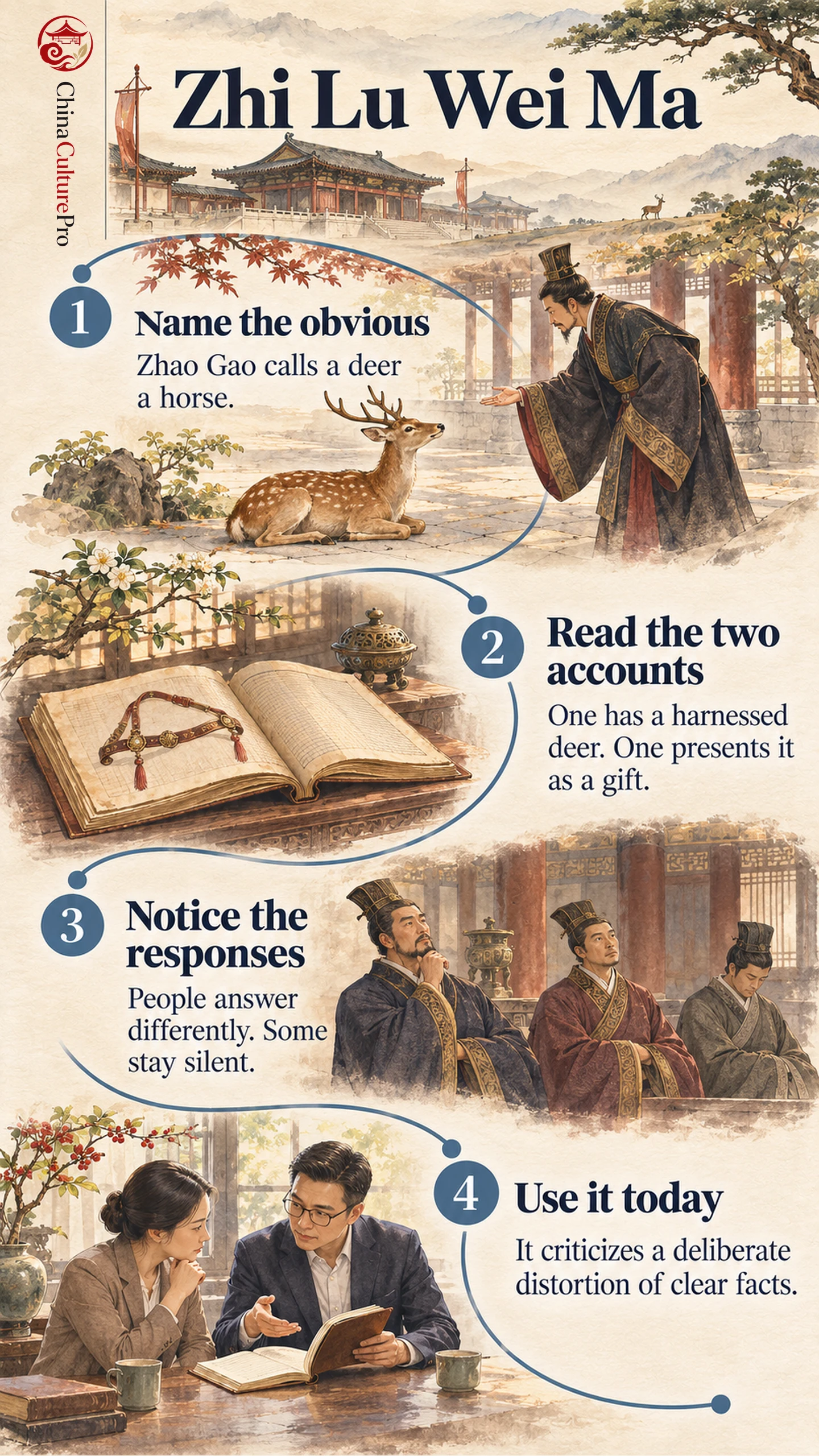
In the court scene, the deer is easy to recognize. The two early accounts are interested in what happens after the obvious answer becomes difficult to say aloud.[2][3]
What happens in the two early accounts
In New Discourses (新语, Xīnyǔ), Zhao Gao is traveling with a deer harnessed to a vehicle. The Second Emperor of Qin (秦二世, Qín Èrshì) asks why he is driving a deer. Zhao insists it is a horse and suggests asking the ministers. The text says half reply “deer” and half “horse.” The emperor comes to doubt what he saw and follows the false account.[1][3]
The Records of the Grand Historian (史记, Shǐjì) describes Zhao presenting a deer to the emperor and calling it a horse. It treats the encounter as a test of how other officials will respond. Some stay silent, some agree with Zhao, and others answer “deer.” The account says Zhao covertly uses the law against those who call it a deer and that officials come to fear him.[2]
Both accounts keep the same challenge to what the emperor sees. Each makes a different detail of the officials’ responses important. In one text, he loses confidence in what he plainly saw. In the other, the fate of those who answer truthfully explains why others might be afraid to speak.[2][3]
Why the court’s answers matter
In New Discourses, the author asks how the emperor could judge a subtle case if he cannot resolve one where the evidence is right in front of him. The chapter next tells the story of a mother who hears a mistaken allegation about someone with her son’s name. Together the two scenes show how voices around a person can undermine confidence in a judgment, even when the original judgment was sound.[3]
In the Records of the Grand Historian, the silence matters too. The narrative describes silence as a third response alongside naming the animal truthfully and repeating Zhao’s claim. Silence gives us no firm evidence of an individual’s belief. It shows that ministers had a response other than taking one side aloud.[2]
How the idiom works in modern Chinese
Use the phrase when the facts are plain enough to name and someone knowingly gives them another description. If a group has documentation and an influential speaker insists on the opposite, the deer and horse capture why the disagreement matters. For a misrepresentation, the strongest example gives readers the clear record and the incompatible claim side by side.[1][2]
- A misleading label: 明明没做过测试,却硬说检测合格,这不是指鹿为马吗? “They never ran the test, yet they insist it passed. That’s a blatant distortion.”
- A record contradicted: 会议记录写得很清楚,他还把反对说成同意,简直是指鹿为马。 “The minutes are clear, but he still calls opposition approval. He’s turning the facts upside down.”
The examples are original. In both, the sentence gives the reader something definite to compare against the speaker’s claim. The guide to Chinese chengyu explains how an old image can make the force of a brief judgment clear.
FAQs About Zhi Lu Wei Ma
How do you pronounce 为 in the idiom?
Read 为 as wéi. Here it means to treat or call one thing another. The full reading is zhǐ lù wéi mǎ.[1]
Is it about an honest mistake?
Usually no. The expression criticizes twisting the facts on purpose. It carries more blame than saying someone is mistaken.[1][2]
How do you translate it into English?
“Deliberately distort the facts” fits a direct explanation. Use “call a deer a horse” when you need to keep the historical image and have room to explain it.[1][2]
出典
[1] 台湾教育部。 Dictionary of Chinese Idioms, Zhi Lu Wei Ma
[2] 台湾教育部。 Records of the Grand Historian, the deer episode
[3] Wikisource. New Discourses, Discerning Confusion