


Quick Answer: Why Is Table Tennis China’s National Sport?
Table tennis (乒乓球, pīngpāngqiú) is often called China’s national sport, or guoqiu (国球, guóqiú). Its place in public life grew through organized support, international competition and opportunities to learn or play locally. Rong Guotuan’s 1959 world title helped make the game a symbol of national sporting achievement. [1][2]
- Early landmark: Rong won the men’s singles world championship in 1959. [1][2]
- Everyday play: School events and outdoor tables give people different ways to play. [4][5][6]
- International visibility: Table tennis entered the Olympics in 1988 after decades of international competition. [1][7]
The phrase describes the game’s cultural standing, from public recreation to elite sport.
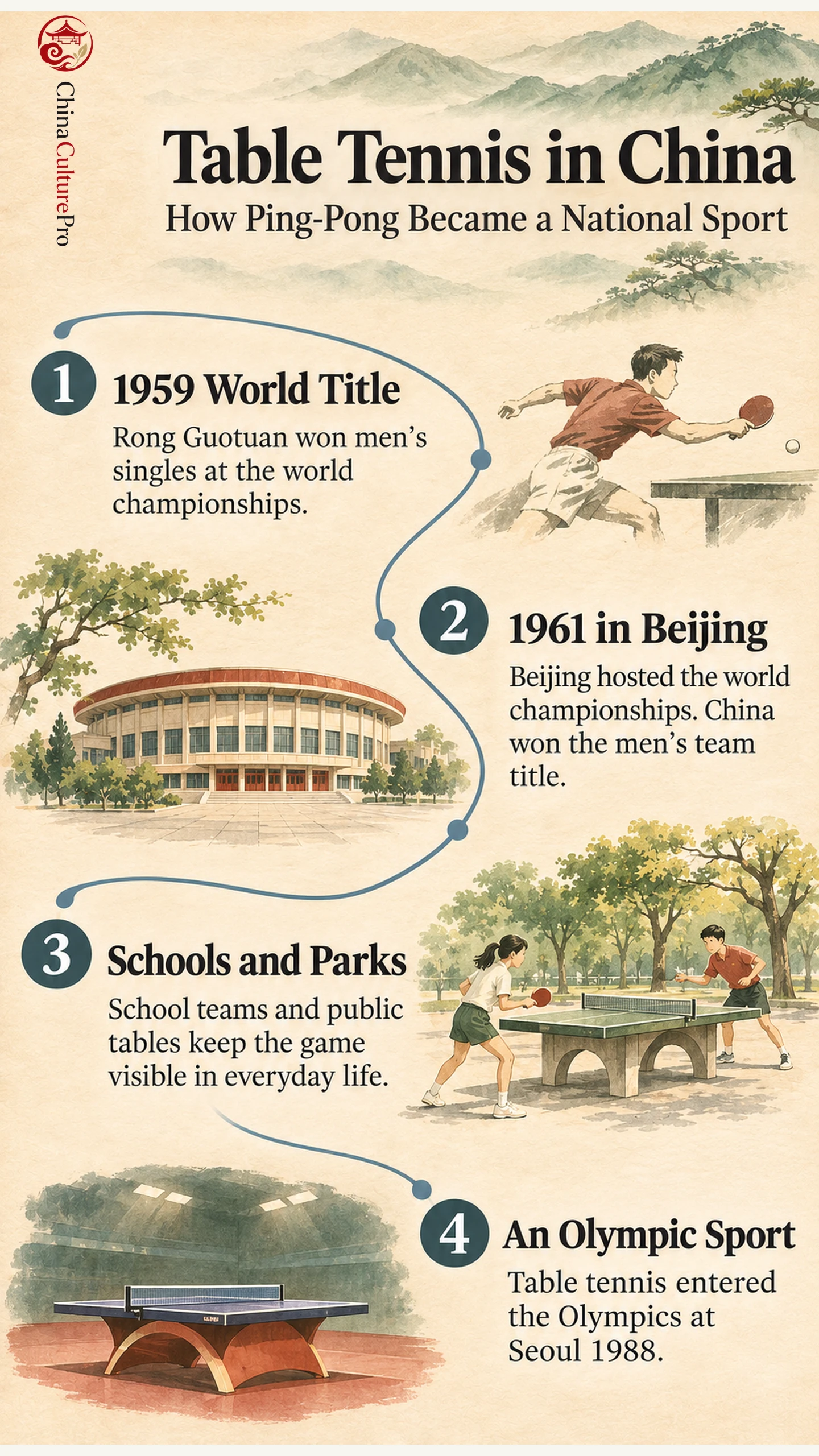
A concrete table in a park and a television feed from a championship can show the same sport in two settings. In one, the goal may be to keep a rally going with a neighbor. In the other, a few points can decide a national team match. Chinese table tennis became publicly recognizable through the combination of those settings. [2][3][5]
The 1950s and the First World Title
The People’s Republic of China first entered the World Table Tennis Championships in 1953. Sports historians Aurélien Boucher and Steven Pope describe how invitations from International Table Tennis Federation president Ivor Montagu helped draw official attention to international table tennis. In their account, better opportunities to compete and a growing institutional commitment helped build the program before it had a world champion. [1][2]
At the 1959 championships in Dortmund, Rong Guotuan won men’s singles. The international federation records him as China’s first world champion in any sport. His title gave the emerging program a result people could recognize beyond the training hall. The 1959 title helped cement the sport’s standing with officials and spectators. [1][2]
Beijing hosted the World Table Tennis Championships in 1961. China won the men’s team title. Zhuang Zedong took men’s singles, and Qiu Zhonghui became the first Chinese player to win women’s singles. Those results made the strength of the emerging program visible across several events. [3]
How Schools and Neighborhoods Keep the Game in Use
In Shanghai, Julu Road No. 1 Primary School traces its program to a makeshift table in 1959. The municipal account describes teachers and pupils assembling available boards before the school had a dedicated facility. The improvised table let pupils get started before dedicated facilities were available. Later training routes in Shanghai have included school coaches and more specialized instruction. [4]
School competitions give some players a chance to meet opponents outside their own school. The first Sichuan provincial school table tennis competition in 2024 brought primary school teams into a dedicated event. Competing as a school team gave the players a structure different from casual practice. A recreational match can need only a table, two players, paddles and a ball. [5]
In 2025, the ITTF Foundation documented World Table Tennis Day activities in 114 parks in China. The number describes a coordinated celebration, and the parks illustrate the shared spaces where people can encounter the sport. Other forms of recreation also use public space. Chinese square dancing offers a separate example of how parks and squares can become regular places to meet. [6]
A park table can serve several groups in the same afternoon. Two neighbors may play informally before a club member arrives to practice. At a scheduled school competition, adults organize registration and matches around particular age groups. Both settings keep the game in public view, while access and coaching differ by place. [5][6]
International Matches and a Spectator Sport
International matches also gave table tennis a role outside sport. After the 1971 world championships in Nagoya, several teams were invited to China for friendship matches. The US visit became known as Ping-Pong Diplomacy. That episode belongs to a longer history of competition and exchange that was already visible in China’s attendance at the 1953 championships. [1][2]
The Olympic debut came in Seoul in 1988. Olympic matches gave the sport a further stage alongside its world championships. Those matches make a game familiar from schools and parks visible in an international arena. For a broader view of how organized competition and neighborhood activities coexist, see everyday leisure in modern China. [1][6][7]
Beijing’s 2024 China Smash put international competition next to public viewing. At Shougang Park, people could watch matches on a large screen from the lawn. Matches took place in facilities used for the 2022 Winter Olympics. The event coincided with the October Golden Week break, and the municipal coverage describes families making a holiday outing of it. That example shows how a tournament can draw a social crowd outside its competition hall. [8]
FAQs About Table Tennis in China
Did table tennis originate in China?
The federation traces early table tennis to late nineteenth-century Britain. The game became strongly associated with China through later participation and achievement. [1][2]
Who was China’s first table tennis world champion?
Rong Guotuan won the men’s singles title in 1959. [1][3]
Where do people encounter the sport outside international tournaments?
Some schools, clubs and public parks host tables or activities. The Shanghai school and the 2025 park events are examples of two different settings. [4][6]
出典
[1] International Table Tennis Federation. History of Table Tennis
[2] Asian Journal of Sport History & Culture. Without a Red Leader’s Fan: A Connected History of the Emergence of Table Tennis as China’s National Sport
[3] International Table Tennis Federation. Six Decades, Sixth Host City for China at World Championships
[4] Shanghai Municipal Government. From improvised tables to training future champions
[5] General Administration of Sport of China. First Sichuan Provincial School Table Tennis Tournament
[6] ITTF Foundation. World Table Tennis Day 2025 in China
[7] International Olympic Committee. International Table Tennis Federation
[8] Beijing Municipal Government. Residents and Visitors Watch Table Tennis During the National Day Holiday