

Quick Answer: What Is the Huashan Rock Art?
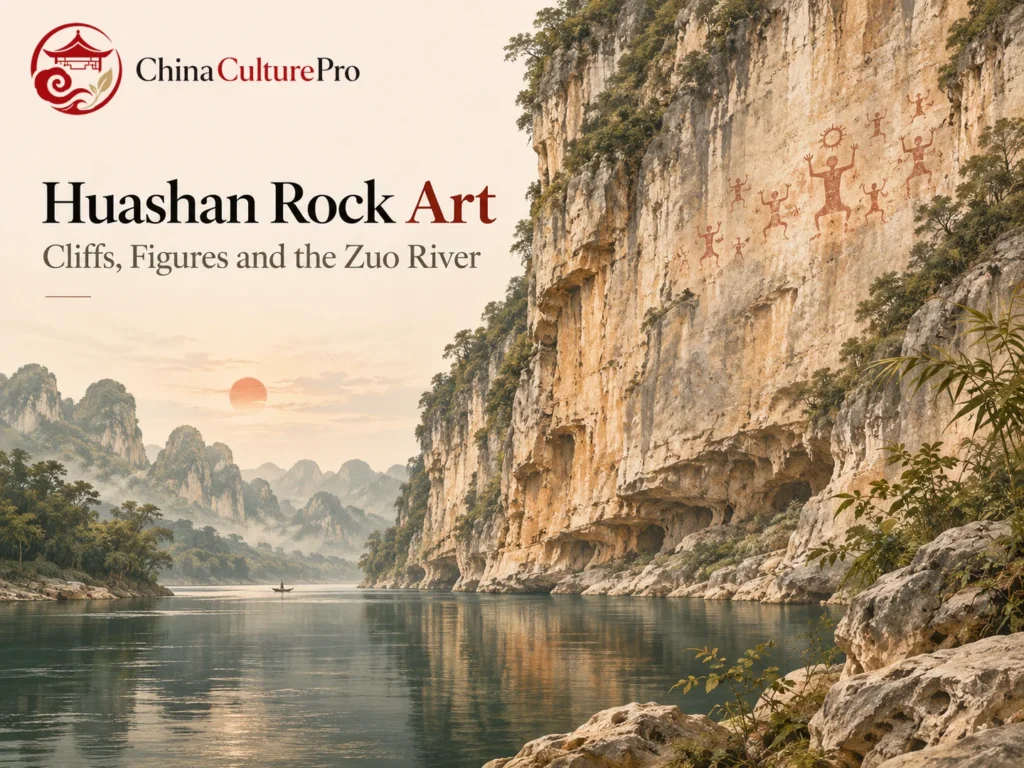
Guangxi’s Huashan rock art (花山岩画, Huāshān yánhuà) is a group of cliff paintings along the Zuojiang and Mingjiang rivers. UNESCO’s cultural landscape includes 38 sites and associates the paintings with the Luoyue (骆越, Luòyuè). The paintings date broadly from the fifth century BCE to the second century CE. [1][2]
- Setting: The figures are painted on steep cliffs within a landscape of rivers, karst mountains and tablelands. [1][2]
- Images: Human figures, animals and other forms were painted rather than cut into the rock. [1][2]
- Interpretation: UNESCO connects some depictions to ceremonies and a bronze drum tradition once widespread in southern China. [1][3]
A visible posture or shape is evidence. The exact meaning of a painted scene may still require interpretation.
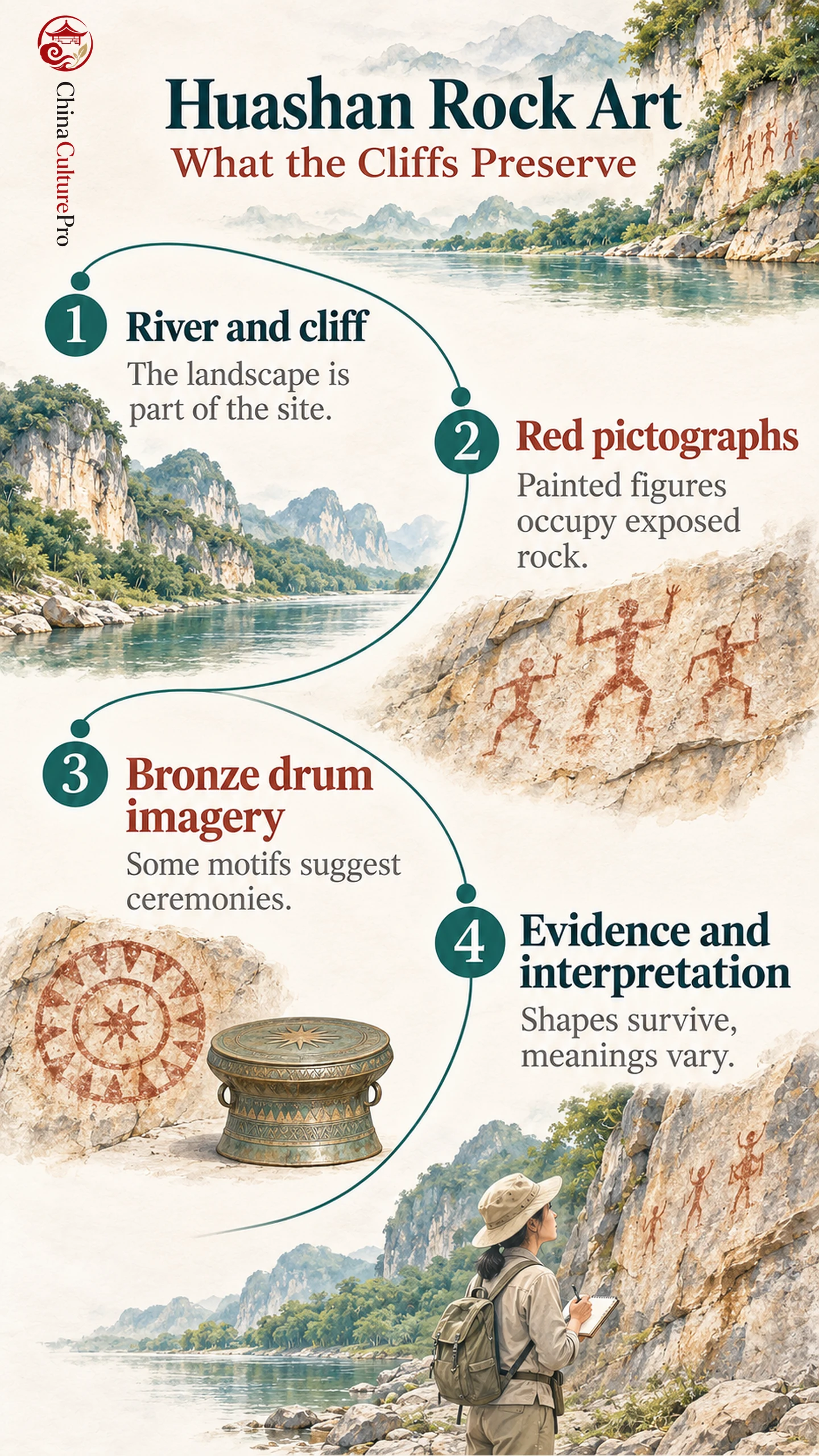
The color draws your eye first. Then look at where each group sits on the cliff. A figure painted high above the river tells you something about how the landscape was used before you give the motif a name.
What You Can Read on the Cliffs
| 比較項目 | Visible evidence | What remains interpretive |
|---|---|---|
| Human figures | Repeated silhouettes and groups of different sizes. [2] | The roles of participants and the particular actions depicted. [1][2] |
| Round motifs | Circular forms appear alongside people and other images. [2] | Some have been associated with bronze drums. [1][3] |
| Cliff placement | Panels sit high above river meanders, with the exposed rock forming the surface. [1][2] | The routes and equipment used to reach the painters’ working positions. [2] |
The rock surface and the placement of an entire panel can be as significant as an individual shape. This makes Huashan a different kind of record within Chinese visual art from an object originally made to be carried. [1][2]
Why the River and Cliff Are Part of the Evidence
The Zuojiang and its tributary Mingjiang cut through karst country. The protected areas include rock faces, their river settings and adjacent land. The cliff height raises a practical question of access. ICOMOS discusses remnants and landscape conditions that suggest how painters reached some elevated surfaces. Its assessment includes the possibility of scaffolds or platforms, rather than one solution demonstrated for every panel. [1][2]
The 38 selected sites are a group, with Ningming Huashan one named location. The landscape idea makes sense beside other cultural World Heritage sites, where a feature often matters because of its setting. [1][3]
What the Painted Ceremonies May Mean
Some round motifs have been interpreted as drum images. A round shape alone cannot identify every motif. UNESCO connects the paintings to a regional bronze drum culture. Figure groupings and related objects support ceremony as one interpretation. The images rarely identify the participants or spell out an event as a written account could. [1][2][3]
Cultural traditions of the Zhuang offer context for the region today. The archaeology identifies an ancient Luoyue setting, and cultural practices of later communities have their own histories. Local reverence for the painted cliffs, documented by UNESCO, is a separate layer in the life of the place. [1]
FAQs About Huashan Rock Art
Is Huashan one painting or a group?
The World Heritage property includes 38 selected rock art sites. Ningming Huashan is one of those locations. [1]
Are the figures carvings?
They are pictographs painted onto exposed rock. The cliffs are part of their original setting. [1][2]
Do we know which ceremonies are shown?
Researchers interpret scenes as relating to ritual and bronze drum culture. The precise identities of participants and meanings of individual scenes remain matters of interpretation. [1][2][3]
出典
[1] UNESCO World Heritage Centre. Zuojiang Huashan Rock Art Cultural Landscape
[2] ICOMOS. Zuojiang Huashan Rock Art Advisory Body Evaluation
[3] World Heritage Committee. Zuojiang Huashan Rock Art Inscription Decision