
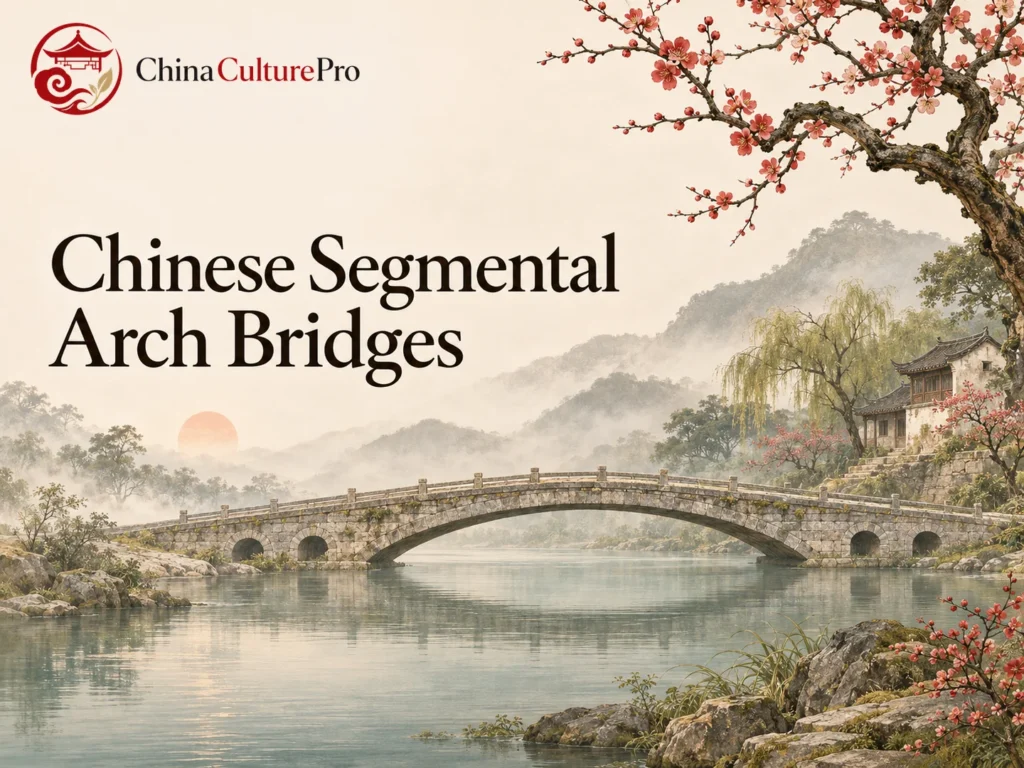

Quick Answer: What Is a Chinese Segmental Arch Bridge?
A segmental arch uses an arc shallower than a semicircle. In a bridge, that gives the main opening a low rise for its span. Zhaozhou Bridge (赵州桥, Zhàozhōu Qiáo) in Hebei is a Sui-dynasty example with an opening about 37 metres wide.[1][2]
- Main arch: The shallow curve spans the river in one opening.[1][2]
- Open spandrels: Smaller openings pierce the areas above the shoulders of the main arch.[1][3]
- Stone ribs: At Zhaozhou, 28 side-by-side stone arches form the width of the main structure.[2]
A shallow profile and open shoulders describe separate features. Zhaozhou has both.[1][2]

A side view of a bridge can show several arches at once. At Zhaozhou the large curve below the deck and the smaller curves above it do different jobs. Start with the large opening, then look at the stonework between its shoulders and the roadway.[1][3]
What Makes the Main Arch Segmental
The span is the horizontal distance between the sides of an opening. The rise is the vertical distance from the line connecting the two points where the arch begins to curve up to the top of the arch. A semicircular arch rises by half its span. An arch shaped as a smaller segment of a circle has a lower rise relative to that same width.[1][2]
At Zhaozhou, the published figures for the principal opening are about 37 metres of span and 7.2 metres of rise. That is roughly one unit of rise for five units of span. A semicircle over the same opening would rise about 18.5 metres. The comparison explains why Zhaozhou looks low and elongated in profile.[1][2]
A shallow arch can carry a roadway over a wide opening without forcing it as high above the banks as a taller arch would. The horizontal thrust still has to be resisted where the arch meets its supports. An outline can show the profile, but the condition of the masonry and supports calls for other evidence.[1][3]
What Open Spandrels Do
A spandrel is the space above an arch shoulder and below the deck. At Zhaozhou, that area has two openings on each side of the main arch, four in all. From the bank, you can identify them by looking higher than the river opening and closer to the ends of the bridge.[1][2][3]
These openings reduce the weight of masonry carried by the main arch. They also give high water additional ways to pass through the structure. That matters during floods, when water can press against the part of a bridge that normally stands above the river. The openings have a purpose distinct from the low shape of the main arch.[1][3]
There is another feature a side view rarely reveals. The main arch consists of 28 stone ribs across the width of the bridge. The small openings are visible when you look at the bridge from the side. The ribs run side by side from one edge of the roadway to the other, so a photograph taken from the bank can make them look like one continuous band.[2]
How Zhaozhou and Yongtong Compare
Zhaozhou is also called Anji Bridge (安济桥, Ānjì Qiáo) and is locally known as the Great Stone Bridge. Nearby Yongtong Bridge (永通桥, Yǒngtōng Qiáo) is called the Small Stone Bridge. Both are in Zhao County, Hebei. The two local names help distinguish the landmarks when a caption or map gives a stone bridge a more general name.[1][4][5]
Yongtong also has a segmental main arch with open spandrels. A published comparison illustrates iron clamps at its stone joints. That evidence concerns how parts of the masonry were held together. The side-by-side bridge comparison shows why an overall profile and a close view of a joint answer different questions.[4]
For the construction history, names and measurements of the larger landmark, see Zhaozhou Bridge engineering. For another kind of crossing, Chinese suspension bridges show how builders carried a deck with suspension instead of masonry arches.[1][3]
FAQs About Chinese Segmental Arch Bridges
What is the difference between an arch rib and an arch opening?
The rib is a strip of load-bearing stonework. The opening is the space under an arch. A bridge can have a single main opening formed by many ribs laid side by side.[2]
Does every segmental arch bridge have open spandrels?
“Segmental” describes the main arch’s shallow curve. “Open spandrel” describes the voids above its shoulders. You need to see both features before applying both labels.[1][3]
Is Anji Bridge the same as Zhaozhou Bridge?
Yes. Anji and Zhaozhou are names for the same bridge in Zhao County. The smaller nearby Yongtong Bridge has its own name and identity.[1][5]
出典
[1] American Society of Civil Engineers. Zhaozhou Bridge
[2] ChinaCulture.org. Anji Bridge: The Oldest Extant Bridge in China
[3] Institution of Civil Engineers. Spanning Over 1400 Years: China’s Remarkable Zhaozhou Bridge
[4] The Silk Road, volume 18. Yongtong Bridge and the Comparative Stonework, Figure 10
[5] Changchun Institute of Technology. The Anji Bridge