

Quick Answer: How Does Chinese Natural Lacquer Cure?
Chinese natural lacquer (大漆, dàqī) is made from sap of the lacquer tree. The sap includes urushiol (漆酚, qīfēn). An enzyme called laccase (漆酶, qīméi) helps start a reaction with oxygen, and the molecules form a solid network as the coating cures.[3][4]
- The coating forms through chemical reactions as it hardens.[3]
- Layers can build a surface thick enough to carve.[5]
- Early archaeological finds include a red-coated wooden bowl from Hemudu culture.[1][2]
A glossy surface can preserve the work of both applying the coating and shaping it after it hardens.

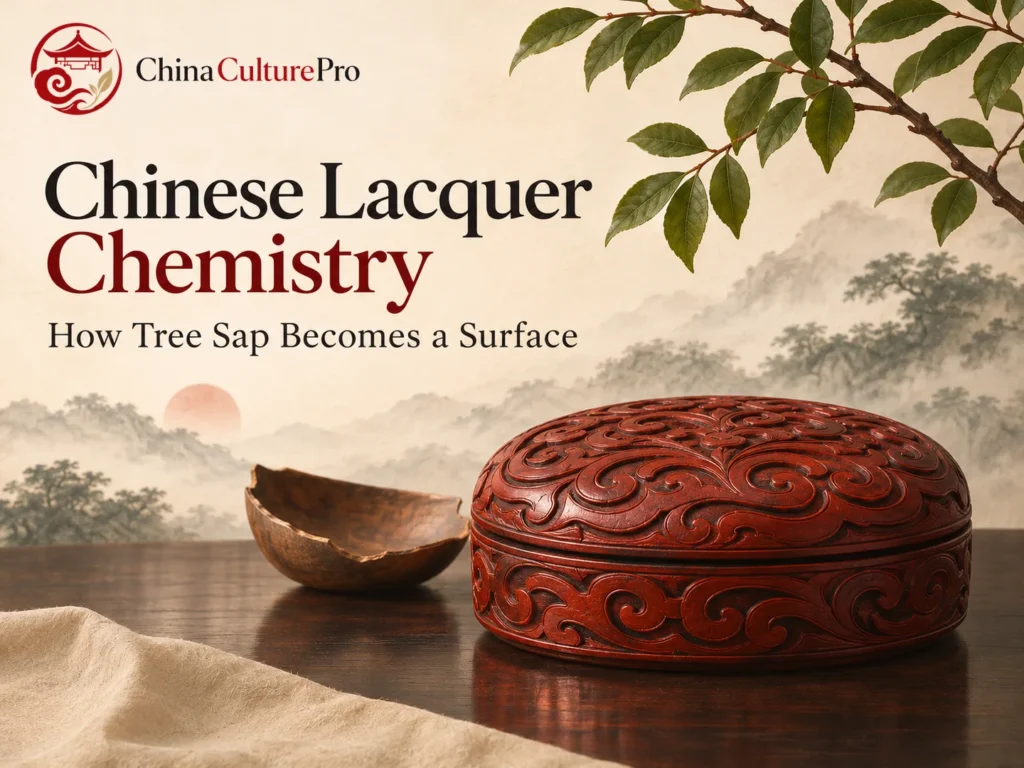
A Yuan box may look solid red from across the room. Follow its carved grooves more closely and you can see lines of another color, exposed where a maker cut through the finished layers.
From Tree Sap to a Solid Film
The lacquer tree’s sap contains a mixture of urushiol compounds, water and other components. Laccase helps oxidize urushiol in the presence of oxygen. During curing, molecules link together to form a continuous solid coating. The hardening is more than the loss of water from the surface.[3][4]
Moisture conditions also affect how natural lacquer cures. That makes it different from the familiar idea of a coating that hardens simply because its thinner has evaporated.[4]
Why Some Lacquer Objects Have Many Layers
A lacquer coating can cover a wooden or other shaped body. On some pieces, repeated applications build up a thicker surface for carving. A late Yuan box in the Metropolitan Museum of Art uses red and black layers. The carved grooves reveal bands of black beneath the dominant red.[5]
The box shows one form of Chinese lacquerware. A thin painted coating and a carved finish use the same broad material category to achieve different effects.
What an Excavated Surface Can Tell Us
A red-coated wooden bowl from Hemudu culture in Zhejiang gives evidence of an early use of the material. Its surviving wooden body and the study of its coating help connect the appearance of the bowl to the substance applied to it.[1][2]
Burial can alter a lacquer film. Studies of excavated material from Shanxi examine how such films respond to their surroundings. A surface preserved in the ground may carry evidence of what happened after manufacture as well as evidence of the original work.[6]
A Lacquer Film and a Ceramic Glaze
Natural lacquer and ceramic glazes can both look glossy. The lacquer becomes a solid organic coating as its molecules link together. A glaze develops a glasslike surface in a firing. On a bronze mirror, finishing can instead produce shine by smoothing the metal surface.
FAQs About Chinese Lacquer Chemistry
Does lacquer harden just because water evaporates?
The sap undergoes oxidation and polymerization. These chemical changes help create the solid coating.[3][4]
Why can a carved box show more than one color?
The carving can expose colored layers beneath the surface. The Met’s Yuan box includes both red and black lacquer.[5]
Is lacquer a glaze?
Natural lacquer is an organic coating made from tree sap. A ceramic glaze forms a glasslike layer during firing.[3]
出典
[1] 故宮博物院。 Lacquerware collection
[2] China Intangible Cultural Heritage Network. 漆芸
[3] Scientific Reports. Polymerization mechanism of natural lacquer sap
[4] Polymers. Research on the curing mechanism of Chinese lacquer
[5] The Metropolitan Museum of Art. Yuan box with pommel scroll
[6] Heritage Science. Warping behavior of ancient lacquer films excavated in Shanxi