

Quick Answer: What Shapes Chinese Culture in Laos?
Chinese communities in Laos formed through several routes. Migrants came from Yunnan into northern Laos, while merchants from southern China reached Mekong towns through other parts of Southeast Asia. [1][2]
- Trade. Merchants and shopkeepers settled in places including Vientiane, Savannakhet and Pakse. [1]
- Community life. Schools, temples and associations gave families places to maintain language and traditions. [1][2]
- New migration. Many long-established families left after 1975. A different period of trade and settlement began in the 1990s. [3]
The route and period of arrival help explain why communities in different Lao towns developed differently.
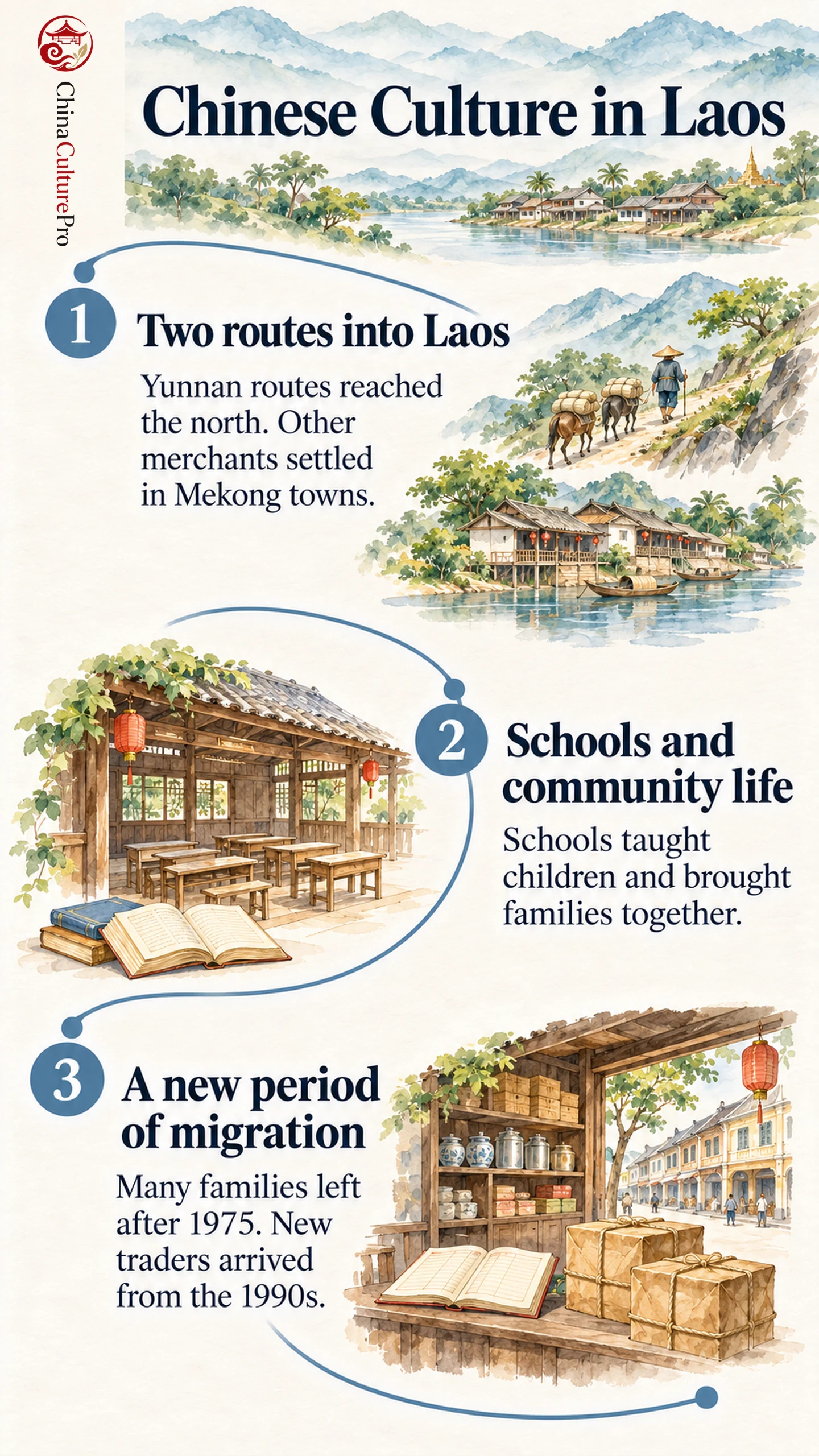
A Chinese school procession in Luang Prabang and a family shop in Pakse tell different parts of the Chinese Lao story. Both grew out of migration networks that crossed borders long before the modern railway.
Yunnan Routes and Mekong Trading Towns
In northern Laos, a study published in 1961 documented families with roots in Yunnan around Phongsaly. In central and southern towns, another route was common. Some migrants had already lived in Vietnam, Cambodia or Thailand before moving inland to Laos. [1][2]
Among migrants to these trading towns were speakers of Teochew (潮州, Cháozhōu) and Hakka (客家, Kèjiā), as well as people from Hainan. The Teochew connection links this history with Chinese communities in Cambodia. The mix varied by town and migration route. [1][2] Yunnan’s overland connections also shaped settlement in northern Myanmar.
Schools, Temples and Public Life
Chinese schools in towns such as Vientiane provided formal education in a community setting. Associations and temples also brought families together. In one mid-twentieth-century Buddhist anniversary procession in Luang Prabang, Chinese schoolchildren carried a lit paper dragon to the royal palace. [1][2]
Migration After 1975
The change of government in 1975 led many established families to leave Laos. Improved relations with China around 1990 brought traders and later new business associations. In 2025 a research center in Vientiane was launched to document Chinese migration and community life. [3][4]
FAQs About Chinese Culture in Laos
Did all Chinese migrants in Laos come from Yunnan?
Yunnan was especially important to northern settlements. Other communities included families from Guangdong and Hainan, some of whom reached Laos through other Southeast Asian countries. [1][2]
What role did Chinese schools play in Laos?
They provided an institutional setting for education and cultural continuity. Pupils sometimes took part in public events alongside other communities. [2]
いいえ。性別によって異なる習慣を記した資料もありますが、それがすべての家庭の祝いを制限するわけではありません。赤い卵は男の子にも女の子にも誕生祝いとして用いられ、ほかの誕生日にも登場します。
[1] Perspectives chinoises. La renaissance du fait chinois au Laos
[2] Journal of the Siam Society. The role of the Chinese in Lao society
[3] The China Quarterly. Diaspora governance and Chinese migration in Laos
[4] Xiamen University. Launch of the Laos Overseas Chinese Research Center