

Quick Answer: How Did Chinese Culture Develop in Brazil?
Chinese culture in Brazil developed through several migrations and through the institutions people built after arriving. Early records connect Chinese workers with tea cultivation in Rio de Janeiro. Twentieth-century migration brought people from Taiwan, mainland China, and other places to São Paulo, where businesses, churches, newspapers, and associations became part of community life.[1][2][3]
- Rio de Janeiro. Chinese workers contributed to an early nineteenth-century tea experiment.[1][2]
- São Paulo. Later arrivals built businesses and institutions in several parts of the city.[3]
- Public celebrations. Praça da Liberdade has hosted Lunar New Year programs with lion and dragon dances.[4]
People’s routes, languages, and institutions vary across generations.[2][3]
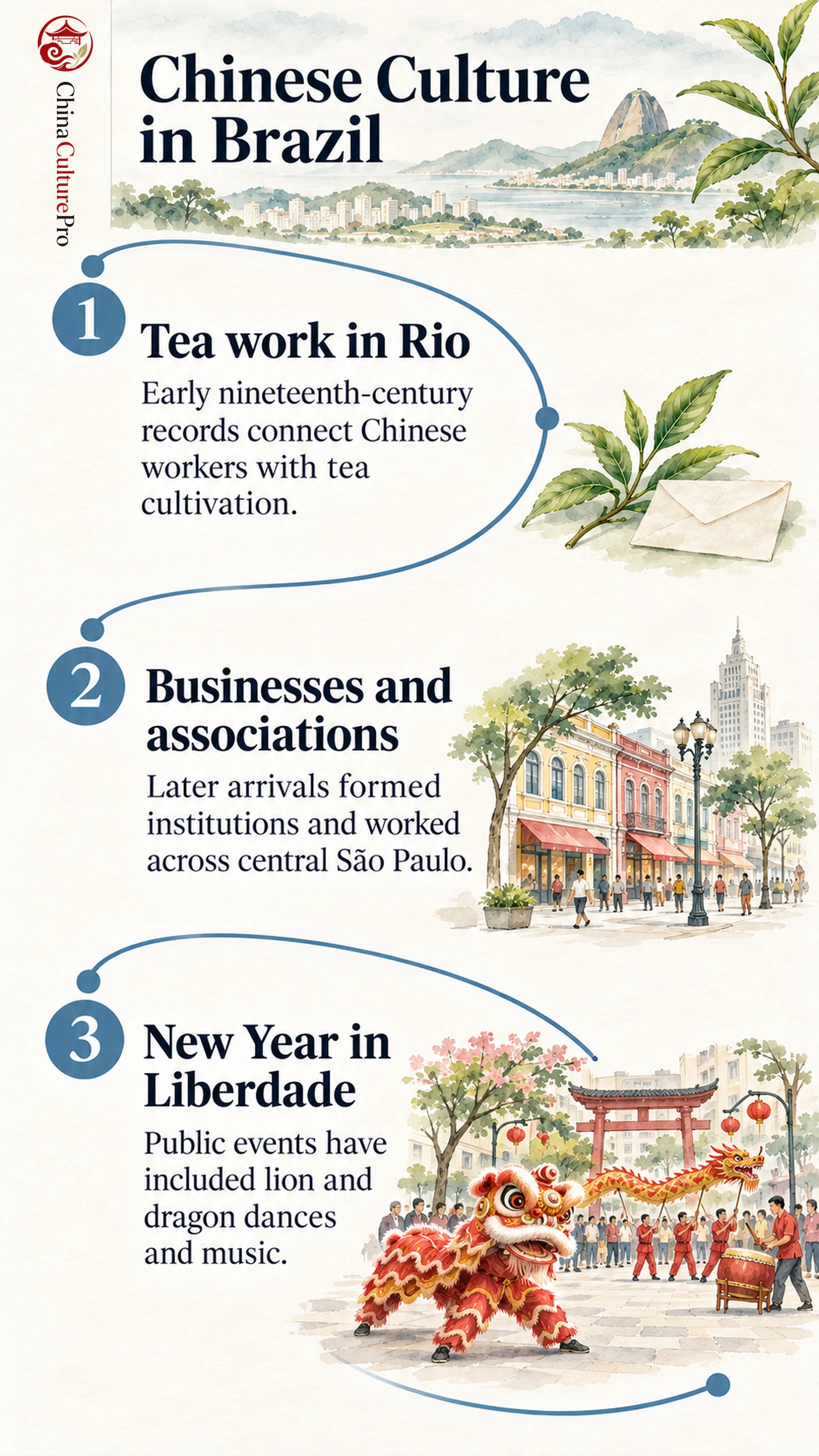
A letter from an early tea worker and a newspaper produced in São Paulo document very different moments. Put them together and you can see how far the history extends beyond a single wave of immigration.[2][3]
The Tea Workers of Rio de Janeiro
Brazil’s National Archives describes a push to cultivate tea in Rio after seeds arrived from Macao in 1812. Chinese workers brought experience in growing and preparing it. The University of São Paulo’s source collection lists an 1812 letter from a worker named A Teng to a shopkeeper in Macao.[1][2]
The same collection lists an 1819 petition from Chinese residents of Rio requesting an interpreter to represent their interests. Alongside the tea records, it shows that migrants also had to negotiate language and representation in their new city.[2]
How Chinese Communities Grew in São Paulo
Research on central São Paulo describes arrivals from Taiwan in the mid-to-late twentieth century, including people who opened groceries and restaurants. Some also formed a Presbyterian congregation in Liberdade. Later arrivals from mainland China contributed to commercial activity around Rua 25 de Março and other parts of the city.[3]
Liberdade became a place for Chinese associations and services alongside its established Japanese institutions. The distribution of homes and shops also illustrates how Chinese diaspora neighborhoods can take forms that differ from a compact Chinatown.[3]
Where Cultural Life Is Visible Today
A São Paulo city program at Praça da Liberdade listed lion and dragon dances and musical arrangements that brought Chinese and Brazilian sounds together. The Brazil–China Friendship Association organized the program. The event is one public expression of a broader Chinese diaspora culture that also lives through smaller institutions and family relationships.[3][4]
FAQs About Chinese Culture in Brazil
Is Liberdade a Chinese-only neighborhood?
Liberdade has a longstanding Japanese presence alongside Chinese associations, residents, and businesses. Researchers also document Chinese commercial activity in other parts of São Paulo.[3]
Where can you find early Chinese migration records?
The University of São Paulo’s migration collection indexes early letters and petitions. These include a worker’s 1812 letter to Macao and a petition from Chinese residents of Rio dated 1819.[2]
出典
[1] Brazil National Archives. Rio de Janeiro Botanical Garden, 1811–1821
[2] University of São Paulo. Documents for the study of Chinese migration to Brazil
[3] Cadernos Metrópole. Brazil–China connections and migration in central São Paulo
[4] City of São Paulo. Chinese New Year in Liberdade