


Quick Answer: What Were Cantonese Diaspora Networks?
Cantonese diaspora networks connected people from parts of southern China with relatives, merchants, and associations overseas. Migrants from places such as Taishan (台山, Táishān) could keep in touch with home through letters and remittances while drawing on district connections abroad.[1][2][3]
- Family ties. Relatives exchanged news, instructions, and financial support.[2][3]
- Intermediaries. Merchants or agents could carry money and messages across borders.[1][2]
- Associations. People from the same district could organize services and mutual aid at their destination.[4][5]
Speech, family connections, and place of origin could overlap. Each relationship could serve a different purpose.[2][4][6]
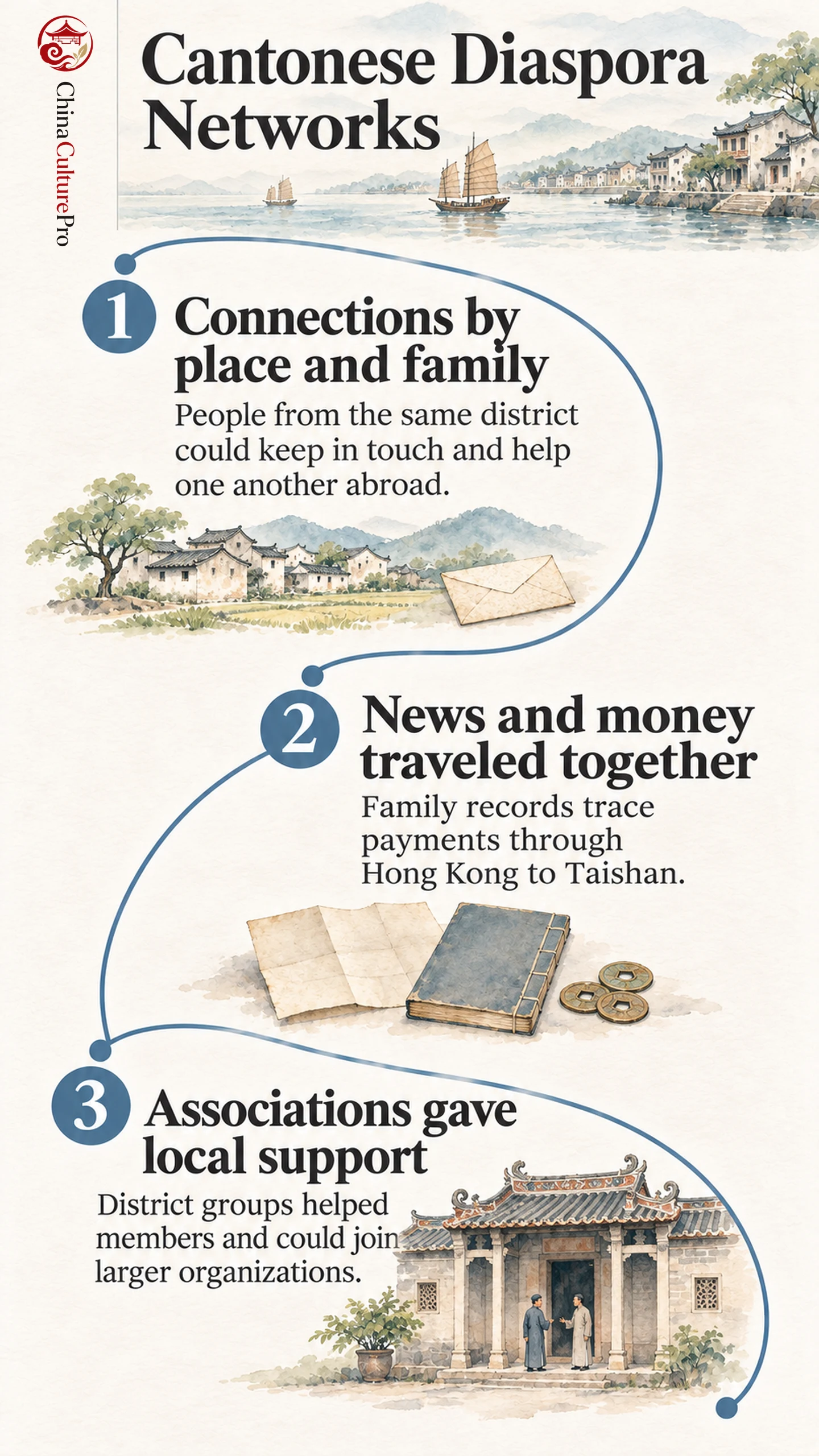
A receipt from Hong Kong and a district association in San Francisco show different sides of the same migration history. One recorded money on its way to a family. The other helped people find support after arrival.[2][4]
Why District and Family Ties Mattered
Historians use family letters and wills to trace Cantonese merchant connections linking Guangdong, Hong Kong, and overseas ports. Family correspondence helps show where merchants lived, traded, and maintained contact with relatives. People from a shared district could also help one another without belonging to the same family.[1][2][4]
The wider Cantonese language community included more than one speech variety. Toisanese, a name for Taishanese used in overseas communities, can be heard in modern readings of Chinese poems from Angel Island. Those recordings help connect written evidence to regional voices.[6][7]
What Letters and Remittances Carried
Collections of qiaopi (僑批, qiáopī) preserve correspondence alongside remittance receipts and accounts. In one case, hundreds of surviving documents from Taishan’s Wu family trace payments between the United States, Hong Kong, and Taishan from 1898 to 1946. Receipts made transactions traceable, and intermediaries helped move money and information.[2][3]
These documents make it possible to connect Chinatowns and qiaoxiang communities through particular people and records. The records can link a person’s address overseas with the household that received a payment.
What Associations Did in Different Cities
In San Francisco, district associations in the Chinese Consolidated Benevolent Association made resources such as housing and job assistance available to members from the areas they represented. An umbrella organization could also speak on broader issues affecting Chinese immigrants.[4]
In Singapore, several Taishan associations supported a regional federation founded in 1947. Its aims included education, welfare, and economic cooperation. These examples show how diaspora dialect and district associations could respond to local needs while reaching beyond a single city.[4][5]
FAQs About Cantonese Diaspora Networks
Is Taishanese the same speech as Hong Kong Cantonese?
They belong to related southern Chinese speech traditions. Taishanese has marked pronunciation differences from the Cantonese commonly associated with Hong Kong and Guangzhou.[6]
Did all emigrants follow the same route?
Routes varied. The Wu family records document one United States–Hong Kong–Taishan connection. The Taishan associations in Singapore grew within a different set of regional connections.[2][5]
出典
[1] Pui-tak Lee, University of Hong Kong Scholars Hub. Cantonese emigration and family business networks
[2] The Development of Humanities and Social Sciences. The Wu family’s remittance letters in Taishan, 1898–1946
[3] UNESCO Memory of the World. Qiaopi and yinxin correspondence and remittance documents
[4] Library of Congress. Community bonds and the Chinese Six Companies
[5] Hong Liu, Journal of Current Chinese Affairs. Transnational Chinese sphere in Singapore
[6] Linguistic Data Consortium, University of Pennsylvania. Cantonese language-specific documentation
[7] Angel Island Immigration Station Foundation. Poetry Finder and regional audio readings