


Quick Answer: What Are Campus Folk Songs in China?
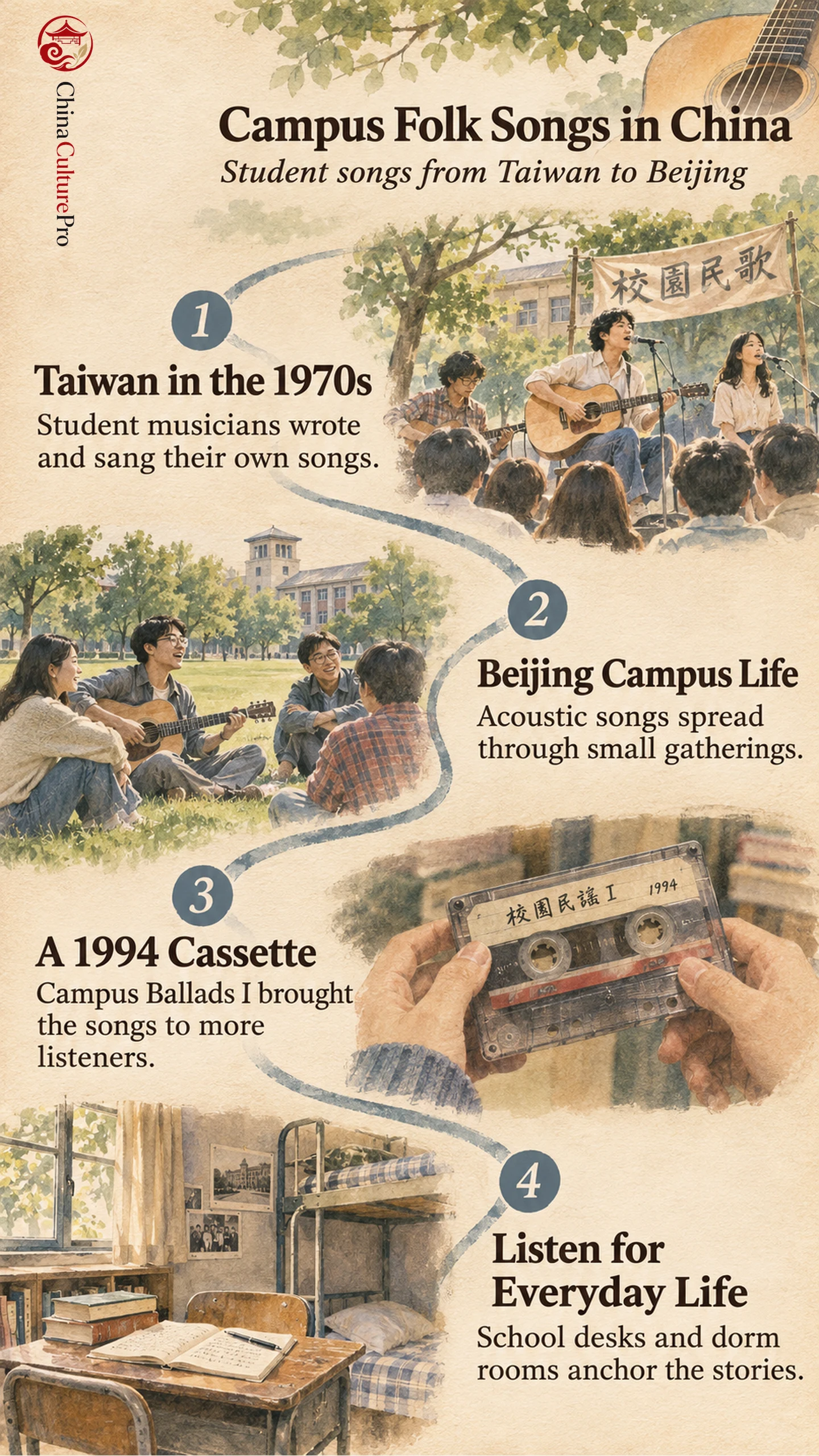
Campus folk songs are modern songs associated with student songwriters and university life. The label in mainland China is xiaoyuan minyao (校园民谣, xiàoyuán mínyáo). It became closely associated with Beijing’s campus songwriting scene and the 1994 compilation Campus Ballads I. Taiwan had a related campus folk song movement in the 1970s that helped inspire mainland listeners and songwriters. [1][2][3][4]
- Sound: Acoustic guitar, a clear melody and conversational singing are useful listening cues. [2][3]
- Themes: Classmates, dorm life and the passage out of school appear in well-known recordings. [3]
- Start here: Lao Lang (老狼, Lǎo Láng) sings “My Deskmate” and “The Brother in the Bunk Above Me” on the 1994 compilation. [3]
The same label can point to Taiwan’s earlier songwriting movement or to the mainland recordings that became popular in the 1990s.
“My Deskmate” starts with a school relationship almost anyone can picture. “The Brother in the Bunk Above Me” shifts the scene to a shared room. Both songs became familiar through a 1994 recording of campus songwriting, when memories of student life found a bigger audience on cassette and in concerts. [2][3]
Taiwan’s 1970s Campus Song Movement
In Taiwan in the 1970s, student musicians developed a modern folk song movement around writing songs in their own language and bringing their own subjects into popular music. International folk recordings and acoustic guitar helped shape the sound. In 1975 Yang Hsien performed a modern Chinese folk song concert that set poems by Yu Kwang-chung to music. A 1976 concert at Tamkang University became associated with Li Shuang-tse’s call for people to sing their own songs. [1][4][5]
The campus-era Golden Melody competitions began in 1977 and offered a path from student songwriting to commercial recording. In mainland accounts, Taiwanese songs such as “Grandma’s Penghu Bay” also appear among the recordings listeners knew before the 1990s Beijing compilation. The guide to Mandopop and Cantopop puts the circulation of Mandarin recordings in a wider language and industry context. [4][5][6]
From Beijing Campuses to the 1994 Cassette
By the late 1980s, campus guitarists in mainland China were writing and singing their own songs. Accounts describe students gathering on campus lawns to share music. These gatherings gave songwriters a small audience before their songs reached recordings or larger concerts. [2][6]
Dadi Records released Campus Ballads I in 1994. A contemporaneous People’s Daily report records eleven songs on the release and describes university concerts and a graduation performance that helped bring it to a broader audience. Lao Lang sang several songs written by Gao Xiaosong, including two that came to define how many listeners remember the genre. [3]
Three Songs to Start With
| 宋 | What to Listen For |
|---|---|
| “My Deskmate” (同桌的你, Tóngzhuō de Nǐ) | Lao Lang sings Gao Xiaosong’s song about looking back on a person who once shared a school desk. [3] |
| “The Brother in the Bunk Above Me” (睡在我上铺的兄弟, Shuì zài Wǒ Shàngpù de Xiōngdì) | Another Lao Lang recording of a Gao song. The dorm room gives the memory a concrete setting. [3] |
| “Youth” (青春, Qīngchūn) | Shen Qing’s contribution to the compilation offers another songwriter’s perspective on youth and memory. [3][7] |
Listen to how the singer delivers the words before focusing on the accompaniment. An everyday detail such as a school desk can carry the story, while the voice and melody make the song easy to remember. The translated titles here identify the songs. The Chinese titles are useful when looking up recordings. [3][7]
Why the Songs Outlasted Their Campus Setting
The 1994 release brought songs written by students to listeners at other universities and beyond. The songs gave familiar memories specific settings, from a shared desk to a dorm bunk. The songs are often heard as memories of youth even by people who encountered them after the original cassette era. [2][3][7]
Campus folk is one strand of modern songwriting. The guide to Chinese folk-music revival covers a different question, how musicians bring older repertories and practices back into public life. A campus song may share an acoustic sound with other folk styles, while its subject and performance history point back to student life. [1][2][6]
FAQs About Campus Folk Songs in China
Who sang “My Deskmate”?
Lao Lang sang the recording on Campus Ballads I, released in 1994. Gao Xiaosong wrote the song. [3]
Were Taiwan and mainland campus folk songs part of the same movement?
They had separate scenes and timelines. Taiwan’s student songwriting gained visibility in the 1970s. Taiwan’s recordings helped influence mainland listeners before the mainland compilation appeared in 1994. [1][2][4][6]
Are campus folk songs traditional folk songs?
The genre described here consists of modern compositions, many with named writers. The term folk refers to a musical approach and scene that often favored guitar and direct songwriting. [1][2][3]
出典
[1] Yeh En-Tsz, National Taiwan University. Construction and Transformation of Taiwan Campus Folk Songs’ Culture
[2] China Culture. Development of Campus Ballads in Mainland
[3] People’s Daily archive. A Contemporary Account of Campus Ballads I (September 3, 1994)
[4] Kate Liu, Fu Jen Catholic University. Important Historical Dates in the Development of Taiwanese Musical and National Identity
[5] National Chengchi University academic repository. Tracing Li Shuangze: Listening to the Screams of Taiwan in the 1970s
[6] Chaoxing course material. A Brief History of Chinese Popular Music: The Rise of Campus Folk
[7] The Paper. A Retrospective on Shen Qing and Campus Folk