


Quick Answer: What Does Zuo Jing Guan Tian Mean?
Zuo Jing Guan Tian (坐井观天, zuò jǐng guān tiān) literally means “to sit in a well and look at the sky.” It describes someone who mistakes a restricted view for the whole picture. The Tang essayist Han Yu (韩愈, Hán Yù) uses the image of a small patch of sky to make that mistake visible.[1][2]
- The image: From the bottom of a well, you see only what the opening frames.[1][2]
- The judgment: The idiom criticizes conclusions drawn from a narrow range of experience.[2]
- The frog connection: A separate classical passage about a well frog makes a related point. Some teaching retellings combine the images.[3][4]
The strongest use points to a broad judgment that someone has made on the basis of limited experience.
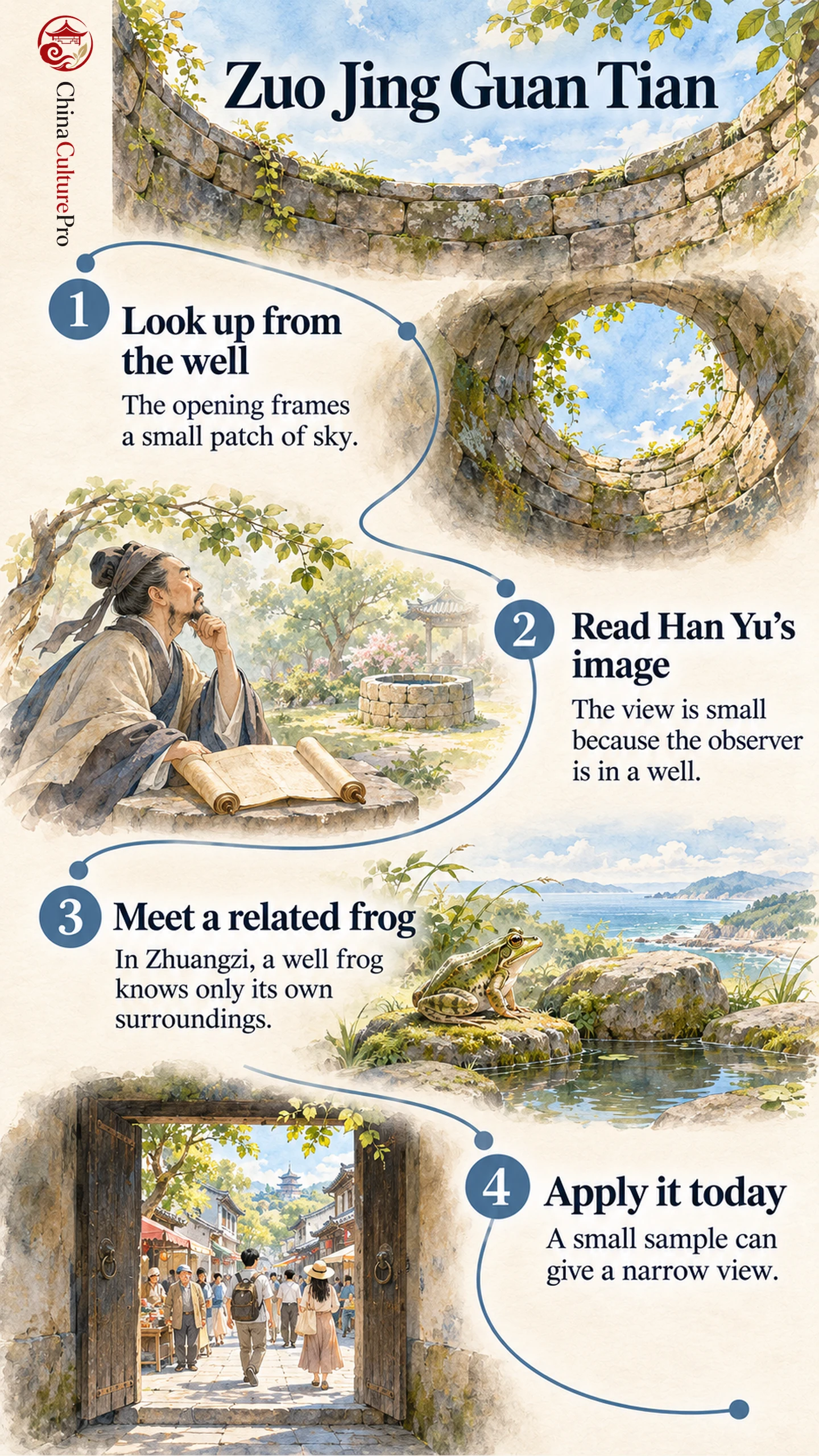
The sky above the well looks like a small circle. Han Yu used that ordinary sight in an argument about how to understand some of the largest ideas in Chinese thought.[1][2]
Why Han Yu asks readers to imagine a well
In On the Origin of the Way (原道, Yuándào), Han Yu argues over how central ideas such as benevolence and righteousness should be understood. He presents Laozi (老子, Lǎozǐ) as seeing those ideas in diminished terms. He then compares that perspective to looking up from a well and calling the sky small. The audience can see that the opening, rather than the sky, limits the view.[1][2]
That is Han Yu’s argument in a dispute between traditions. The image draws its force from something both sides can picture. The viewer sees the patch clearly enough. Given the shape of the opening, it is the inference about the size of the sky that fails.[1][2]
Where the frog in the well comes from
The Zhuangzi (庄子, Zhuāngzǐ) uses the related image of a well frog in “Autumn Floods” (秋水, Qiūshuǐ). There the spirit of the Northern Sea says that you cannot discuss the sea with a well frog because its experience is confined to the place where it lives. The remark follows the river spirit’s admission that he had mistaken his swollen river for the finest thing in the world. When he reaches the sea, he cannot see where the water ends.[3]
The popular teaching story about a frog and a bird underlines a similar lesson. The frog looks up and judges the sky by what it can see, while the bird speaks from experience outside the well. Jing Di Zhi Wa (井底之蛙, jǐng dǐ zhī wā), “a frog at the bottom of a well,” names the figure. Zuo Jing Guan Tian describes the act of looking from that restricted position and, by extension, judging the world from it.[2][3][4]
How to use the phrase in modern Chinese
When using the idiom, it helps to name both the small sample and the large conclusion. That shows what the other person is getting wrong instead of only calling them narrow-minded. It can also be self-directed if a speaker has noticed a limit to their own perspective.[2][4]
- A criticism: 只问了几个熟人,就说全城的人都这么想,未免有些坐井观天。 “You asked a few people you know and concluded that the whole city thinks that way. That’s taking your own circle for the whole picture.”
- A self-correction: 和外地同行聊过以后,我才知道自己以前有点坐井观天。 “After talking to people in my field from other places, I realized how limited my view had been.”
These are original examples. “未免有些” makes a criticism less blunt. “我才知道” turns the judgment into an admission about the speaker’s earlier view. The guide to Chinese chengyu shows how other concrete images gain this kind of force in a full sentence.
FAQs About Zuo Jing Guan Tian
Is the person in the well a frog?
A frog appears in related stories about a well. In Han Yu’s passage, the image is simply someone sitting in the well and declaring the sky small.[1][3][4]
Can you use it about yourself?
Yes. You can use it to acknowledge that your experience gave you a smaller view than you once assumed. Saying it of someone else usually sounds critical.[2][4]
How can you translate it naturally?
“Taking a narrow view” is concise. “Mistaking a small part for the whole picture” explains the reasoning more directly. Keep “looking at the sky from the bottom of a well” when the image matters.[1][2][4]
出典
[1] Han Yu, Wikisource. On the Origin of the Way
[2] 台湾教育部。 Dictionary of Chinese Idioms, Zuo Jing Guan Tian
[3] Wikisource. Zhuangzi, Autumn Floods
[4] China Plus. Look at the Sky from the Bottom of a Well