
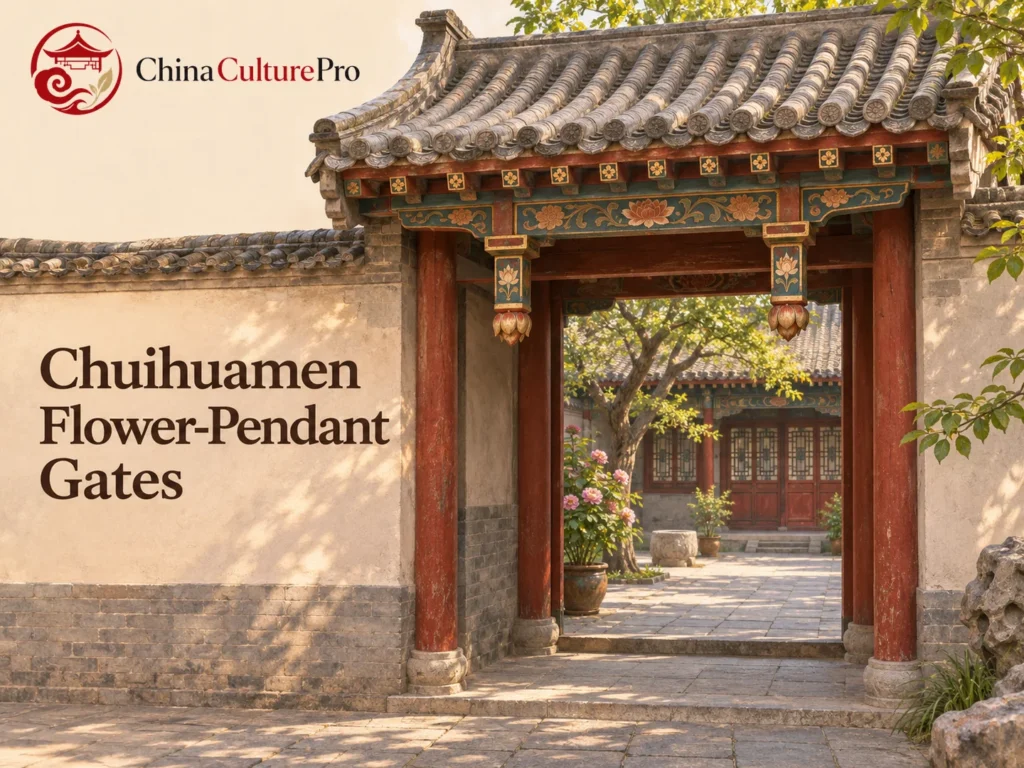

Quick Answer: What Is a Chuihuamen?
A flower-pendant gate (垂花门, chuíhuāmén) is a roofed gateway often placed between the outer and inner courts of a traditional Chinese compound. Two short timbers hang below the front eaves. Carved flower petals or bead forms on their lower ends give the gate its name.[1][2]
- Look up: The carved ends stop in the air, above the entrance.[1][2]
- Check the approach: In a classic Beijing courtyard layout, the gate stands beyond the main street entrance.[2][3]
- Look through: The passage leads toward the main court, sometimes with covered corridors to either side.[3][4]
The hanging ornaments identify the form more reliably than the color of the doors or tiles.[1][5]
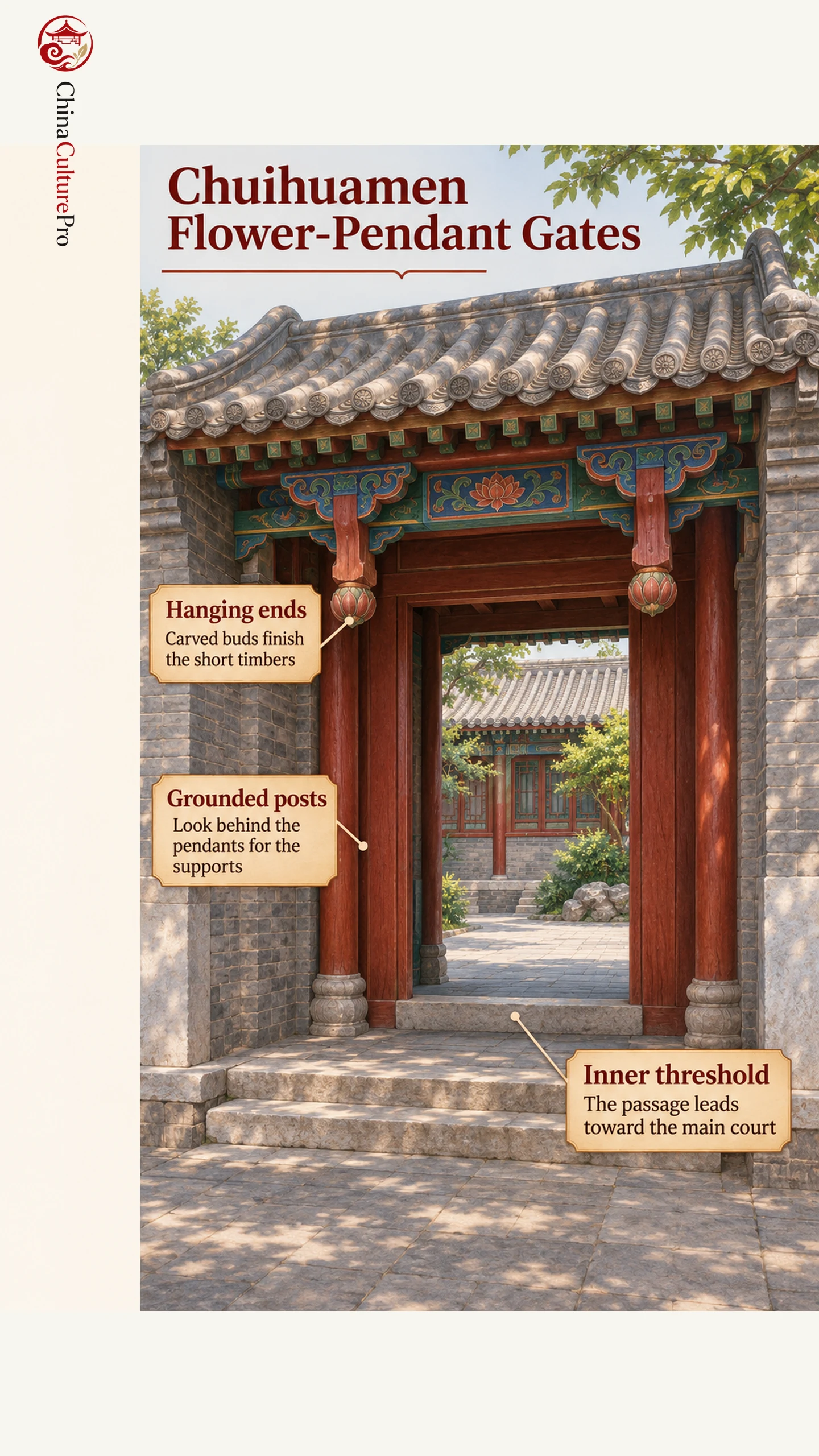
A roof and a pair of decorated timbers mark a change in the route through the house. Look at the gate from the front, then from the side, to see how it frames the passage.[1][2]
The Two Pendants Under the Eaves
The Palace Museum describes a front without full-length posts under the eave purlin. The two short, downward-facing members hang from the frame and leave the space below clear. A carved horizontal timber may span between them, and painted decoration can cover other parts of the frame. The carved ends often resemble a lotus bud or layered petals.[1]
From the side, look behind the hanging ends for the columns that reach the paving. The Palace Museum describes a center-post form in which a row of upright posts across the gate carries an eave beam. The gate can also include more than one roof section. In the form called one hall and one rounded roof (一殿一卷, yī diàn yī juǎn), a rounded roof section is added behind the front structure and has its own supporting columns.[1]
Where the Gate Sits in a Beijing Courtyard
In a multi-court Beijing siheyuan, the gate can stand on the main axis between the outer and inner courts. Historically, that boundary helped distinguish the part of the compound used by guests and servants from the family’s inner spaces. In some houses, covered corridors behind the gate lead off to either side.[2][3][4]
At Dongsi Hutong Museum, the street entrance first leads to a screen wall and a turn into the front court. The flower-pendant gate stands across that court. Go through it and the main courtyard opens beyond. The two gates mark separate points on the route, and the turn between them keeps the main court out of the direct line of sight from the street.[6]
A Palace Example at Jingfu Gate
The Palace Museum identifies Jingfu Gate, built in 1772 by Jingfu Palace, as a flower-pendant gate. Green glazed tiles with yellow edging cover the roof. Painted timber is visible beneath the eaves, and four screen leaves stand inside the doorway. The Palace Museum records the same form here at the west side of a small palace forecourt. The position differs from the familiar placement between the outer and main courts of a house. Look for the hanging members as well as the position in the plan.[5][6]
FAQs About Chuihuamen Gates
Is a flower-pendant gate the main entrance from the street?
It is commonly the inner gate in a multi-court Beijing house. The street gate leads into the compound before you reach it.[2][3][6]
Does the name refer to flowers hanging from the roof?
It refers to decoration carved into the hanging timber ends. Lotus petals are one documented motif.[1]
Do all flower-pendant gates have the same roof?
The form can use different roof arrangements. One variant joins a rounded roof behind the front section.[1]
出典
[1] The Palace Museum. Flower-Pendant Gate Architectural Glossary
[2] White Rose eTheses. Gates of Late Imperial China
[3] Daniel Benjamin Abramson. The Fate of the Siheyuan
[4] Beijing Daily. Gates and Architectural Details of Old Beijing Courtyard Houses
[5] The Palace Museum. Jingfu Palace and Jingfu Gate
[6] Visit Beijing. Dongsi Hutong Museum