

Quick Answer: What Is the Zhou Surname?
The Zhou surname (周,zhōu) has Mandarin’s first tone. The character also has ordinary word uses, which should be distinguished from explanations of the family name.[1]
- Historical accounts: A traditional compilation records several routes to the surname.
- Character caution: Overlapping word meanings do not justify automatically changing a person’s surname.
- Personal spellings: Zhou, Chow and Chau appear in institutional records for 周.
Neither the dynasty’s name nor a matching spelling proves a particular family relationship.
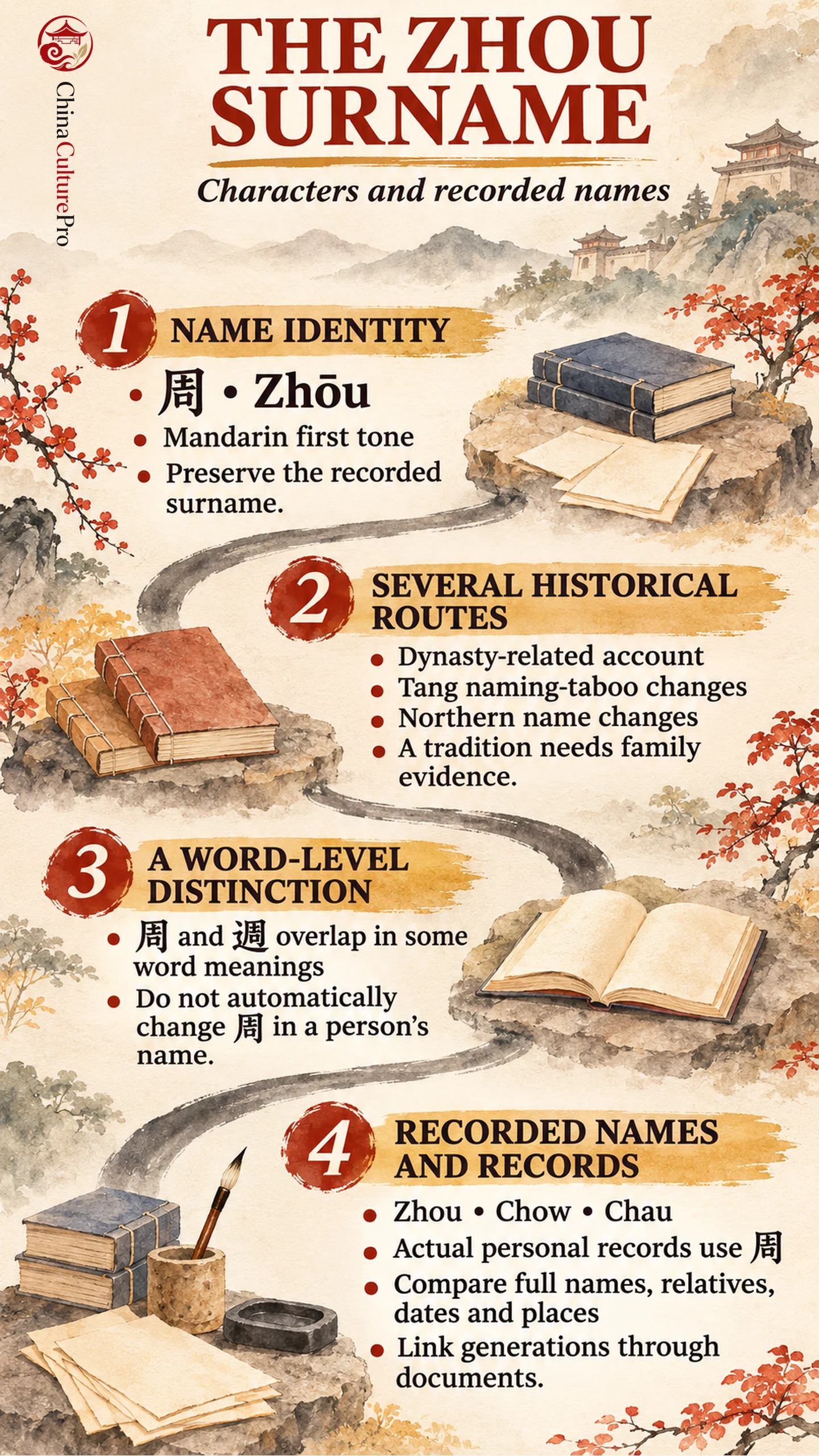
The same character can name a dynasty, identify a person and form part of everyday vocabulary. For family history, the important question is which use a document actually records.
The Character 周: Surname and Ordinary Word Uses
The Ministry of Education lists 周 as a surname pronounced zhōu. Other senses include completeness, surrounding something, a circuit and a week. These word meanings are not separate proofs of how a family acquired its name.[1]
2019 mainland rank: 10th.[8]
Several Historical Routes to the Zhou Name
Tongzhi (通志,tōngzhì), volume 26, connects one tradition with the ancient Zhou ruling house and its Ji (姬,jī) lineage. Its entry also records later name changes. The dynasty-related account is therefore not the compilation’s only explanation.[2]
| Recorded route | What the compilation describes |
|---|---|
| Dynastic association | Use of Zhou by people associated with the former Zhou ruling house.[2] |
| Tang naming taboo | Ji families changing to Zhou to avoid a sound associated with an imperial personal name.[2] |
| Northern name changes | Other family names changing to Zhou in northern historical contexts, including Northern Wei.[2] |
These are accounts preserved in a historical compilation. Assigning a modern household to one of them requires evidence connecting its own generations.
Why a Surname Written 周 Should Not Be Automatically Changed to 週
The week character (週,zhōu) shares several ordinary meanings with 周. The Ministry of Education’s variant dictionary specifically describes 週 as a partial variant, applicable to certain meanings involving extent or circuit.[3][4]
That qualified relationship is not a universal instruction to replace 周 in personal names. When transcribing a record into traditional characters, preserve the person’s recorded surname rather than applying a word-level substitution automatically.
Zhou, Chow and Chau in Personal Records
HKUST records Yuanyuan Zhou (周圆圆/周圓圓,zhōu yuányuán) with the surname spelling Zhou.[5]
Its separate profiles record King Lau Chow (周敬流,zhōu jìngliú) and Ying Chau (周迎,zhōu yíng). All three have 周, despite their different Latin surname spellings.[6][7]
The pinyin annotations give Mandarin readings. They do not change these individuals’ established names, or demonstrate a relationship between their families.
How to Compare Zhou Family Documents
- Copy the full Chinese name and preserve the source’s Latin spelling.
- Compare dates, localities, named relatives and the document’s creator.
- Connect generations through records before choosing a historical surname branch.
FAQs About the Zhou Surname
Does Every Zhou Family Descend from Zhou Royalty?
That cannot be inferred from the surname. Tongzhi records multiple historical routes, including later name changes.[2]
Should the Zhou Surname Be Written 週 in Traditional Chinese?
Do not change 周 automatically. The dictionary’s partial-variant relationship concerns specified word meanings; preserve the surname recorded for the individual.[4]
Can Chow and Chau Both Represent 周?
Yes. King Lau Chow and Ying Chau provide institutional examples. Full names and family evidence remain necessary when comparing records.[6][7]
Fuentes
[1] Ministry of Education. 周: Revised Mandarin Chinese Dictionary
[2] Zheng Qiao. Tongzhi, volume 26: 周
[3] Ministry of Education. 週: Revised Mandarin Chinese Dictionary
[4] Ministry of Education. 週 as a partial variant of 周
[5] HKUST. Yuanyuan Zhou
[6] HKUST. King Lau Chow
[7] HKUST. Ying Chau
[8] Ministry of Public Security, via reproduced report. 2019 National Name Report