

Quick Answer: What Is Xingyiquan?
Xingyiquan (形意拳, xíngyìquán) is a Chinese martial art whose name joins bodily form with intent.
- Its core training includes standing practice, five basic fists and twelve animal methods.
- Repeated short drills connect stepping with hand and body movement.
- Regional branches share foundations but preserve different teaching approaches.
The name describes a martial training tradition, not a promise of effortless power.
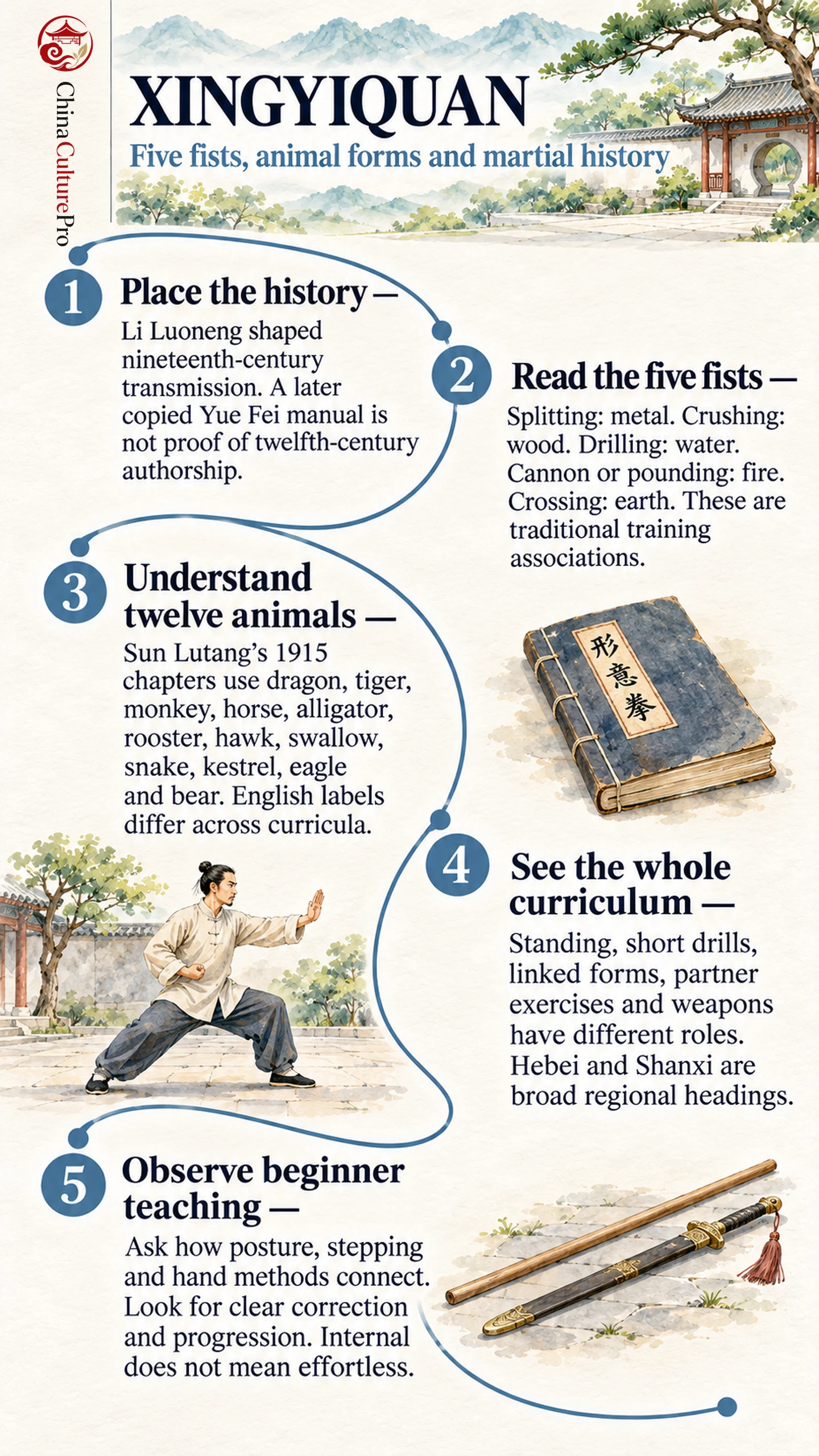
Xingyiquan connects posture, timing, forms, partner work and weapons. Read it as a Chinese martial arts curriculum rather than five isolated punches.[2]
History: Li Luoneng and Earlier Origin Traditions
Li Luoneng (李洛能, Lǐ Luònéng), from Hebei (河北, Héběi), is central to nineteenth-century xingyiquan transmission. A heritage account places his development of the art in Taigu (太谷, Tàigǔ), Shanxi (山西, Shānxī), around the 1860s, following study of Dai-family Xinyiquan (心意拳, xīnyìquán). It names students in both provinces, showing transmission through several teachers rather than one unchanged syllabus.[1]
Sun Lutang (孙禄堂, Sūn Lùtáng) published his xingyi manual in 1915. His preface repeats an origin tradition involving the general Yue Fei (岳飞, Yuè Fēi), yet explicitly identifies the attributed manual he saw as a later handwritten copy. That is evidence of what circulated in Sun’s time, not proof of twelfth-century authorship. Read such accounts with the distinction between history and legend in mind.[3]
Standing, Repetition and the Five Fists
The standing foundation is santishi (三体式, sāntǐshì), or Three Bodies Posture. In the Shenzhou (深州, Shēnzhōu) tradition, it accompanies five-fist and twelve-animal methods. Basic actions recur on alternating sides along a short path: repetition develops a method rather than merely lengthening a routine.[2]
The five fists use the traditional framework of wuxing (五行, wǔxíng), or Five Phases. Their standard associations are:[1]
| Fist | Common English sense | Traditional phase |
|---|---|---|
| Piquan (劈拳, pīquán) | Splitting | Metal |
| Bengquan (崩拳, bēngquán) | Crushing | Madera |
| Zuanquan (钻拳, zuānquán) | Drilling | Agua |
| Paoquan (炮拳, pàoquán) | Cannon or pounding | Fuego |
| Hengquan (横拳, héngquán) | Crossing | Tierra |
These are training categories. Splitting suggests a descending quality, drilling a rising quality, crushing a direct release, cannon an explosive action, and crossing a transverse action. A teacher must connect those labels to coordinated movement; the English noun alone cannot teach the method.[4]
The phase names also place practice within a broader vocabulary of generating and controlling relationships. They do not establish that a fist mechanically repairs its traditionally associated organ.[1]
Twelve Animals: A Named Example and Translation Differences
The twelve animals offer another way to organize movement qualities. Sun’s 1915 chapters cover dragon, tiger, monkey, horse, alligator, rooster, hawk, swallow, snake, a bird rendered as kestrel in the English translation, eagle and bear. His book also joins animal material into a combined sequence; the chapters are parts of a training system, not a collection of wildlife impersonations.[3]
Animal labels need their curriculum attached. A contemporary teaching list in the Che Yonghong (车永宏, Chē Yǒnghóng) lineage, for example, uses turtle, falcon and Tai Bird or Water Walker among its English labels. This differs from the alligator, hawk and kestrel wording above. Do not conclude from an English label alone that two teachers mean identical methods—or entirely unrelated ones. Check the original name and the sequence being taught.[5]
Branches, Linking Forms and Weapons
Hebei and Shanxi are broad regional headings. Xinyi Liuhequan (心意六合拳, xīnyì liùhéquán) is an important antecedent. A three-region classification also includes Henan (河南, Hénán), but the Shenzhou heritage account qualifies that category as xinyi. These names do not identify interchangeable curricula.[2]
A five-fist drill is also different from a linked form. Sun’s manual distinguishes solo material from paired practice and includes connected sequences. Ask whether a demonstration shows one repeated method, a linked routine or a partner exercise; each has a different job.[3]
The wider curriculum includes martial arts weapons such as sabre, spear, straight sword and staff. Knowing the five hand methods therefore does not mean knowing the whole tradition. Compare specific syllabuses within the broader map of Chinese styles.[2]
How to Read a Beginner Curriculum
When observing a class, ask three useful questions:
- Foundation: How are standing posture, stepping and the first fist drills connected?
- Correction: What feedback helps a learner coordinate the body rather than simply move the arm?
- Progression: When do linked forms, partner work and weapons enter this particular curriculum?
These questions reflect actual teaching components, not a universal grading ladder. One contemporary curriculum begins with standing and early five-element work and uses controlled cooperative applications rather than regular free sparring. Another school may organize practice differently. Discuss the actual lesson, including manageable demands and training etiquette.[4]
The label internal should not be read as gentle, passive or free of physical effort. In a 1929 essay, Sun challenged rigid internal-versus-external divisions and treated hardness and softness as capacities developed through training. The classification is historical vocabulary, not a substitute for observing what a class does.[6]
FAQs About Xingyiquan
Is xingyiquan only straight-line punching?
No. Standing, animal methods, linked forms, partner exercises and weapons extend beyond direct punching.[2]
Did Yue Fei invent xingyiquan?
That is an origin tradition. Sun’s own account of seeing a later copy does not verify a surviving manual written by Yue Fei.[3]
Is xingyiquan the same as xinyiquan?
Their histories connect, but the names need a specific branch and teacher attached.[2]
Does internal mean gentle or effortless?
No. It is a classification, not a guarantee about intensity. As with tai chi (太极拳, tàijíquán) and baguazhang (八卦掌, bāguàzhǎng), examine the actual training demands.[6]
Fuentes
[1] China Intangible Cultural Heritage Network. Xingyiquan: Taigu heritage entry
[2] China Intangible Cultural Heritage Network (Red del Patrimonio Cultural Inmaterial de China). Xingyiquan: Shenzhou heritage entry
[3] Sun Lutang; translated by Paul Brennan. A Study of Xingyi Boxing, 1915
[4] The Moral Dragon. Hebei Xingyiquan teaching FAQ
[5] Taiji Qigong Luxembourg. Che Xingyiquan curriculum overview
[6] Sun Lutang; translated by Paul Brennan. Discussing Distinctions Between the Internal and External Schools, 1929