

Quick Answer: What Is a Xiehouyu?
A xiehouyu(歇后语,xiēhòuyǔ)is a Chinese saying built around a setup and an explanatory or revealing second part. The first presents an image or situation; the second supplies the point the speaker wants to make.[1]
- Structure: Two connected parts create a small interpretive turn.
- Meaning: The connection may involve metaphor, wordplay or a familiar story.
- Reading: The literal picture and the intended comment are different layers.
Not every example is a pun, a four-character phrase or a riddle to answer literally. Understanding the connection matters more than memorizing the two halves as unrelated lines.

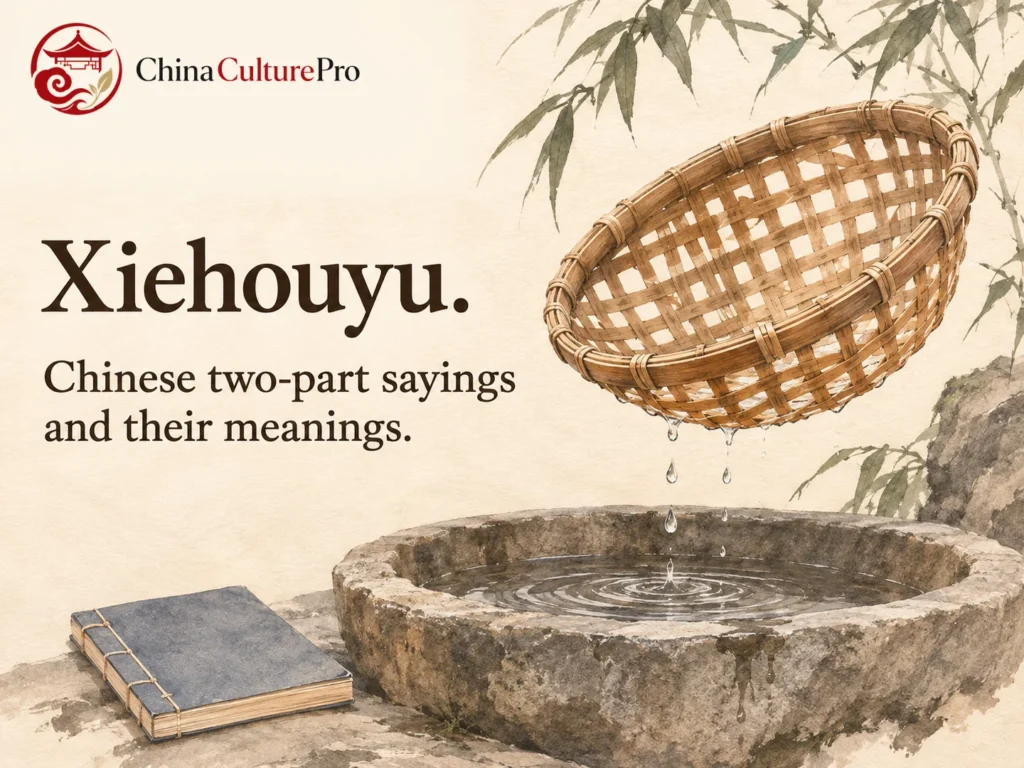
A bamboo basket cannot hold water in the image behind one familiar saying, so the result is “all for nothing.” Another saying depends on the sound of the word for an uncle. Xiehouyu makes everyday objects, family words and remembered stories do expressive work, giving a listener something to recognize and then reinterpret.
The Two-Part Structure
The setup creates a scene. The reveal turns that scene into a comment about a person, action or situation. What joins them may be a straightforward consequence, a figurative shift or an extra layer of similar-sounding words.[2]
A dash often makes the division visible in print. It marks the written separation; spoken delivery depends on the context. The important boundary is between the image and the point drawn from it.
Dictionaries may index only the setup, placing the explanatory half at the beginning of the definition.[3] A reader who finds a short headword has therefore not necessarily found an incomplete entry. Look for how the dictionary organizes the expression before deciding that its answer is missing.
The form gives the speaker an image as well as a direct comment. The listener moves from a concrete situation to a meaning that fits the conversation. Without that connection, two colorful phrases beside each other would not perform the same job.
Metaphor, Homophones and Story Allusions
Three examples show different connections. The pinyin below gives Mandarin readings; the English explains each expression rather than replacing it with an unrelated English proverb.
- Image-based meaning: 竹篮儿打水——一场空(zhú lánr dǎ shuǐ — yī cháng kōng)pictures drawing water with a bamboo basket and ending with nothing. Water leaks through the woven basket, so the expression comments on wasted effort. The dictionary form here includes an r-colored ending on “basket.”[4]
- Sound-based wordplay: 外甥打灯笼——照舅(照旧)(wài shēng dǎ dēng lóng — zhào jiù)pictures a nephew carrying a lantern to illuminate his maternal uncle. The word 舅, “maternal uncle,” sounds like 旧, “old” or “previous.” The result points to 照旧, “as before” or “unchanged.” The family relationship makes the pun possible.[5]
- Story-based allusion: 八仙过海——各显神通(bā xiān guò hǎi — gè xiǎn shén tōng)evokes the Eight Immortals crossing the sea, each using a different power. In ordinary use, it describes people applying their own abilities toward a goal. The supernatural scene belongs to the legend; the figurative comment concerns individual skills.[6]
The basket works through its visible result, the lantern adds a sound substitution, and the sea-crossing example depends on a remembered narrative. Reading all three as literal instructions would miss their purpose.
Xiehouyu, Chengyu and Proverbs
English “saying” can cover several categories. These distinctions help identify how an expression is working, without making the boundaries completely exclusive.[1][7][8]
| Categoría | Typical form | En qué fijarse |
|---|---|---|
| Xiehouyu | A setup connected with a revealing second part | How the image leads to the intended point |
| Chengyu(成语,chéngyǔ) | A fixed idiomatic phrase, often four characters | Its established figurative use and context |
| Yanyu(谚语,yànyǔ) | A traditional popular proverb | The observation or advice expressed by the whole saying |
“Four characters” is a useful association for many idioms, not a definition of every Chinese expression. Nor does a proverb need to recreate the setup-and-reveal structure. The broader comparison of Chinese idioms and proverbs explores those neighboring categories.
A dictionary’s classification can help, but the immediate reading task is still practical: identify the expression’s parts and the meaning they convey. A saying may draw on an idiom or become an established expression in its own right.
Speaking, Writing and Regional Variation
A shared expression can be economical because the audience already knows the image and its implication. With an unfamiliar listener, giving the full form and explaining the connection is usually clearer. Shortening it is a choice that depends on shared knowledge, not a rule that the second half must always disappear.
Wordplay adds another complication. A cultural analysis notes that the sound connection can involve identical or similar readings, with regional pronunciation and literary versus colloquial readings affecting the relationship.[2] The Mandarin examples in this article do not prove that the same pun works identically in every Chinese language or variety.
Tone and audience also matter. A vivid comparison can sound affectionate, playful, mocking or dismissive in its setting. Before applying one to another person, check both its dictionary meaning and its tone in the actual conversation or passage.
Reading and Translating a Xiehouyu
Separate the literal image from the intended meaning first. Then ask whether the connection relies on a physical result, a second sense of a word, similar sounds or a story. That question gives the reader a reason for each half instead of treating the reveal as an arbitrary answer.
For a sound-based example, the Pinyin guide can help interpret a recorded Mandarin reading, but spelling alone does not explain the cultural reference. For the lantern example, an English translation needs to state both the uncle image and the “as before” meaning. English words for those ideas do not reproduce the Chinese homophone.
In a translation, a short explanation may therefore be more informative than a literal phrase alone. Preserve the particular image when it matters to the scene, and make the intended comment clear. If a dictionary records variant wording, check the version actually used in the source rather than silently replacing it with another familiar form.
FAQs About Xiehouyu
Are all xiehouyu puns?
No. Some depend on metaphor or a familiar story; others add homophones or similar-sounding words.
Can you say only the first half?
Use the shortened form only when the listener can recognize its completion. For an unfamiliar audience, give both parts and explain the connection.
Are xiehouyu always four characters long?
No. Their defining feature is the relationship between setup and reveal, not a fixed character count.
Can a literal English translation explain a xiehouyu?
Sometimes the image is clear, but a pun or allusion often needs an added explanation of the intended meaning.
Fuentes
[1] Ministry of Education, Taiwan. Revised Mandarin Dictionary: Xiehouyu
[2] Academy of Chinese Studies. How the Parts of a Xiehouyu Connect
[3] Ministry of Education, Taiwan. Revised Dictionary: Xiehouyu Editorial Format
[4] Ministry of Education, Taiwan. Revised Dictionary: Drawing Water with a Bamboo Basket
[5] Mandarin Daily News. Homophones and the Nephew-with-a-Lantern Saying
[6] Ministry of Education, Taiwan. Concise Dictionary: The Eight Immortals Crossing the Sea
[7] Ministry of Education, Taiwan. Concise Dictionary: Chengyu
[8] Ministry of Education, Taiwan. Concise Dictionary: Yanyu