


Quick Answer: When Is Xiaohan, Minor Cold?
Xiaohan (小寒, Xiǎohán), or Minor Cold, is the 23rd of the 24 solar terms. It begins when the Sun’s apparent ecliptic longitude reaches 285 degrees. The Hong Kong Observatory dates it to January 5 in 2026 and 2027. [1][2][3]
- Where it falls: Xiaohan follows Winter Solstice and comes before Major Cold. [1]
- Season: The name marks a part of winter. Local temperatures vary and can be lower during Minor Cold than during Major Cold. [4]
- Local foods: Nanjing has a tradition of vegetable rice (菜饭, càifàn). Guangzhou is known for savory glutinous rice (糯米饭, nuòmǐfàn). [5][6][7]
The Observatory also calls it Moderate Cold. Both translations refer to Xiaohan. [1][4]
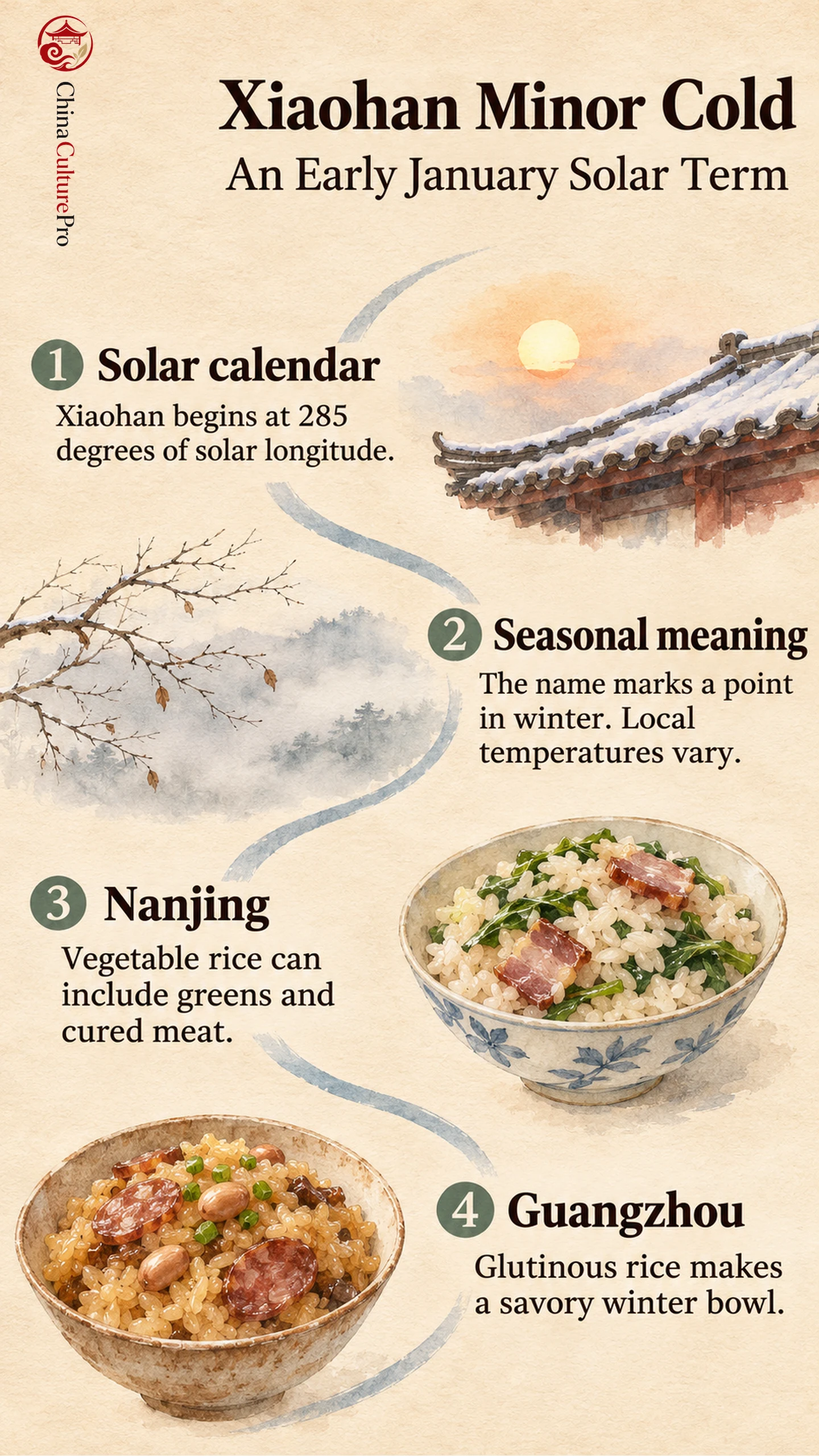
In Nanjing, a bowl of rice cooked with winter greens and cured meat is associated with Xiaohan. Guangzhou has its own cold-season bowl, often made with glutinous rice, cured meat and peanuts. The two dishes mark the same point in the calendar with ingredients familiar to their cities. [5][6][7]
The Calendar Date and Its Place in Winter
The 24 solar terms are spaced 15 degrees apart along the Sun’s apparent annual path. Xiaohan follows Winter Solstice at 270 degrees and precedes Major Cold at 300 degrees. Its starting moment is the crossing at 285 degrees. The Hong Kong calendar puts that crossing in early January. [1][2][3]
Minor Cold and Major Cold name consecutive solar terms. China Meteorological Administration’s newspaper notes that in many parts of China average temperatures during Minor Cold are lower than during Major Cold. The names preserve a seasonal sequence, while the timing of the coldest weather varies by location and year. [4]
From the Winter Solstice to the Coldest Weeks
Xiaohan comes near the third group of nine days, or sanjiu (三九, sānjiǔ), in the seasonal practice of counting nine-day periods from Winter Solstice. The nine-day count begins at the solstice, while Xiaohan begins at its own solar longitude. The two methods bring this part of winter into focus from different directions. [4][5]
The days are already lengthening in the Northern Hemisphere after the solstice. The extra daylight at this point does not immediately reverse seasonal heat loss, which helps explain why very cold spells often arrive after the shortest day. [1][4]
Two Local Rice Traditions
Nanjing’s local gazetteer office describes vegetable rice cooked with a local winter green and ingredients that might include cured pork, sausage or salted duck. Recipes vary from one household to another. The gazetteer names a local short-stemmed green and describes versions seasoned with chopped ginger. [5][7]
In Guangzhou, a hot bowl of glutinous rice is associated with cold weather. China Daily describes a Cantonese Xiaohan breakfast with glutinous rice, cured pork, sausage and peanuts. The two dishes can share cured meats, but the Nanjing description emphasizes greens while the Guangzhou example emphasizes sticky rice with savory toppings. [5][6][7]
FAQs About Xiaohan and Minor Cold
Is Xiaohan always January 5?
The calendar date can vary with the year and time zone. The Hong Kong Observatory lists January 5 for both 2026 and 2027. [1][2][3]
Is Minor Cold always warmer than Major Cold?
The two names mark consecutive solar terms. Recorded average temperatures during Minor Cold can be lower than those during Major Cold in parts of China. [4]
Fuentes
[1] Hong Kong Observatory. The 24 Solar Terms
[2] Hong Kong Observatory. 2026 Gregorian–Lunar Calendar Conversion Table
[3] Hong Kong Observatory. 2027 Gregorian–Lunar Calendar Conversion Table
[4] China Meteorological Administration. Minor Cold and Seasonal Temperatures
[5] Nanjing Local Gazetteer Office. Jinling Solar Term Poetry, Xiaohan
[6] Guangzhou Municipal Health Information Platform. Guangzhou’s Cold-Season Glutinous Rice
[7] China Daily. A Time to Celebrate Tradition