
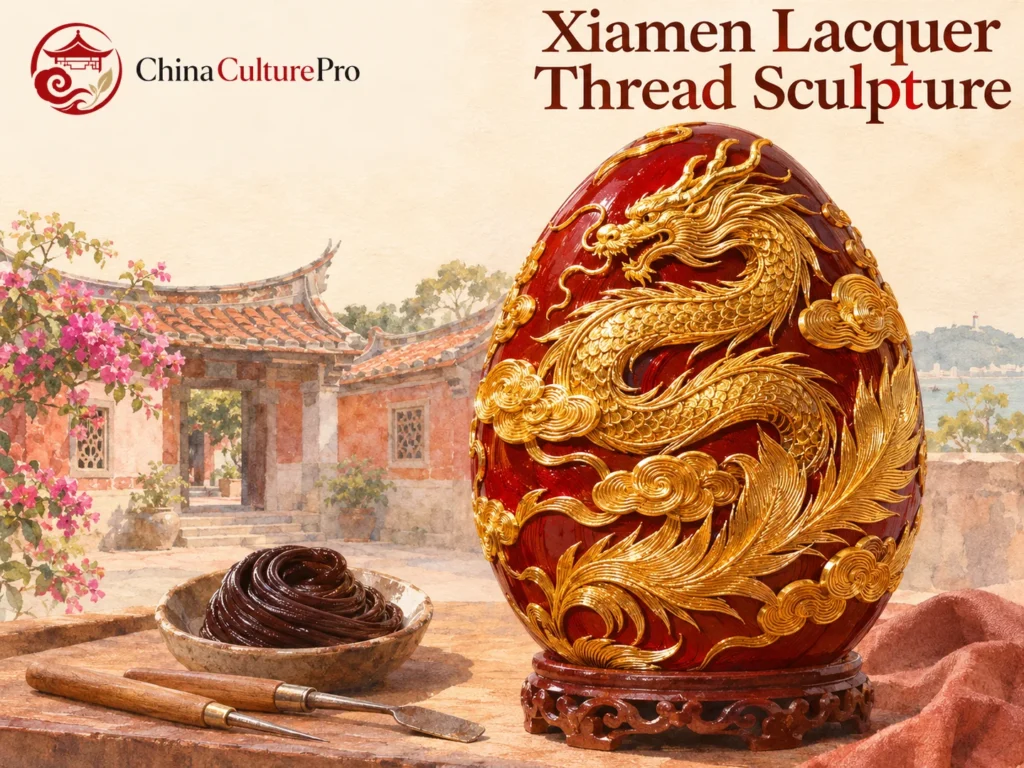

Quick Answer: What Is Xiamen Lacquer Thread Sculpture?
Xiamen lacquer thread sculpture (厦门漆线雕, Xiàmén qīxiàndiāo) creates raised decoration on an object with fine strands of a lacquer-based paste. Makers roll the strands by hand and bend them into curves, knots and layered patterns. The relief can then receive gold leaf or painted color.[1][2][5]
- Base: A sculpture or other prepared object supports the decoration.[1]
- Thread: Rolled paste forms the raised lines on that surface.[1][2]
- Finish: Gold or paint can change how the raised pattern catches the light.[1][2]
The Xiamen tradition grew out of sculpture decoration and entered China’s first national intangible heritage list in 2006.[1]

A gilded line can look like a narrow stroke of paint from the front. Turn the object toward the light and the line has a side and a shadow. The raised pattern sits above the prepared body, where its curves follow the shape underneath.[1][2]
How Raised Lacquer Lines Are Made
The national account identifies lacquer-thread paste (漆线土, qīxiàntǔ) as a malleable mixture traditionally made with materials including aged brick powder, natural lacquer and processed tung oil. The result is worked into fine strands. Once placed on a prepared surface, the strands can be coiled, crossed or piled to give the motif height.[1][2][5]
The cordlike shape gives the material its name. One strand can outline a form. Several close strands can build up a border or create a change in depth. A side view can reveal separate ridges where the strands lie side by side or pass over one another.[1][5]
Reading the Base, Pattern and Gilded Finish
| Nivel | Qué aporta | En qué fijarse |
|---|---|---|
| Prepared body | Carries the whole shape | A sculpture, vessel or other form beneath the decoration |
| Lacquer threads | Build a design in relief | Curves, ridges and overlaps that stand above the ground |
| Gold leaf or color | Finishes selected surfaces | Bright edges and highlights following the relief |
A maker can prepare the sculpture first, lay the threads over a ground, then add gold or color. The way the metallic finish wraps over a ridge can make a small change in height easy to see. The thin surface finish follows the relief already formed by the strands.[1][2]
Other lacquer traditions organize the surface differently. Pingyao polished lacquerware gives an example in which the sheen of the finished surface is central. On the Xiamen object, follow the outline of a motif in side light to see how a line sits above the ground.[1][2]
From Figure Decoration to Independent Objects
The national profile connects the craft with the decoration of Buddhist and other religious sculptures. It dates the formation of the Xiamen tradition to the late Ming and early Qing. A Cai family workshop was based in Maxiang before Cai Wenpei moved the workshop to Xiamen. His son Cai Shuikuang began learning from him in 1956. That training covered sculpture, ground preparation, lacquer lines and finishing.[1][3][4]
The National Library’s practitioner record describes Cai Shuikuang’s 1972 dragon-and-phoenix egg as an example of using lacquer thread on an independent decorative form. The egg shows the use of the same raised lines on a surface with a different purpose and shape. The workshop’s earlier association with religious sculpture remains part of its place in Minnan culture.[1][3][4]
Cai Shuikuang also made figure compositions, including a scene of the Monkey King subduing demons. The National Library identifies that work among pieces collected by the China National Arts and Crafts Museum. A separate heritage exhibition documented Wang Zhiqiang and Cai Chaorong demonstrating the raised-line technique. Such displays give viewers a chance to see the individual strands before the finish makes them look like one continuous gold pattern.[1][4][5]
FAQs About Xiamen Lacquer Thread Sculpture
Is lacquer thread made from spun fiber?
Lacquer thread is a rolled paste. Its narrow strand can resemble a cord, and it is applied to a prepared surface to build raised decoration.[1][2]
Is the raised pattern carved into the object?
The raised motif is built up from strands laid on the surface. The underlying object can also be carved, giving it a form that supports the added decoration.[1][2]
Does the craft only decorate statues?
The craft has roots in decorating sculptures, and documented later work includes independent decorative objects. Cai Shuikuang’s dragon-and-phoenix egg is one example.[1][4]
Fuentes
[1] China Intangible Cultural Heritage Digital Museum. Xiamen Lacquer Thread Sculpture Technique
[2] Fujian Provincial People’s Government. National Intangible Heritage: Xiamen Lacquer Thread Sculpture Technique
[3] China Intangible Cultural Heritage Digital Museum. Cai Shuikuang
[4] National Library of China. Xiamen Lacquer Thread Sculpture: Cai Shuikuang
[5] China Intangible Cultural Heritage Digital Museum. Southern Fujian Craft Exhibition and Demonstrations