
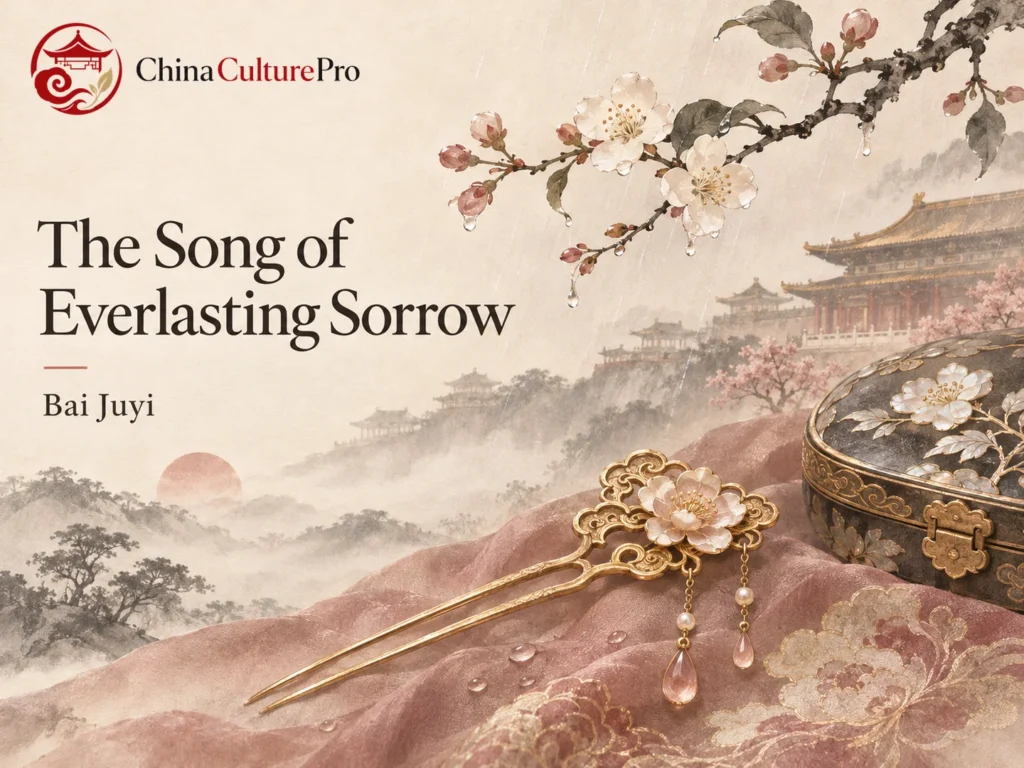

Quick Answer: What Is The Song of Everlasting Sorrow About?
The Song of Everlasting Sorrow (长恨歌, Cháng Hèn Gē) is a long Tang poem by Bai Juyi (白居易, Bái Jūyì). It retells the love and separation of Emperor Xuanzong (玄宗, Xuánzōng) and Yang Guifei (杨贵妃, Yáng Guìfēi) against the crisis of the An Lushan Rebellion.[1][3]
- The court: The ruler’s devotion to Yang grows as his attention to public duties recedes.
- The loss: On the flight west, the troops refuse to continue. Yang dies at Mawei (马嵬, Mǎwéi).
- The search: A Daoist adept finds her beyond the human world and receives tokens and a remembered vow.[1][2]
The poem moves from a political crisis into grief and supernatural encounter.[1]

At first, a glance from Yang makes the rest of the palace seem colourless. Later, the emperor sees her face in a flower because she is no longer there to look back. Between those two moments, Bai Juyi changes the meaning of the palace itself. The objects that once marked favour become reminders of what imperial power cannot recover.
The Story from Huaqing to the Immortal Realm
The 120-line poem begins with a ruler searching for beauty and ends with the ruler still separated from the person he found. It calls him a Han emperor while drawing on the Tang story of Xuanzong and Yang Guifei. The first court scenes build up from baths at Huaqing (华清, Huáqīng) to music, shared nights, late mornings and favour for Yang’s family. The ruler stops attending early audiences. Pleasure has acquired consequences outside the private rooms.[1][3][4]
War first reaches the poem as a sound. Drums from Yuyang break into the court’s music and interrupt the dance. The procession flees toward the southwest. On the road the troops refuse to move, Yang dies and her ornaments lie uncollected. The poem shows the emperor covering his face and unable to save her. The broader An Lushan Rebellion explains the flight. The poem concentrates on the moment the couple separates.[1][3]
Return brings no relief. The pools, flowers and palace buildings recall Yang, while candles, falling leaves and long nights make absence something the emperor has to live through. A Daoist adept is sent to look for her. He passes through distant realms and finds her in a dwelling of the immortals. She gives him parts of a gold hairpin and an inlaid box and recalls a vow made in private. The adept carries her words and tokens back. The poem ends with a vow of union still unfulfilled.[1]
Five Lines and Couplets That Shape the Poem
These excerpts follow the base text of the Chinese edition. The English gives their sense rather than reproducing the verse pattern.[1]
| Chino | Sentido en español | What changes here |
|---|---|---|
| 春宵苦短日高起,从此君王不早朝。 | Spring nights feel too short. The sun is high when he rises. From then on, the ruler misses early court. | Private time starts to displace public duty. |
| 渔阳鞞鼓动地来,惊破霓裳羽衣曲。 | Drums from Yuyang come shaking the earth and break into the Song of Rainbow Skirts and Feather Robes. | Sound brings the rebellion inside the palace scene. |
| 玉容寂寞泪阑干,梨花一枝春带雨。 | Tears cross her quiet, jade-like face, a branch of pear blossom carrying spring rain. | Yang is seen again, through grief. |
| 在天愿作比翼鸟,在地愿为连理枝。 | In heaven, may we be birds joined wing to wing. On earth, may we be branches grown together. | The vow gives union two different shapes. |
| 天长地久有时尽,此恨绵绵无绝期。 | Even lasting heaven and earth must end someday. This sorrow goes on without an end. | The ending measures feeling against cosmic time. |
Why the Ending Is About Both Love and Loss
The poem does not make Yang and the emperor equal speakers from the start. The opening watches the ruler’s pursuit and favour. Later it watches him mourn. Only after the adept reaches the other world does Yang have the room to entrust a message to someone. Her tears and the words of the vow make the ending more than a description of his loneliness. Earlier the emperor imagined her face in a lotus. The adept now sees her face as pear blossom carrying rain. In both cases a flower does the work of a portrait, but the second image lets her own grief appear.[1][4]
The divided keepsakes do something different from the vow. Each object could be fitted together again in principle. The words imagine another kind of union, in the sky or on earth. The story leaves both possibilities open as hopes. The last couplet dwells instead on the feeling that outlasts the encounter.[1]
The court scenes matter to that grief. An account concerned only with devoted lovers could omit the missed audiences or the advancement of a family. Those details come early, where they complicate the sympathy of the ending. Passing Huaqing Palace uses a different poem’s much shorter scene to make court privilege visible through the arrival of a consort’s fruit.[1][3]
Where the Poem Parts Company with History
An Lushan rebelled in 755, and Yang was killed during the imperial flight in 756. These events ground the poem’s crisis. Bai wrote decades after them. His rendering of the court, the death and the ruler’s grief selects details for a narrative whose final journey takes place beyond the human world.[1][2][3]
Chen Hong’s companion prose account shares the story of the search and describes the private vow in more detail. It also gives its own account of how the poem came to be written. The two works are useful together because their emphases differ. Neither turns the adept’s meeting or the vow into independently established history.[2][4] In the Qing drama The Palace of Eternal Life, Hong Sheng reworks the same story for the stage.[5]
The poem itself gives the ruler a choice about where to spend his attention and his retinue a choice about whether to move. Yang is remembered for bearing the result of decisions made around her. Those are ways the narrative distributes agency. They do not make the historical rebellion the fault of one woman.[1][3]
FAQs About The Song of Everlasting Sorrow
What does Chang Hen Ge mean in English?
It is often rendered as Song of Everlasting Sorrow or Song of Eternal Regret. Here hen carries the sense of lasting sorrow or regret at a separation the story cannot undo.[1]
When did Bai Juyi write the poem?
The work is dated to 806, the first year of the Yuanhe era. Its historical crisis took place half a century earlier.[1][2][3]
Is this the same work as The Palace of Eternal Life?
The Palace of Eternal Life is Hong Sheng’s Qing play, completed in 1688. Bai’s work is the earlier Tang poem.[1][5]
Fuentes
[1] Bai Juyi. The Song of Everlasting Sorrow
[2] Chen Hong. The Account of the Song of Everlasting Sorrow
[3] ExEAS. East Asian Attitudes Towards Court Women: The Legend of Yang Guifei
[4] Library and Archives Canada. Narrative Perspective and Historical Representation in Bai Juyi’s Song of Eternal Sorrow
[5] University of Chicago. History, Drama, Fantasy: Palace of Lasting Life