

Quick Answer: What Are the Ten Heavenly Stems?
The Heavenly Stems (天干, tiāngān) are ten ordered characters used in a repeating Chinese calendrical sequence. Their traditional classification combines five phases with yin and yang (阴阳, yīnyáng).
- Each phase has two stems: one yang and one yin.
- The sequence alternates yang and yin, beginning with yang.
- A stem pairs with an Earthly Branch (地支, dìzhī) to form a calendrical label.
- The standard paired sequence repeats after sixty positions.
These are calendar and interpretive classifications, rather than ten zodiac animals or fixed descriptions of a person.
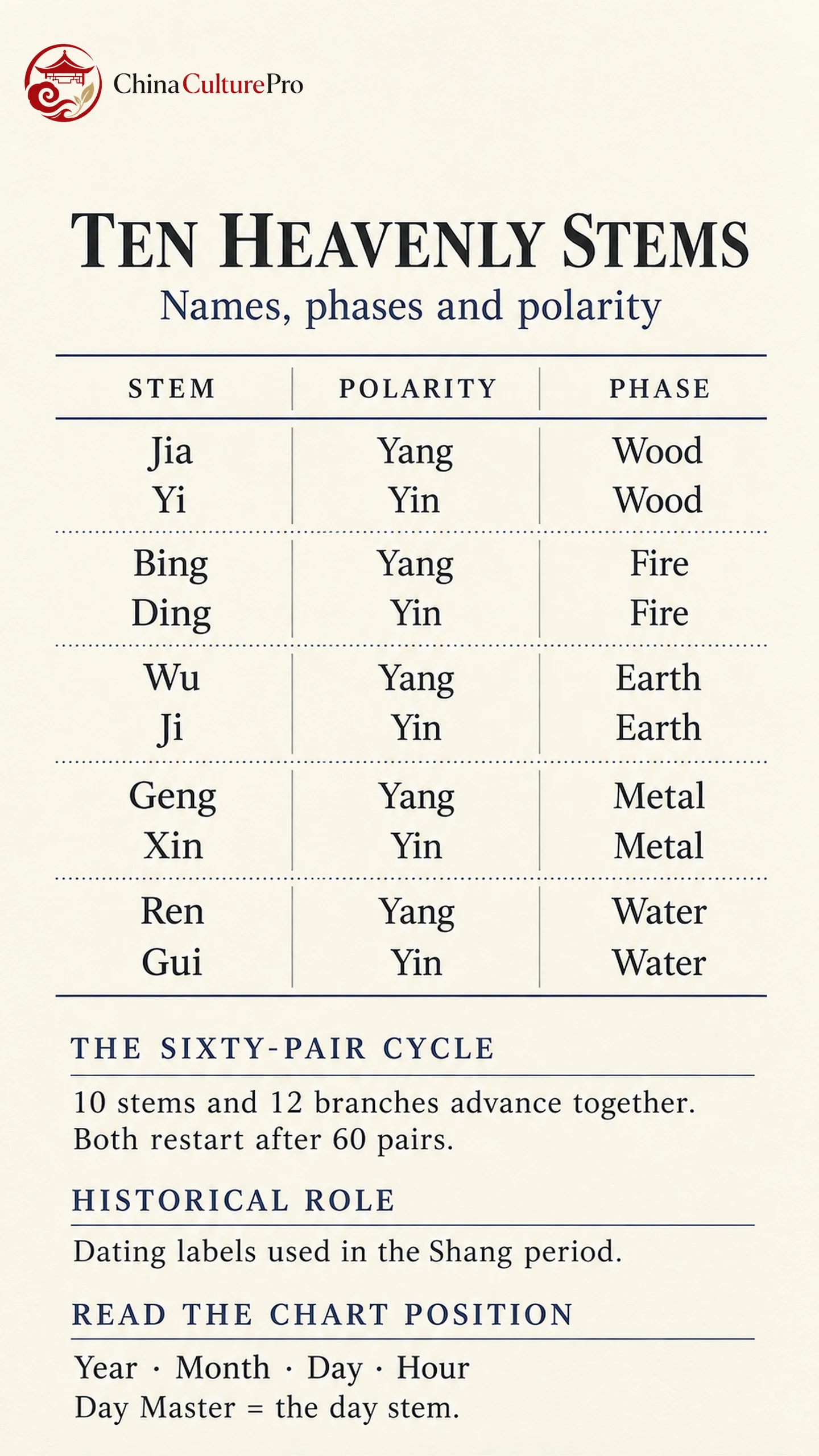
The first task is recognizing which sequence you are reading. A stem, a branch and an animal label can appear beside one another, but they do different jobs. The stem-branch overview explains the shared framework; the table below isolates the ten stems for reference.
Their names are cyclical labels. Translating the everyday meaning of a character does not necessarily explain the function it performs in a date or chart.
The Ten Stems in Their Standard Order
The order below is standard; the Chinese characters, tone-marked pinyin and classifications help distinguish similar-looking or similarly romanized names.[1][2]
| Posición | Tronco | Traditional classification |
|---|---|---|
| 1 | Jia (甲, Jiǎ) | Yang Wood (阳木, yáng mù) |
| 2 | Yi (乙, Yǐ) | Yin Wood (阴木, yīn mù) |
| 3 | Bing (丙, Bǐng) | Yang Fire (阳火, yáng huǒ) |
| 4 | Ding (丁, Dīng) | Yin Fire (阴火, yīn huǒ) |
| 5 | Wu (戊, Wù) | Yang Earth (阳土, yáng tǔ) |
| 6 | Ji (己, Jǐ) | Yin Earth (阴土, yīn tǔ) |
| 7 | Geng (庚, Gēng) | Yang Metal (阳金, yáng jīn) |
| 8 | Xin (辛, Xīn) | Yin Metal (阴金, yīn jīn) |
| 9 | Ren (壬, Rén) | Yang Water (阳水, yáng shuǐ) |
| 10 | Gui (癸, Guǐ) | Yin Water (阴水, yīn shuǐ) |
After Gui, the stem sequence returns to Jia. That does not mean the whole stem-branch pair has returned to its starting point: the branch sequence has twelve members and continues on its own track.[1]
How Phase and Polarity Combine
Each label combines a phase and a polarity. Jia and Yi are both Wood but have opposite polarities. The same pattern applies to the other four phases.[2]
The odd-numbered positions are yang and the even-numbered positions yin. That pattern provides a useful check when copying the table: a row labeled “Jia, Yin Wood” would contradict the standard classification.
The Cinco Elementos are phases within a traditional relational framework. They are not the modern chemical elements. Likewise, the yin–yang distinction should not be reduced to good and bad, or to fixed personality stereotypes.
Why Ten Stems and Twelve Branches Make Sixty Pairs
The Earthly Branches (地支, dìzhī) form a separate twelve-part sequence. In the standard pairing, both sequences advance one position at a time, beginning with Jia-Zi (甲子, Jiǎzǐ).[1]
Why sixty rather than 120? This is a synchronized sequence, not a list of every possible combination. After ten steps, the stems have completed one circuit while the branches have not. Both sequences return to their starting positions together after sixty steps: six stem circuits and five branch circuits.
The paired positions also preserve parity: odd stem positions meet odd branch positions, and even meet even. A random stem-and-branch combination is therefore not automatically a member of the standard sixty-pair cycle. The branches reference supplies the other sequence and its animal and hour associations.
Keep the two spellings of Wu separate. The stem 戊 is pronounced Wù and classified as Yang Earth. The Horse branch is 午, pronounced Wǔ.[2] Romanization without tone marks can hide that difference; the character and the field being labeled resolve it.
Historical Dates and Modern Chart Labels
The stems have a long history as dating labels, including Shang-period use.[3] A museum-catalogued Shang oracle bone preserves divination inscriptions dated by stem-branch days.[4] This provides a concrete historical setting for the sequence beyond modern personality descriptions.
Stem-branch labels were also applied to years, months and hours at different periods. Four year, month, day and hour pairs form the eight characters used in BaZi (八字, bāzì).[1]
In a common BaZi approach, the Day Master (日主, rìzhǔ) is the stem of the Day Pillar, not the Year Pillar.[5] A year-stem element consequently cannot be substituted automatically for a day-stem classification. The BaZi and zodiac comparison explains the difference in inputs and scale.
When reading a label, preserve its position: year stem, day stem or another specified component. A stem’s classification tells you how it is placed within a traditional system; it does not establish an individual’s character, health or future. The wider cosmology guide supplies further cultural context.
FAQs About the Heavenly Stems
Are the stems the twelve zodiac animals?
No. There are ten stems. The twelve animals correspond to the separate Earthly Branches in their zodiac role.
What happens after Gui?
The stem sequence returns to Jia. The accompanying branch continues through its own twelve-part sequence, so the complete pair does not necessarily repeat yet.
Is the stem Wu the same as the Horse branch?
No. The stem is 戊, Wù, Yang Earth. The Horse branch is 午, Wǔ. Their characters, tones and roles differ.
Can my birth-year stem identify my Day Master?
No. A year stem belongs to the Year Pillar. The Day Master refers to the Day Pillar’s stem in the BaZi approach described here.
Fuentes
[1] Hong Kong Observatory. Heavenly Stems and Earthly Branches
[2] Joseph A. Adler, Kenyon College. Stems-Branches
[3] ChinaCulture.org. Heavenly Stems System
[4] University of Cambridge, Museum of Archaeology and Anthropology. Oracle bone, accession 1927.835 A
[5] School of BaZi. What Is BaZi? The Four Pillars, Explained