


Quick Answer: What Are Singapore Noodles?
Singapore noodles (星洲炒米粉, xīngzhōu chǎo mǐfěn) are curry-seasoned, stir-fried rice vermicelli (米粉, mǐfěn), commonly mixed with shrimp, egg, vegetables and char siu (叉烧, chāshāo).[2][3]
- Choose thin rice noodles, rather than clear mung-bean vermicelli.[2]
- Curry powder provides the characteristic yellow seasoning.[2]
- Cook shrimp and egg before the final noodle toss.[1]
This is a dry noodle stir-fry, with a coating of seasoning rather than a bowlful of sauce.
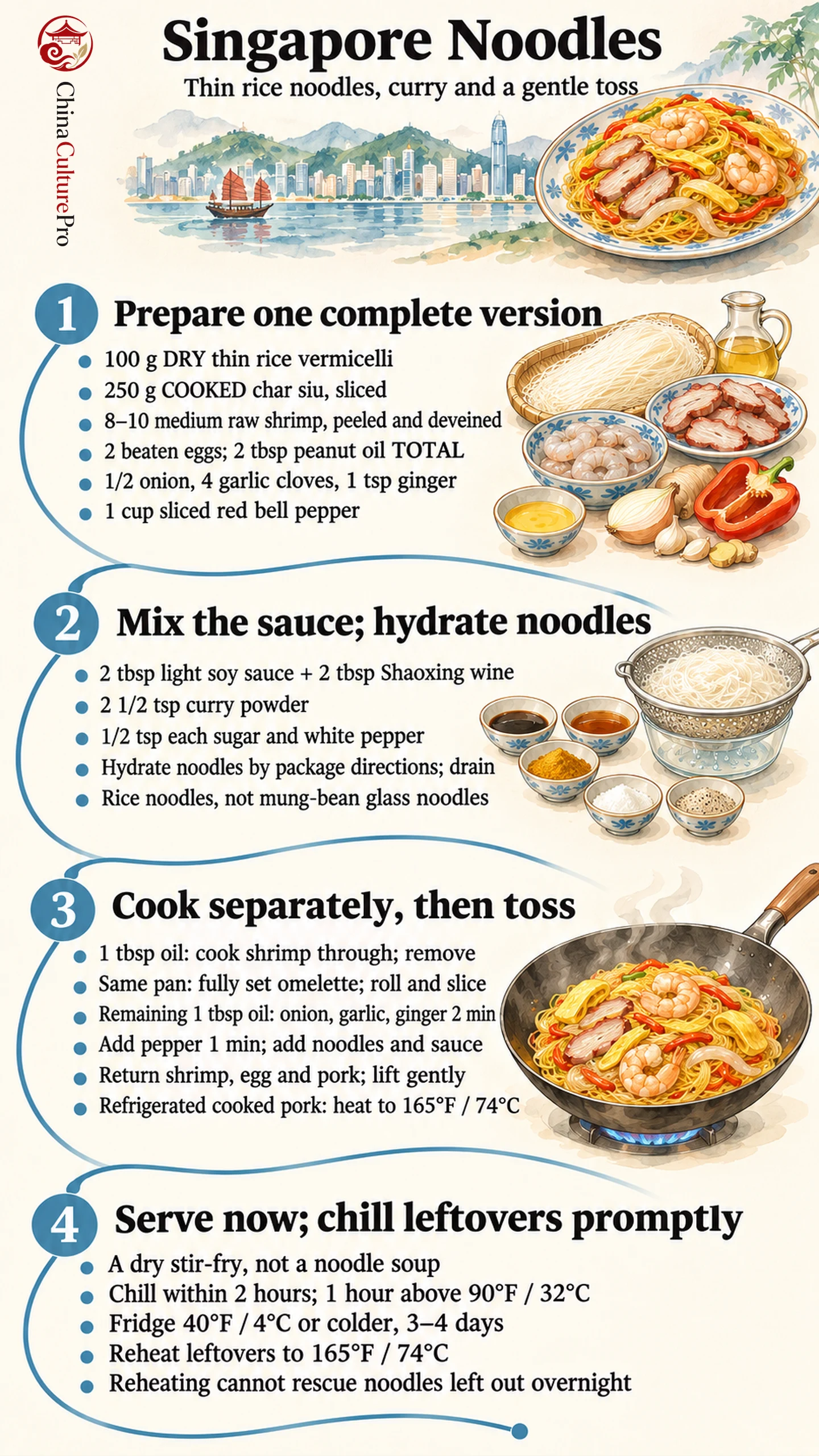
Have the sauce mixed and vegetables sliced before heating the pan. The cooking moves quickly once the noodles are hydrated, so ingredient preparation should happen first.
The Name, Noodles and Restaurant Variations
The dish is associated with Hong Kong and Cantonese cuisine (粤菜, yuècài). Its place on a Chinese-American takeout menu does not establish a Singaporean birthplace.[2][3]
Choose thin, rice-based vermicelli. The rice-versus-wheat noodle guide explains the ingredient distinction.[2]
Restaurant and home versions vary:
- Pork, shrimp and bell pepper: The measured version below uses sliced roast pork, shrimp, an omelette and red pepper.[1]
- Cabbage and carrot: Another version combines shredded cabbage, carrot, scallion and onion with the noodles and proteins.[2]
- Bean sprouts and egg threads: A different recipe includes bean sprouts and vigorously stirred egg threads, with optional sliced fishcake.[3]
These are recipe variations, rather than three fixed regional rules. Changing vegetables does not require replacing the noodle type.
Ingredients for One Curry-Vermicelli Version
- Main ingredients: 100 g dry rice vermicelli; 250 g cooked char siu, sliced; 8–10 medium raw shrimp, peeled and deveined; 2 beaten eggs; 2 tbsp peanut oil, divided.[1]
- Vegetables: ½ medium onion, sliced; 4 minced garlic cloves; 1 tsp grated ginger; 1 cup sliced red bell pepper.[1]
- Sauce: 2 tbsp light soy sauce (生抽, shēngchōu); 2 tbsp Shaoxing wine (绍兴酒, Shàoxīng jiǔ); 2½ tsp curry powder; ½ tsp each sugar and white pepper.[1]
Use already-cooked roast pork; raw pork is not an interchangeable shortcut at the final mixing stage.
How to Cook Without Breaking the Noodles
- Prepare noodles and sauce. Hydrate noodles according to package directions; drain. Mix sauce separately.[1]
- Cook shrimp. Heat 1 tbsp oil over medium heat; cook shrimp through, about 2½–3 minutes as a guide; remove.[1]
- Make egg ribbons. In the same pan, cook eggs as a thin, fully set omelette; roll, remove and slice.[1]
- Fry vegetables. Add remaining oil, onion, garlic and ginger; cook 2 minutes. Add pepper; cook 1 minute.[1]
- Toss and finish. Add noodles and sauce; lift gently. Return shrimp, egg and pork; toss 1–2 minutes as a guide, heating refrigerated cooked pork to 165°F/74°C.[1][6]
Shrimp should be firm and pearly opaque; curled shape alone is insufficient. Eggs should be fully set. Extend cooking when needed to meet the temperature check.[4][5]
FAQs About Singapore Noodles
Can I use glass noodles or wheat noodles?
Glass noodles made from mung-bean starch are different. Check the ingredients; the word “vermicelli” alone does not identify rice noodles.[2]
Why are my noodles mushy or stuck together?
Overhydrating thin noodles makes them vulnerable to breaking during tossing. Follow the packet rather than a universal soaking time, drain, and use a lifting motion instead of repeatedly chopping through the strands.[2]
Can I leave out the pork or shrimp?
Ham appears in other versions; vegetable-forward variations are possible too. Removing meat does not automatically make every packaged seasoning suitable for a particular diet.[2][3]
How should I store and reheat leftovers?
Refrigerate shallow portions within 2 hours, or 1 hour above 90°F/32°C. Store at 40°F/4°C or colder for 3–4 days; reheat to 165°F/74°C. Do not leave cooked noodles out overnight and rely on reheating: prolonged room-temperature holding can allow heat-stable toxins to develop.[6][7]
Fuentes
[1] Nagi Maehashi. Singapore Noodles
[2] Bill Leung. Singapore Noodles: Singapore Mei Fun
[3] Adam Liaw. Singapore Noodles
[4] U.S. Food and Drug Administration. Selecting and Serving Fresh and Frozen Seafood Safely
[5] U.S. Food and Drug Administration. What You Need to Know About Egg Safety
[6] U.S. Department of Agriculture. How Do I Handle Leftovers Safely?
[7] Hong Kong Centre for Food Safety. Guidelines for Safe Production of Rice and Noodles