


Quick Answer: Who Are China’s Ethnic Russians?
China’s ethnic Russians(俄罗斯族,Éluósīzú) form one of the country’s officially recognized ethnic groups. Communities are found especially in Xinjiang and Inner Mongolia, with people also living elsewhere. Family histories and cultural practices reflect generations of settlement, intermarriage and exchange in China. Understanding them requires attention to locality and to the difference between ethnicity, citizenship and the wider history of Russian migration. [1]
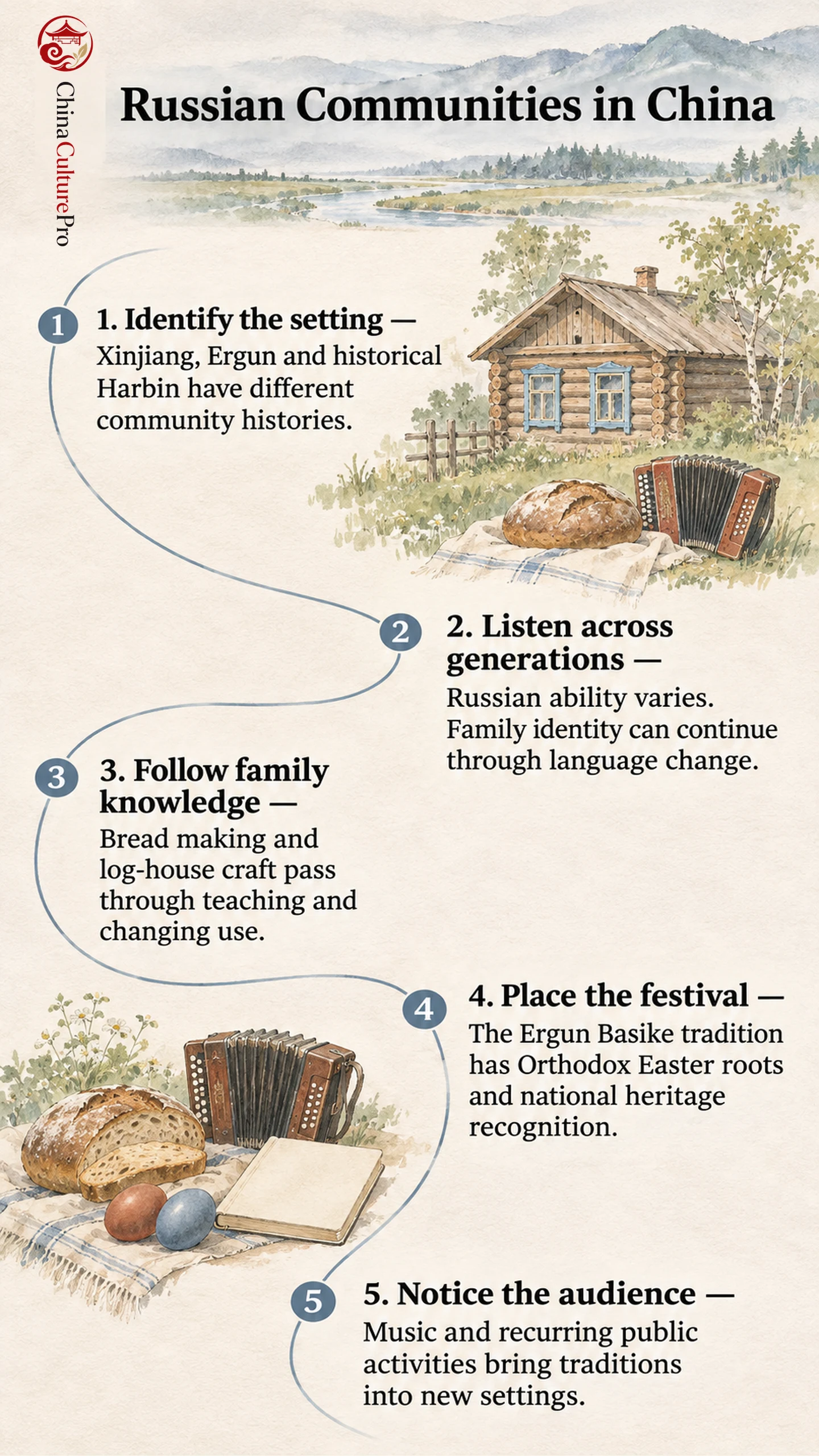
Bread making, songs and family photographs offer different ways to trace a household’s history. In China’s Russian communities, the setting of that story matters. A household in Enhe, a family in Tacheng and a historical account of Harbin bring different experiences into view.
Different Histories in Xinjiang, Ergun and Harbin
Settlement histories include movement into China during the late imperial period and the upheavals around the Russian Revolution. Families settled, married locally and built relationships with neighboring communities. Present-day ethnic communities in Xinjiang and Inner Mongolia grew within those regional histories. Older records can use administrative names or population figures that describe a particular period. [1]
Harbin’s large historical Russian-speaking community belongs to a related but broader history. It included people from different backgrounds, including Jewish communities, whose citizenship and identities changed amid Russian, Chinese and Japanese political power. A history of “Russian Harbin” therefore needs to identify whose experience it describes. It may follow a diaspora family that later moved elsewhere. [2]
| Three Settings for Reading Russian Community History | En qué fijarse | What a source can tell you |
|---|---|---|
| Xinjiang, including Tacheng and Ili | Long-established ethnic communities and regional exchange | Family histories and relationships with neighboring groups |
| Ergun, including Enhe | Mixed family histories and heritage practices in Inner Mongolia | Local language change, food knowledge and festivals |
| Historical Harbin | A diverse Russian-speaking diaspora | Migration, institutions and changing identities over time |
The place name gives an initial clue to the source’s scope. Then check whether the author is discussing an official ethnic category, a household’s ancestry, a spoken language or a historical population. Each can be significant without describing exactly the same set of people.
Language and Identity across Generations
Russian belongs to the East Slavic branch of the Indo-European family. Within China’s ethnic communities, its use varies between families and generations. An ethnic label alone gives little information about whether someone speaks Russian, reads it or remembers a few expressions learned from relatives. [1]
A study published in 2015 examined Russian language decline in the Ergun area. It documented stronger Russian ability among older participants and widespread Chinese use among younger family members. The account relates that change to intermarriage, shifts in the language environment and the political pressures experienced in the twentieth century. Those findings belong to a particular study and period. [3]
This evidence helps readers interpret a family interview. Someone may describe a Russian-speaking grandparent while using Chinese in daily life. A remembered food name, song or expression can remain meaningful after fluent conversation has become difficult. Language transmission and ethnic identification can follow different paths, which a source needs to describe separately.
Bread, Homes and Family Knowledge
In Enhe, bread making has become a visible setting for passing on family knowledge. An account of a local bakery describes a third-generation descendant teaching visitors techniques learned from her mother. The bread connects remembered household practice with work in a contemporary workshop. A demonstration gives the learner access to some of that knowledge through handling, explanation and observation. [4]
Traditional log houses known locally as mukeleng(木刻楞,mùkèléng) are another example. Their walls use stacked timber, and the buildings can retain features of family homes while being adapted for visitors. Construction knowledge, maintenance and present use all belong to the object’s story. Some log houses now serve visitors as guest accommodation, bringing the inherited building form into a new use. [4]
These examples show why an object benefits from a named owner or maker. Bread on a display table and bread prepared for relatives may follow related techniques while serving different purposes. The context helps explain which knowledge is being shared and how it continues.
Pascha and the Basike Festival
The Basike Festival(巴斯克节,Bāsīkè Jié) is rooted in Orthodox Easter, or Pascha, and is an important heritage tradition in the Ergun area. Preparations include baking, decorating the home and making festive foods. A tall cylindrical Easter bread and decorated eggs are among its recognizable objects. In 2011, the local tradition entered China’s third national intangible cultural heritage list. [5]
The celebration belongs within the wider history of Christian traditions in China. Household practices and participation can vary, and a cultural heritage description does not establish every participant’s religious affiliation. It is more informative to ask how a family observes the occasion and what particular objects or gestures mean to them.
The Easter connection also affects the calendar. A date reported for one year belongs to that year’s observance. When reading a program, distinguish the annual celebration from a public event using its food, music or crafts. The heritage title identifies a living tradition, while an organizer’s schedule identifies a specific activity.
Music and the Public Life of Heritage
Accordion playing offers a particularly visible connection between Russian traditions and the wider musical life of Tacheng. Local performances bring together residents from several ethnic communities, including Tatar communities. A performance can draw on a family tradition while involving musicians from several communities. [6]
In Enhe, local organizers have also promoted recurring activities themed around the Basike Festival. Visitors can encounter performances, food or craft experiences outside the annual religious celebration. These programs create opportunities to teach and display cultural practices, while their timing and audience give them a different setting from a family observance. [7]
Read such activities alongside intangible cultural heritage as work carried out by people. A musician, baker or house builder may teach a practice, earn a living through it and adapt it for a new audience. Understanding the setting makes those changes easier to describe without treating culture as a fixed collection of inherited objects.
FAQs About Russian Communities in China
Are China’s ethnic Russians Russian citizens?
The official ethnic category refers to a Chinese ethnic group. Ethnicity and citizenship are separate categories, so a person’s citizenship needs to be identified independently.
Does everyone in these communities speak Russian?
No. Ability varies by region, household and generation. Studies of particular communities document language shift toward Chinese.
Is the Basike Festival connected with Easter?
Yes. The Ergun tradition has Orthodox Easter roots, alongside local family and public cultural forms.
Fuentes
[1] National Ethnic Affairs Commission. Overview of China’s Ethnic Russians
[2] Cosmopolitan Civil Societies, University of Technology Sydney. Russians from China, Migrations and Identity
[3] Bai Ping. An Analysis of the Decline in the Mother Tongue of Russian Ethnic Group in Erguna City
[4] China Intangible Cultural Heritage. A Century of Heritage Transmission among Chinese-Russian Descendants
[5] China Intangible Cultural Heritage. Russian Basike Festival
[6] Xinhua. Tacheng’s Shared Accordion Culture
[7] Ergun Municipal Government. Recurring Basike-Themed Activities in Enhe