
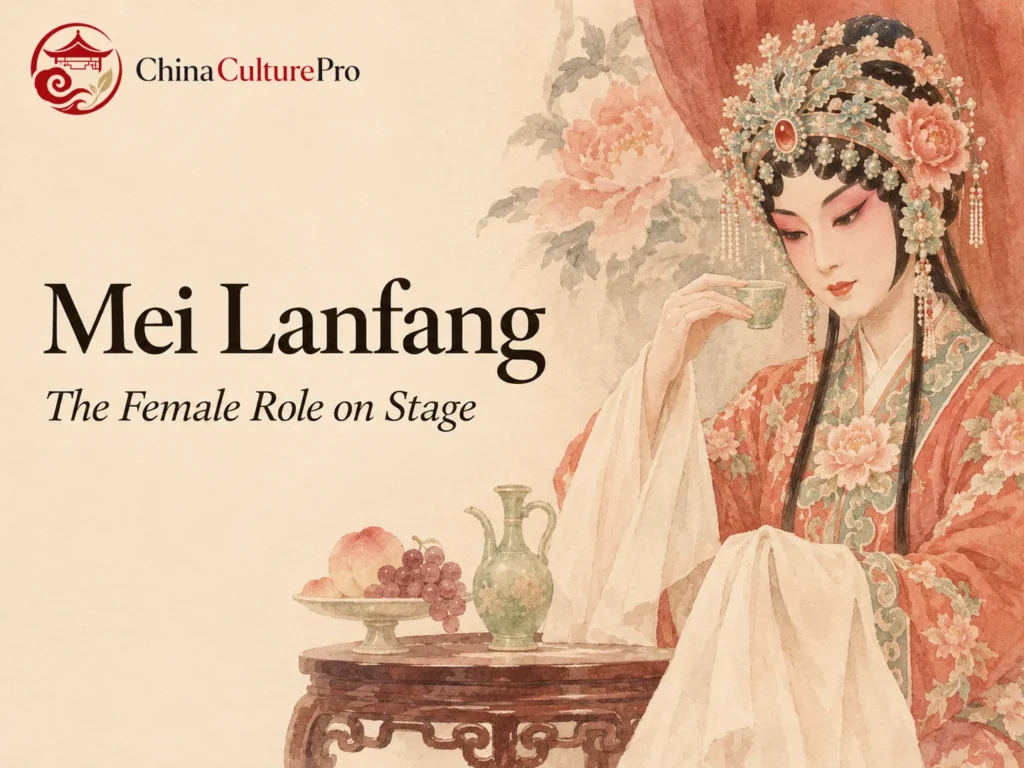

Quick Answer: Who Was Mei Lanfang?
Mei Lanfang (梅兰芳, Méi Lánfāng, 1894–1961) was a Peking opera (京剧, Jīngjù) actor known for dan (旦, dàn), the female roles. He developed the Mei school (梅派, Méipài), a style passed down through students and their performances.[1][2][8]
- Roles: Mei played women in court, female commanders and supernatural figures.[1][2]
- Movement: Watch how he times a glance or sleeve movement with the sung phrase.[2][4]
- Tours: He performed for audiences in Japan, the United States and the Soviet Union.[1][5][6]
Compare the cup at a court banquet with the dance in a farewell scene.
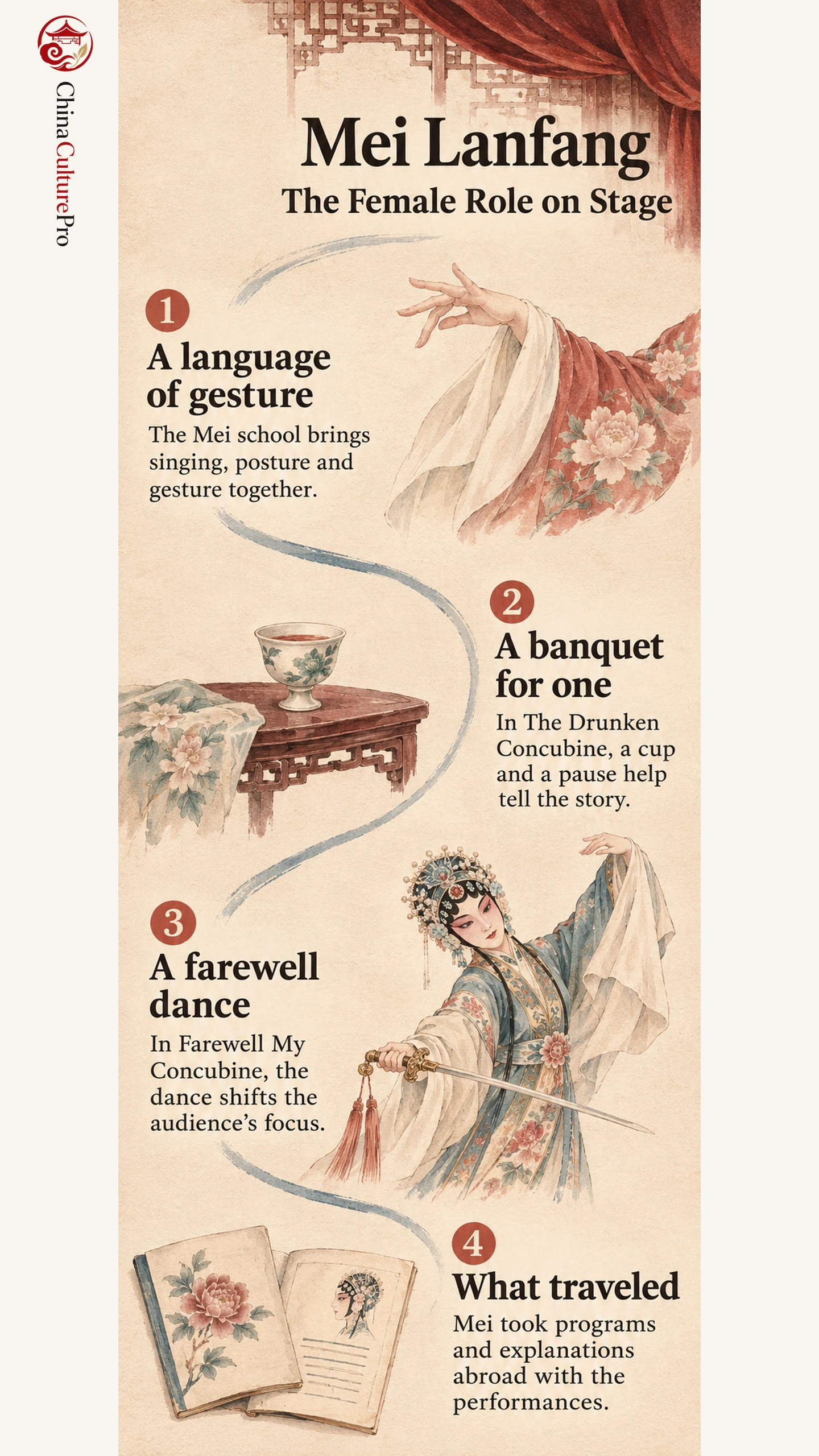
Yang Yuhuan has prepared a banquet for someone who will never arrive. By the time she lifts her cup again, Mei can let a pause carry some of the change in her mood.
What the Mei School Asks of a Performer
Mei performed within a tradition in which men often played female characters. The wider system of Chinese opera roles gave him conventions for voice, gesture and posture. He could use the same conventions to make one woman seem guarded and another composed in public.[1][2]
A recollection of a windy 1953 performance describes him adjusting his turns and sleeve movements to the direction of the wind. He adjusted which way he turned so the sleeve would carry the movement cleanly. Long sleeves in Chinese opera costumes make the direction and timing of that movement visible.[4]
Two Roles to Compare on Stage
In The Drunken Concubine (贵妃醉酒, Guìfēi Zuìjiǔ), Yang Yuhuan prepares a banquet and learns the emperor has gone elsewhere. As she becomes intoxicated, an action as ordinary as lifting a cup can take on a different weight. Follow how the performer preserves some of the character’s courtly bearing even as disappointment becomes visible.[2][3][4]
In Farewell My Concubine (霸王别姬, Bàwáng Bié Jī), Yu dances before Xiang Yu as his army faces defeat. Watch the change in focus from the person she addresses to the space around her during the dance. The arc of the sword dance changes the scale of the movement, taking the audience’s eye beyond the space between the two characters.[3][8]
What Traveled With Mei
Mei toured Japan in 1919 and performed in the United States in 1930 and the Soviet Union in 1935. He and his team prepared programs, explanations and illustrations. A study of those materials found that the U.S. tour emphasized the theater’s antiquity, while the Soviet visit presented it as an art for a modern audience.[1][5]
In Honolulu, the 1930 tour left a trace beyond the stage. The University of Hawaiʻi received a two-volume set of scores from his repertoire, one in Chinese notation and one in Western staff notation. The paired volumes let readers follow the same repertoire through two systems of notation.[6]
FAQs About Mei Lanfang
Does dan describe the actor or the character?
It describes the female role category. Mei was one of several male actors celebrated for playing those roles, and women have also carried the school forward. Shen Xiaomei learned several of its core plays directly from Mei.[1][8]
What should I search for to see Mei Lanfang himself?
Search for The Stage Art of Mei Lanfang (梅兰芳的舞台艺术, Méi Lánfāng de Wǔtái Yìshù), filmed in 1955. It preserves Mei’s own performance in excerpts from his repertoire. A performance listed only as Mei school may feature a later artist in the lineage.[7][8]
Fuentes
[1] ChinaCulture.org. Mei Lanfang and Peking Opera
[2] China Intangible Cultural Heritage Network (Red del Patrimonio Cultural Inmaterial de China). Mei Lanfang at 130
[3] Beijing Municipal Government. Peking Opera Instruments and Classics
[4] Chinese People’s Political Consultative Conference. Mei on a 1953 Performance
[5] New Theatre Quarterly. Antiquity to Modernity
[6] University of Hawaiʻi at Mānoa. Origins of Some Early Donations
[7] CCTV. Mei Lanfang, Master and Cultural Envoy
[8] China Intangible Cultural Heritage Network. Shen Xiaomei