

Quick Answer: Who Was Lin Yutang?
Lin Yutang (林语堂, Lín Yǔtáng; 1895–1976) was a Chinese essayist, novelist, translator and linguist who wrote in both Chinese and English. Humor and cultural interpretation connect much of his work, but his books offer different reading experiences.[1]
- For personal essays: Start with his reflections on leisure and ordinary pleasures.
- For cultural argument: Read his portrait of China as a historically situated interpretation.
- For narrative: Choose between a modern family novel and a biography of a classical poet.
Several of his best-known books are English originals; an English copy is not automatically a translation.
Lin is often encountered through a memorable sentence about enjoying life. A fuller reading begins by choosing a book and following its argument, narrative or portrait beyond the quotation. The guide below separates four useful routes, then shows how to read his inviting prose without treating a single writer as the voice of an entire culture.
A Writer Between Languages and Publics
His career belongs to modern Chinese literature and to English-language writing about China. In Shanghai, he founded a humor magazine in 1932 and encouraged brief informal essays. Satire gave him a way to criticize political and social behavior; humor was more than a preference for cheerful subjects.[1]
His training also crossed institutions and languages, including study at Harvard and a doctorate at Leipzig. He moved to New York in 1936, after the success of his first major English book.[1]
Keep this changing audience in view. An explanatory passage aimed at English-speaking readers may introduce a familiar Chinese practice as something surprising. Ask what the imagined reader needs explained, what the author assumes and what his comparison makes visible.
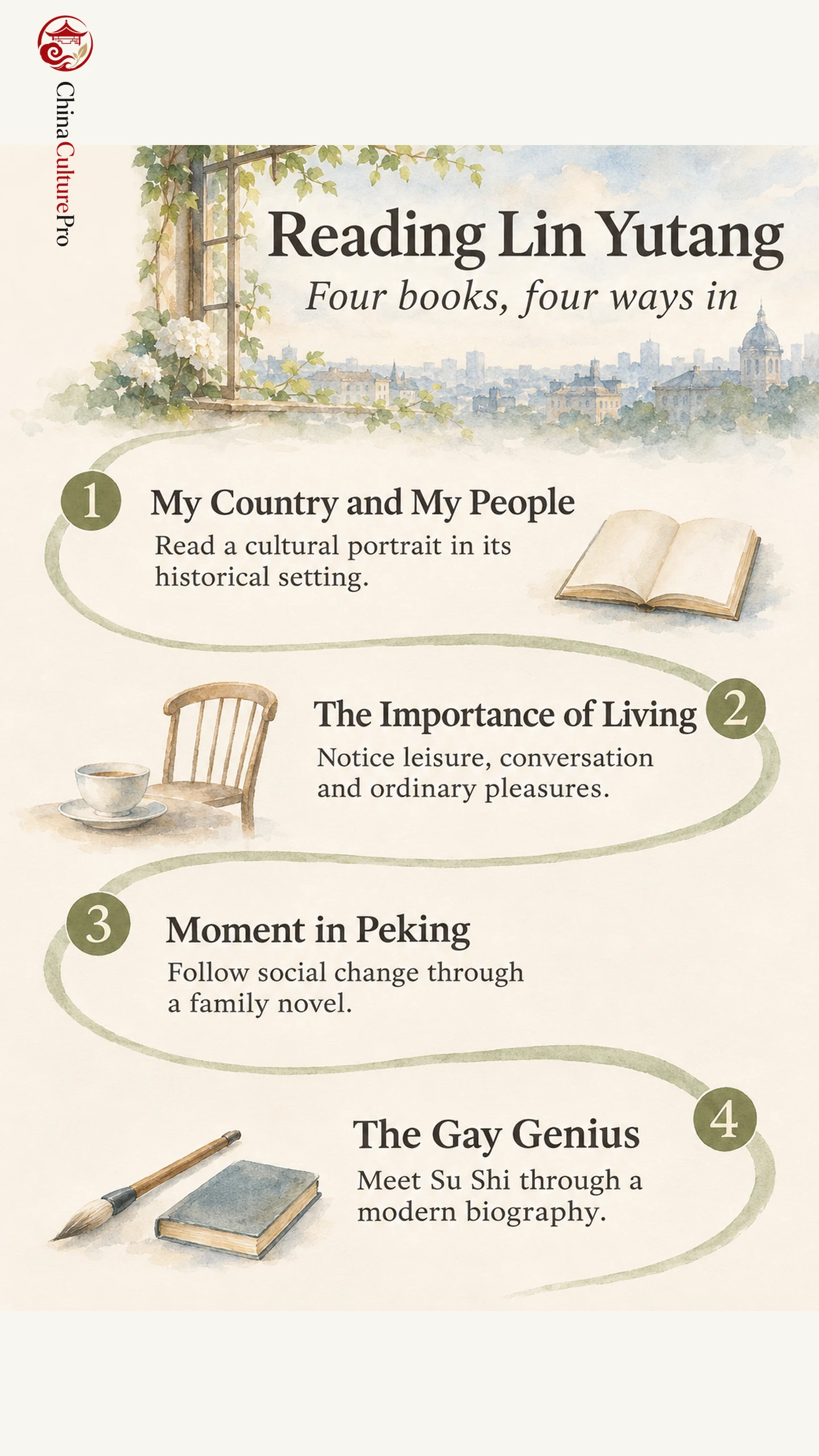
Four Books and Four Reading Routes
Chinese titles below identify the works for readers across languages; they do not mean these books were first written in Chinese.
| Book | Form and starting question |
|---|---|
| My Country and My People (吾国与吾民, Wú Guó Yǔ Wú Mín), 1935. | Cultural essays. How does a writer organize a portrait of a country?[2][4] |
| The Importance of Living (生活的艺术, Shēnghuó De Yìshù), 1937. | Essays about ways of living. What happens when leisure and enjoyment become serious subjects?[2][3] |
| Moment in Peking (京华烟云, Jīnghuá Yānyún), 1939. | A novel of modern Chinese life, modeled in part on the great family-novel tradition. How does social change enter family experience?[2] |
| The Gay Genius (苏东坡传, Sū Dōngpō Zhuàn), 1947. | A biography of the poet Su Shi, titled in full The Gay Genius: The Life and Times of Su Tungpo. How does a modern writer present a poet’s life?[2] |
For the last route, a short introduction to Su Shi, also known as Su Dongpo, helps identify the subject behind the older romanization “Su Tungpo.”
What the Essays Ask Readers to Notice
The contents of My Country and My People move from broad categories such as character, mind and ideals to women’s lives, social and political organization, literature, art and everyday enjoyment. That architecture makes the book an argument about how a society fits together, rather than a collection of unrelated customs.[4]
The Importance of Living shifts the emphasis. Its contents include conversation, tea and friendship, chairs, interiors, nature, travel and thinking. These concrete topics sit alongside a substantial discussion of leisure. The book invites attention to experiences that a schedule organized only around work might overlook.[3]
Try reading one section twice: first for its pleasure, then for its claim. What ordinary activity has been promoted into something worth thinking about? Which example carries the argument? Does the passage persuade through a reason, a comic contrast, an anecdote or an appeal to taste? This small distinction helps you appreciate the voice while still evaluating its ideas.
Reading His Cultural Comparisons Historically
Lin’s cultural portrait is not simple praise. The Metropolitan Museum’s discussion of his writing notes the double edge of his account of worldly cunning: it can protect an individual while also working against reform. A quality that seems helpful in one situation becomes damaging in another.[5]
This is a useful alternative to extracting an isolated declaration about “the Chinese.” Mark the date, the comparison and the people who remain outside the example. Generalizations about women, class or national character deserve the same scrutiny as more attractive claims about wisdom and leisure.
If his essays spark an interest in Chinese philosophy, follow that interest into named thinkers and texts. His personal arrangement of traditions can introduce questions without providing a complete account of every school.
English Originals, Translations and Further Reading
A useful English edition to identify is the HarperCollins reprint of The Importance of Living (1998; ISBN 9780688163525). Its edition date differs from the work’s original publication date.[3]
Lin also translated Chinese literature. A bilingual edition of Six Chapters of a Floating Life (浮生六记, Fúshēng Liù Jì) credits Shen Fu as author and Lin as translator. This is a different role from his authorship of his own essays and novels.[7]
For a broader critical perspective, The Cross-Cultural Legacy of Lin Yutang: Critical Perspectives, edited by Suoqiao Qian and published by Berkeley’s Institute of East Asian Studies in 2015, offers several lines of inquiry. Its chapters address religion, language, reception, Montaigne and food, among other subjects. Choose a chapter that tests the aspect of Lin you found most persuasive or puzzling.[6]
FAQs About Lin Yutang
Did Lin Yutang write his famous books in English?
Yes. His major English-language career includes My Country and My People and the novel Moment in Peking. He also wrote in Chinese and translated Chinese literature, so check his role for each title.[1]
Which book is the easiest place to begin?
For short sessions, try an essay from The Importance of Living on a subject that interests you. Choose Moment in Peking instead if you prefer sustained narrative to discursive argument.
Is Moment in Peking a history book?
It is a novel. Its fictional presentation of social change should be distinguished from documentary history.[2]
Fuentes
[1] American Academy of Arts and Sciences. Lin Yutang
[2] The Lin Yutang House. Chronology of Lin Yutang’s Life and Works
[3] HarperCollins, via Google Books. The Importance of Living: Description, Contents and Reprint Details
[4] Smithsonian Libraries. My Country and My People: Bibliographic Record and Contents
[5] Shi-yee Liu, Metropolitan Museum of Art. Straddling East and West: Lin Yutang, a Modern Literatus
[6] University of California Press. The Cross-Cultural Legacy of Lin Yutang: Critical Perspectives
[7] National Institute of Informatics, CiNii Books. Shen Fu’s Six Chapters of a Floating Life: Bilingual Edition