

Quick Answer: Who Was Huang Tingjian?
Huang Tingjian(黄庭坚,huáng tíngjiān; 1045–1105)was a Northern Song poet and calligrapher.[1][2]
- Forms: He wrote shi poetry(诗,shī)and ci lyrics(词,cí).
- Literary position: He is a leading figure associated with the Jiangxi Poetry School(江西诗派,jiāngxī shīpài).[2]
- Starting points: Friendship, landscape and the passing of spring provide three useful reading paths.
His poetry and calligraphy overlap, but a later handwritten copy of his verse is not necessarily his own handwriting.
A remembered cup of wine, a river under moonlight, a bird asked where spring has gone: these images offer an inviting entrance to this Northern Song poet. His reputation for demanding poetry becomes easier to understand when you begin with a few lines rather than a list of literary labels.
Northern Song Context and the Jiangxi Poetry School
Born in what is now Xiushui, Jiangxi, Huang belonged to the literary circle associated with Su Shi(苏轼,sū shì). His official career included demotions and exile, a useful background when reading about distance and withdrawal.[1][3]
The Jiangxi Poetry School label points readers toward craft: inherited words and references can be rearranged into a fresh expression. Read the resulting image first, then use annotations to recover the older language behind it.[2][3]
Three Works to Start With
| Work | Forma | What to notice first |
|---|---|---|
| To Huang Jifu(寄黄几复,jì huáng jīfù) | Seven-character shi | A shared spring evening set against years apart.[3][5] |
| Climbing Kuai Pavilion(登快阁,dēng kuài gé) | Seven-character shi | A viewpoint opening from official duties toward hills and river.[4] |
| Qingping Le(清平乐,qīngpíng yuè), beginning “Where has spring gone?” | Ci lyric | A search for spring that turns toward an oriole.[6] |
Friendship, Landscape and Passing Spring
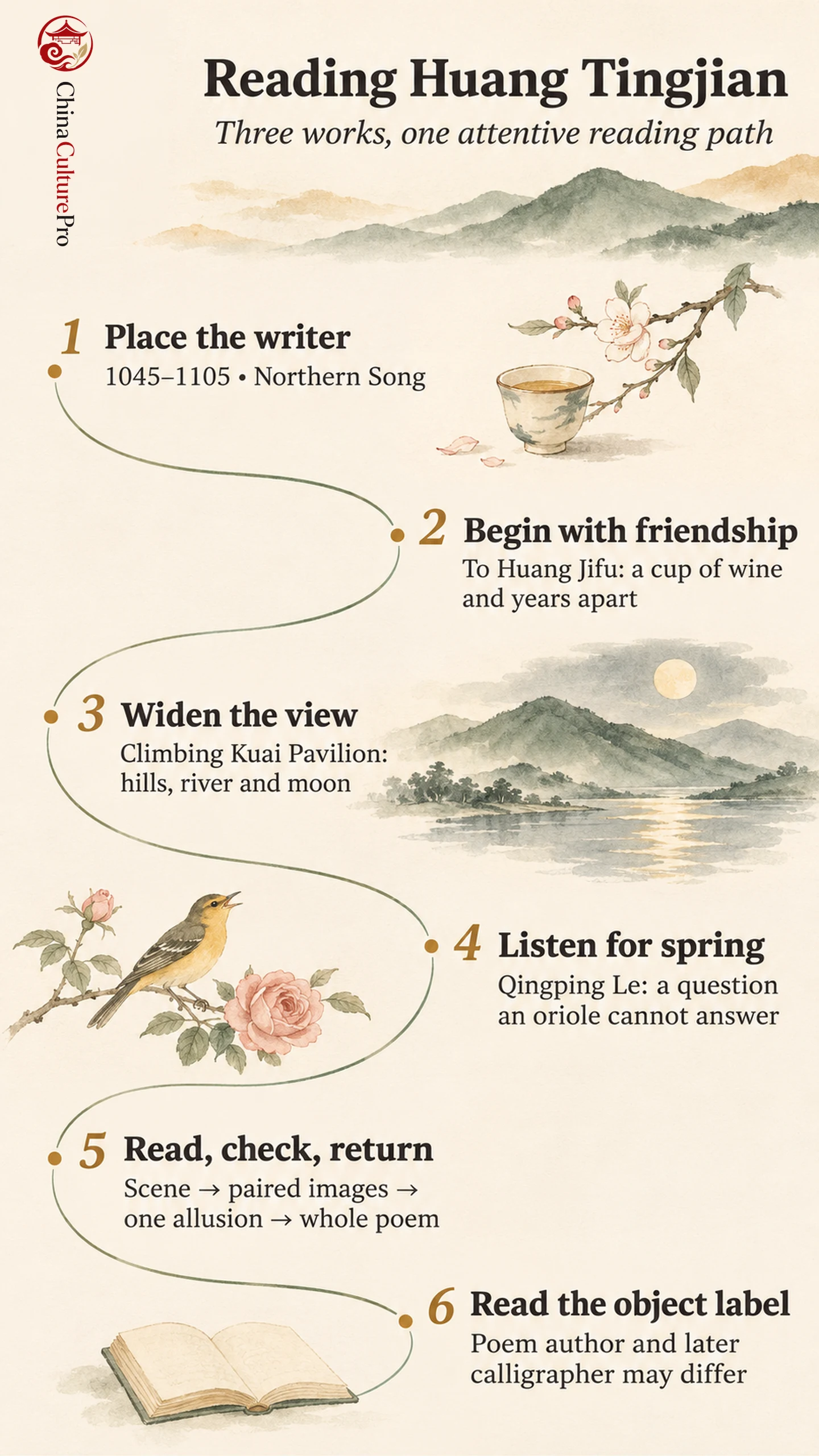
In To Huang Jifu, the central couplet reads “桃李春风一杯酒,江湖夜雨十年灯。” A working translation is: “Peach and plum blossom, spring wind, a cup of wine; rivers and lakes, night rain, ten years by the lamp.” The lines place clusters of images beside one another instead of explaining the emotion in a sentence. Shared brightness gives way to dispersed places, darkness and prolonged separation.[5]
Climbing Kuai Pavilion offers another celebrated pair: “落木千山天远大,澄江一道月分明。” Here rendered: “Leaves fall across a thousand hills; the sky opens wide. Along a clear river, the moon shines distinct.” The eye moves from many hills into one bright river. Later wishes for a homeward boat and companionship with gulls can be read as a desire for release, rather than evidence that Huang actually retired at that moment.[4]
The ci begins “春归何处?”—“Where has spring gone?” It imagines someone calling spring back to stay. An oriole might know the answer, yet no one understands its song; it flies over roses. On this reading, seasonal loss becomes a conversation that cannot be completed. These English renderings are brief working translations of the original texts.[6]
How to Read His Allusions
- Locate the scene: Identify who speaks, the visible setting and any named recipient before consulting a biography.
- Compare paired images: In the friendship couplet, set the cup of wine beside the years of lamplight and notice what changes.
- Check one reference: The geese in the opening of To Huang Jifu draw on stories of carrying letters; the annotation helps explain why communication fails.[3]
- Return to the whole poem: Ask how the reference changes the scene, rather than treating its identification as the final answer.
For another Song writer working extensively in ci, continue with Xin Qiji(辛弃疾,xīn qìjí).
Poetry and Calligraphy Are Related, but Not Identical
Huang also wrote poems about calligraphy; research on those poems examines their judgments about learning and artistic practice.[2] At the Metropolitan Museum, however, Transcriptions of Four Poems by Huang Tingjian names Shen Yinmo(沈尹默,shěn yǐnmò)as the calligrapher and dates the sheets to the twentieth century. Read the poet’s name and the artist credit separately.[7]
FAQs About Huang Tingjian
Which Huang Tingjian Poem Should I Read First?
Try To Huang Jifu. Its contrasting images make friendship and separation accessible before you explore its classical references.[5]
Is Qingping Le a Unique Poem Title?
No. It is a ci tune name; identify Huang’s lyric by its opening question about where spring has gone.[6]
Is Every Scroll of His Poetry in His Own Hand?
No. Later calligraphers copied his poems. Museum labels distinguish the author of the words from the person who wrote the displayed object.[7]
Fuentes
[1] Library of Congress. Complementary Compilation of Shangu’s Ci Poetry
[2] Woo Jae Ho. A Study on The poetry that treats of Calligraphic of Huang Tingjian
[3] Hong Kong Education Bureau. 寄黃幾復: Text and Annotations
[4] Huang Tingjian, Wikisource. 登快閣
[5] Huang Tingjian, Wikisource. 寄黄幾復
[6] Huang Tingjian, Wikisource. 清平樂: 晚春
[7] The Metropolitan Museum of Art. Transcriptions of Four Poems by Huang Tingjian