

Quick Answer: How Do You Read a Chinese Stele Inscription?
A Chinese stele(碑,bēi)is an inscribed standing stone. To read one, identify its physical form, map the writing and separate the text’s subject from the people who produced it. If you are using a rubbing(拓片,tàpiàn), you are examining a paper record of a carved surface.[1][2]
- Object: Distinguish the stone, its paper impression and a modern typed reading.
- Text: Establish the sequence, names, responsibilities and dates.
- Evidence: Keep damage, later carving and uncertain readings visible in your notes.
A date in the inscription does not automatically date the sheet in front of you.
A date cut into stone can describe a dedication, a person’s life or a later act of copying. The name nearby may identify the subject rather than the person who composed the text. Establish these distinctions before translating line by line or interpreting the calligraphy.
First Identify the Stone, Rubbing or Transcription
A rubbing records the surface through paper and ink. For an incised inscription, the recessed strokes commonly appear white against a dark field. That contrast is part of the recording process; it does not mean the carved characters were originally painted white.[2]
A transcription(釋文,shìwén)renders the characters as readable text. It may supply standardized forms, punctuation or proposed restorations. Keep it beside the photograph or rubbing rather than using it as a substitute for the source. You need to see where the editor has resolved something the surface leaves uncertain.
Also identify the kind of stone record. A standing monument, a tomb inscription and a text cut directly into a cliff are related forms of epigraphic evidence, but they are not physically interchangeable. A calligraphy album can preserve impressions from carved models without reproducing an entire freestanding monument.[1]
The guide to Chinese stone rubbings explains the paper medium. Here, the task is to recover the inscription’s sequence and information while keeping that medium clear.
Read the Layout and Separate the People Named
The usual traditional writing direction is downward in columns progressing from right to left. Check the actual arrangement rather than assuming that a modern display’s panel order reproduces it. Different calligraphy styles can also change how recognizable a character looks.[3]
Look for a stele heading(碑額,bēi’é), the main text and any smaller concluding or side inscriptions. These are things to check, not a compulsory three-part template. The Yan Qinli Stele(顏勤禮碑,Yán Qínlǐ Bēi), for example, has writing on three faces but no inscription on its head. A frontal crop will not show its complete text.[4]
The people responsible for a monument can occupy different roles. Cataloging practice distinguishes the following responsibilities rather than assigning them all to the most prominent name.[5]
| Responsibility | What the label identifies |
|---|---|
| Text author(撰文者,zhuànwénzhě) | The person who composed the wording |
| Calligrapher(書丹者,shūdānzhě) | The person who supplied the written model for the inscription |
| Engraver(鐫刻者,juānkèzhě) | The person who cut the design or text into the material |
One person may fill more than one role. The Yan Qinli record identifies Yan Zhenqing as both composer and writer of the inscription commemorating his great-grandfather. It does not make the commemorated Yan Qinli the writer, nor does “composed and wrote” identify the stonecutter.[4]
Assign Each Date to the Right Event or Object
The Palace Museum’s Yan Qinli entry describes a Republican-period rubbing of a stele erected in 779 and rediscovered in 1922. These dates describe different things: the carved monument, its recovery and the later paper impression. Recording only “779” for the paper loses that distinction.[6]
A reign-era name(年號,niánhào)can appear with a numbered year: the Yan Qinli stele is dated to the fourteenth year of Dali(大曆,Dàlì), corresponding to 779 in its museum record. A separate cyclical designation uses the stem-branch cycle(干支,gānzhī)of sixty recurring pairs. Without other chronological context, the pair alone cannot select one unique year.[4][7]
The Mount Yi Stele(嶧山碑,Yìshān Bēi)makes the transmission layers especially clear. Its imperial text originates in 219 BCE, but a museum’s modern rubbings were taken from a much later, tenth-century stone. The original text, the surviving carved version and the paper impression belong to separate points in the work’s history.[8]
Another catalog explains that Chen Wenbao recarved the Mount Yi inscription in 993 using a copy associated with his teacher Xu Xuan. That is a transmission history, not evidence that modern paper survived from the Qin dynasty.[9]
For any date you record, add the event it describes: composition, death, burial, dedication, erection, recarving or impression. Include the month and day when legible, rather than converting a fragment into an unjustifiably exact date.
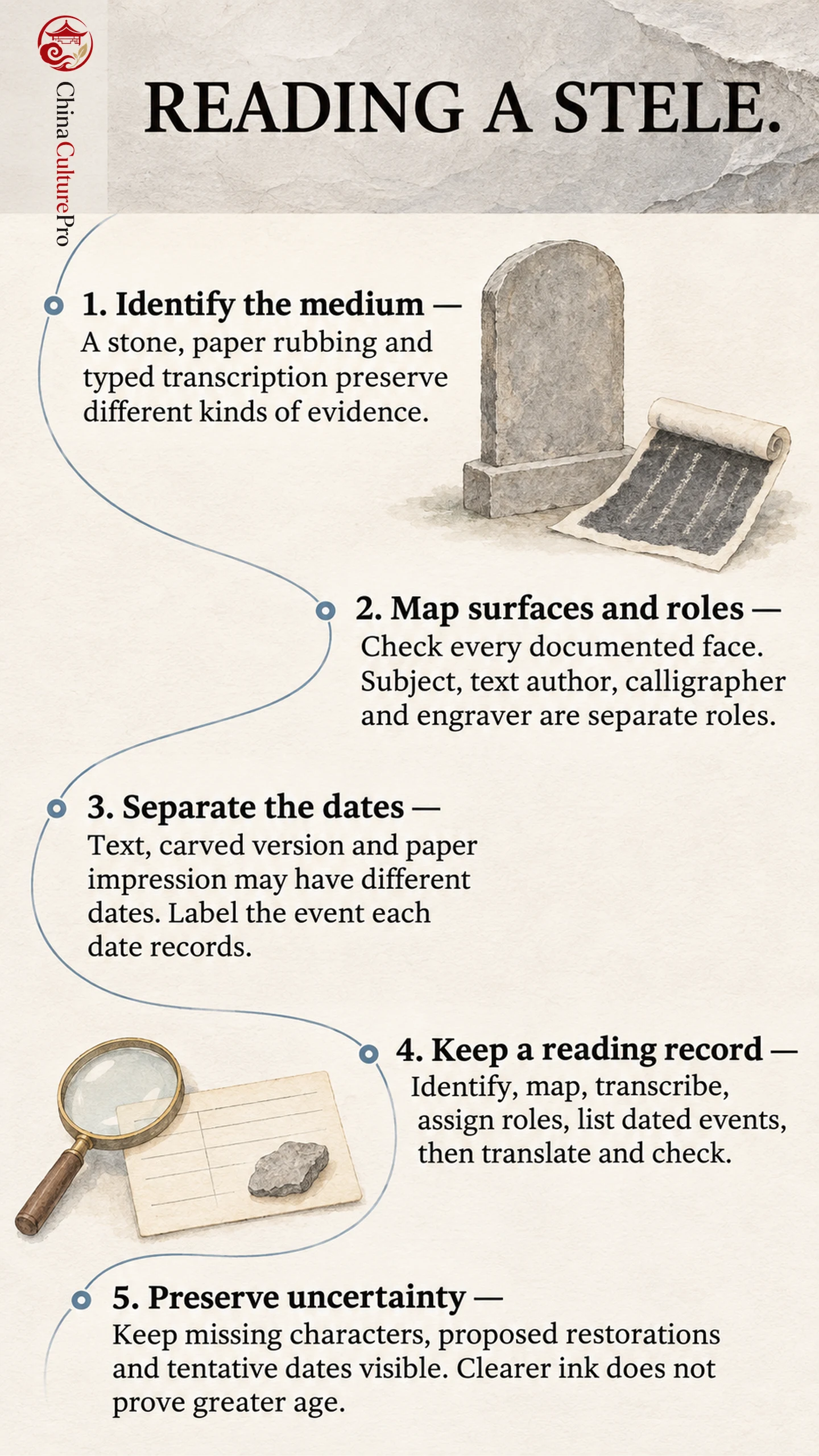
A Six-Step Reading Record for an Inscribed Stone
A useful catalog record preserves the title, people responsible, location, carving and impression dates, script and later notes. These separate fields provide a practical model for your own reading record.[10]
- Identify the source: Record the museum or collection, object identifier and whether you have a stone photograph, rubbing or transcription.
- Map the surfaces: Label the front, back and sides when documented. Save the whole view and mark the sequence of panels or album leaves.
- Transcribe with locations: Work in the established reading order. Attach a face, column or line reference to each passage; mark missing or doubtful characters.
- Identify people and actions: Separate the subject, author, writing-model provider, engraver and patrons where the wording supports those roles.
- Keep a dated event list: Copy each date as written and state what it dates. Place any proposed calendar conversion beside its supporting evidence.
- Translate and check: Translate the passage, compare it with the documented transcription and preserve unresolved alternatives in your final note.
Another reader should be able to find the same passage from your note. If you have only a cropped photograph, say so instead of claiming to have read the complete monument. A translation can remain useful while acknowledging that a side inscription or the beginning of a column is missing.
Use Damage and Catalog Readings Carefully
Cracks, worn strokes and later alterations can change what a surface appears to say. Comparing impressions may help establish changes, but identifying an earlier or more reliable state requires actual comparison, not the assumption that the darkest or clearest sheet is oldest.[1]
A cataloged rubbing of the Gou shen song stele offers a concrete example of visible uncertainty. Its damaged date is rendered as 十[三], “thirteen,” with the restored character bracketed, supporting the catalog’s 778 dating. The paper impression itself is dated tentatively to the late nineteenth or early twentieth century. Preserve the restoration and the question mark; neither should disappear from your notes.[11]
Finally, ask what kind of statement the text makes. A commemorative inscription presents a person, event or institution through the wording selected for that monument. Translate the claim accurately, then compare it with other evidence before turning praise into an independent historical conclusion.
FAQs About Chinese Stele Inscriptions
Is a rubbing the same age as the stele?
Not necessarily. The original text, carved surface and paper impression can have different dates.
Does the name on a stele identify its engraver?
Not necessarily. It may name the subject, author, calligrapher, donor or another participant.
Are all stele inscriptions read from right to left?
Traditional vertical text commonly follows that order, but check each surface, panel and catalog description.
Can missing characters be restored from context?
Sometimes scholars propose restorations. Keep those proposals visibly distinct from characters that survive on the surface.
Fuentes
[1] Palace Museum. Stele and model-calligraphy rubbings: the Gumei Forum lecture
[2] Field Museum. Chinese Rubbings Collection
[3] Dawn Delbanco, Metropolitan Museum of Art. Caligrafía china
[4] Xi’an Beilin Museum. Yan Qinli Stele
[5] Wang Pei, National Library of China. Cataloging and evaluating stele and model-calligraphy rubbings
[6] Qin Ming, Palace Museum. Yan Qinli Stele rubbing
[7] Hong Kong Observatory. Heavenly Stems and Earthly Branches
[8] Metropolitan Museum of Art. Inscriptions from the Stele of Mount Yi
[9] Smithsonian National Museum of Asian Art. The Mount Yi Stele in seal script and colophon in standard script
[10] Capital Normal University Library / National Library of China. Introduction to the Cang Yongling stone-rubbing collection catalog
[11] Princeton University Art Museum. Gou shen song bei