


Quick Answer: What Is Put Chai Ko?
Put Chai Ko (砵仔糕, bō zǎi gāo; Mandarin reading) is a small steamed rice-flour cake associated with Hong Kong. White or brown sugar sweetens it, and red beans are a familiar optional addition.[1]
- Base: rice flour, water and sugar, often with a little added starch.
- Texture: a smooth, gently chewy set cake, with tender beans in the red-bean version.
- Serving: in a small bowl or lifted out onto skewers.[1][2][4]
The English label sticky rice pudding does not automatically mean glutinous rice flour.
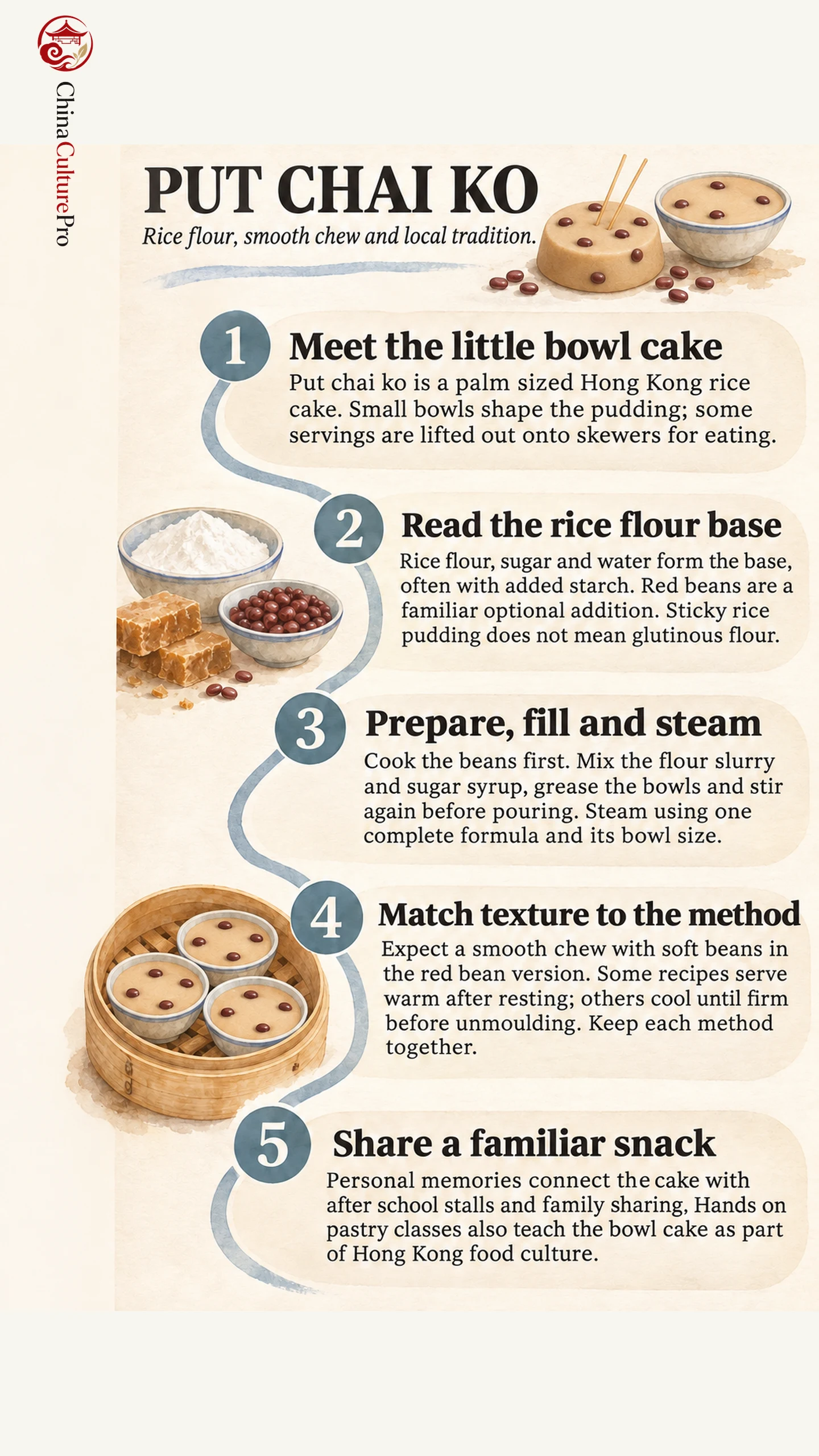
Individual bowls give the little cakes their rounded shape.[1][2]
A Small Bowl Cake in Hong Kong
The palm-sized cake is a familiar small-format snack in Hong Kong’s government street-food guide.[1]
A chef’s preparation uses heatproof bowls or ramekins, with the option of turning the cooked cakes onto skewers.[2]
Rice Flour, Sugar and Red Beans
A published home recipe combines these components:[3]
- Rice flour forms the body; it is mixed with water into a smooth batter.
- Sugar syrup supplies sweetness and changes the colour according to the sugar used.
- Added starch is part of some formulas; cooked red beans add a distinct soft bite.
Cook the adzuki beans before steaming the cakes; the chef’s preparation keeps the tender beans whole.[2]
How Put Chai Ko Is Steamed
One red-bean preparation follows four main stages:[2]
- Cook, sweeten and cool the beans.
- Mix the flour slurry and hot sugar syrup.
- Grease the bowls, add beans and re-stir the batter before pouring.
- In that four-bowl formula, steam for 20 minutes, rest for 5 minutes and serve warm.
Flour can settle, so re-stir before filling. Follow the selected formula for quantities, bowl size and timing.[2]
Texture, Cooling and Serving
A smooth, chewy rice-flour cake surrounds cooked red beans; it is not a filled pastry.[3][4]
Serving instructions differ. One chef’s version is served hot after a brief rest. A separate home recipe waits until the cakes have cooled and firmed before unmoulding; its added wheat starch is intended to make the texture lighter.[2][3]
Follow the chosen method’s setting and serving instructions instead of combining its steaming time with another formula’s cooling schedule.
Street-Snack Memories and Shared Skills
A Hong Kong-born cook recalls after-school stalls and later proposed these cakes for her daughter’s Año Nuevo chino party.[3]
A September 2026 college programme in Hong Kong offered hands-on put chai ko instruction from local pastry chefs, showing its place in cultural teaching.[4]
FAQs About Put Chai Ko
Does sticky rice pudding mean glutinous rice flour?
Not here. The official street-food description specifies long-grain rice flour. Follow the recipe’s flour type rather than interpreting the English nickname as an ingredient instruction.[1]
Must every put chai ko contain red beans?
No. The government guide describes them as an optional addition. Red-bean pudding is a familiar version, not the only possible form.[1]
Should put chai ko be served warm or cold?
Both warm and cooled preparations are documented. Follow one complete recipe’s instructions so its texture and unmoulding method work together.[2][3]
Fuentes
[1] Hong Kong Home Affairs Department. Street-food tour map: put chai ko
[2] ArChan Chan. Red bean puddings: Put chai go
[3] Rice Bowl Tales. Red bean rice-flour pudding: a family New Year snack
[4] Shaw College, Chinese University of Hong Kong. Hong Kong Traditional Treats Workshop