
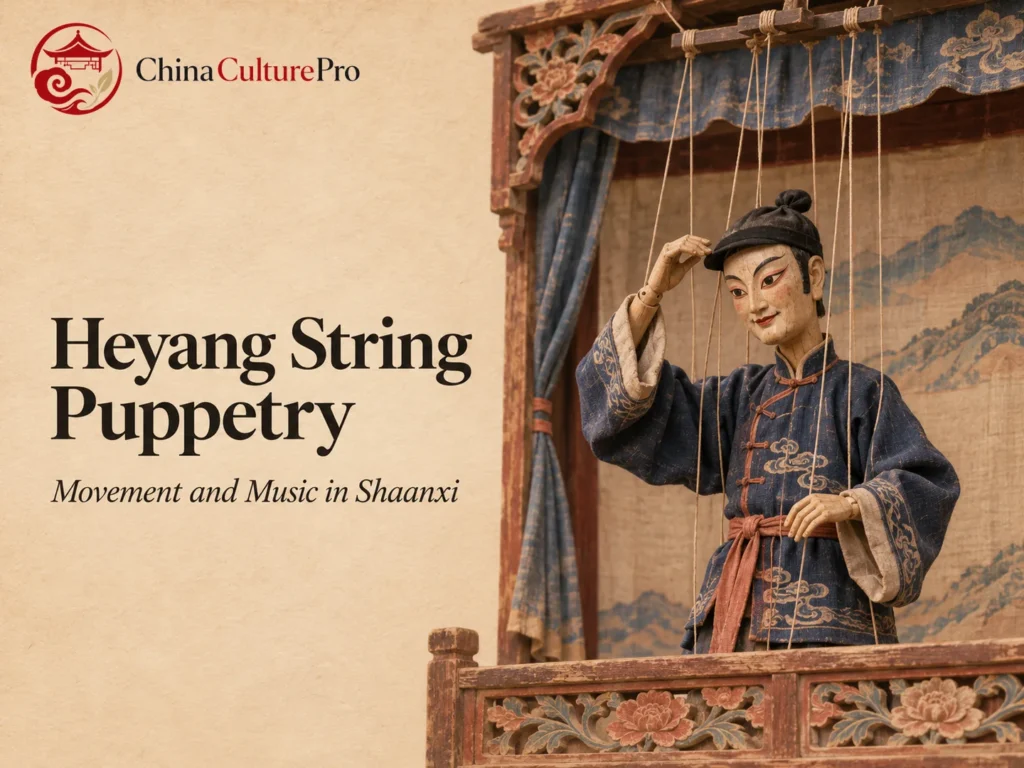

Quick Answer: What Is Heyang String Puppetry?
Heyang string puppetry (合阳提线木偶戏, Héyáng Tíxiàn Mù’ǒuxì) is an opera tradition from Heyang County in eastern Shaanxi. Locally it is known as xianxi (线戏, xiànxì), or string theater. Performers work suspended figures while the voices and instruments give the scene its words, melody and rhythm.[1][2][3]
- Look: Strings allow different parts of the figure to move.[1][2]
- Listen: Local singing can be heard alongside bowed strings and percussion.[1][3]
- Repertoire: The tradition includes short comic scenes and more extended stories.[3][4]
Follow the motion of a single hand or the head as a voice delivers a line. The puppet’s acting depends on the timing of both.

When a puppet takes off a hat, the hand has to meet the brim and the head has to stay in position. The gesture can make the audience see a character taking off a hat before they think about the strings.
How the Puppet Moves on Its Strings
A Heyang marionette hangs from a set of strings controlled from above. Movement in a hand, head or torso gives the figure posture and expression. The Shaanxi cultural center describes figures around 80 to 90 centimeters tall and examples with only a few strings or more than twenty, depending on the character.[1][2]
When a puppet moves a chair, watch where its head turns and how the hands meet the object. The movements can make it look as if the puppet has noticed the chair and decided where to put it. It is also one way this form of Chinese puppetry turns a simple gesture into a scene.[1][2]
What Makes the Heyang Sound Distinct
The local vocal tradition is called xianqiang (线腔, xiànqiāng). In Heyang it can be sung in the local speech variety. The bowed pixianhu (皮弦胡, píxiánhú) sounds alongside percussion such as the maluo gong (马锣, mǎluó) and the zhengzi (铮子, zhēngzi).[1][3][6]
A bowed phrase can give a line room to develop while the percussion punctuates its timing. A listener can follow the sustained sound and the shorter accents separately, then see how they coincide with the puppet’s movement.[1][3]
Comic Skits and Longer Plays
Lai Baozi (赖包子, Lài Bāozi) is a locally distinctive comic character. Fan Pen Li Chen’s English collection includes a skit named for him. Local accounts in the collection connect him with an older figure known as Baldy Guo.[4]
A documented puppet production of Du Shiniang (杜十娘, Dù Shíniáng) gives a different point of entry. It presents a well-known story through local puppet acting and song. Compare the kind of gesture that suits a short clown scene with the pauses and reactions a longer drama can sustain.[3][4]
How the Heyang Repertoire Was Passed Down
Around the transition from Ming to Qing rule, Li Guan (李灌, Lǐ Guàn) revised the music, repertoire and construction of the puppets. During the Qing dynasty, Heyang performers traveled to cities including Suzhou, Yangzhou and Beijing.[1]
Wang Hongmin (王红民, Wáng Hóngmín) entered the Heyang troupe in 1982 and worked on string control and comic and painted-face parts. His documented repertoire includes a comic play about a peddler, Selling Sundries (卖杂货, Mài Záhuò). Published transcriptions give readers access to some of the scripts alongside the records of performance.[4][5]
FAQs About Heyang String Puppetry
Is Heyang string puppetry the same as shadow puppetry?
The Heyang figures are three-dimensional and hang from strings. In shadow puppetry the audience sees a figure’s silhouette on a screen.[1][4]
Can xianqiang also be performed by people onstage?
Yes. The vocal tradition also developed into a form sung and acted by people onstage. The national heritage list has a separate entry for xianqiang in the Yellow River region.[6]
Fuentes
[1] China Intangible Cultural Heritage Network. Heyang String Puppetry
[2] Shaanxi Provincial Cultural Center. Heyang String Puppetry
[3] China National Radio. String Puppetry in Heyang
[4] Fan Pen Li Chen. Marionette Plays from Northern China
[5] China Intangible Cultural Heritage Network (Red del Patrimonio Cultural Inmaterial de China). Wang Hongmin
[6] China Intangible Cultural Heritage Network (Red del Patrimonio Cultural Inmaterial de China). Xianqiang Opera