
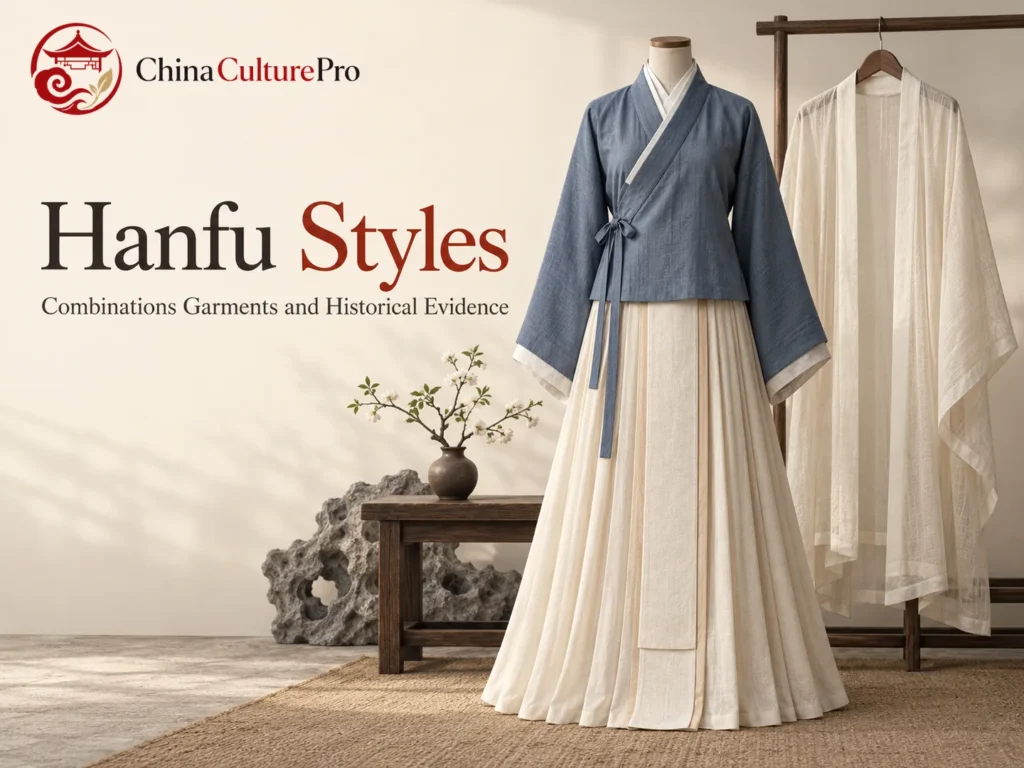

Quick Answer: What Are the Main Hanfu Styles?
Hanfu(汉服,hànfú)covers a range of historically grounded Han Chinese clothing forms and their modern revivals. Common names describe different things, so a useful first distinction is between an outfit combination and one component.
- Combinations: A short upper garment with a skirt, or a jacket with a skirt, names an ensemble of separate pieces.
- Garments: Joined robes, outer layers and pleated skirts are individual items that can belong to larger outfits.
- Descriptors: A round collar, crossed front or particular waist position adds detail to a garment name.
Historical period, fabric and modern adaptation further distinguish examples within each group.
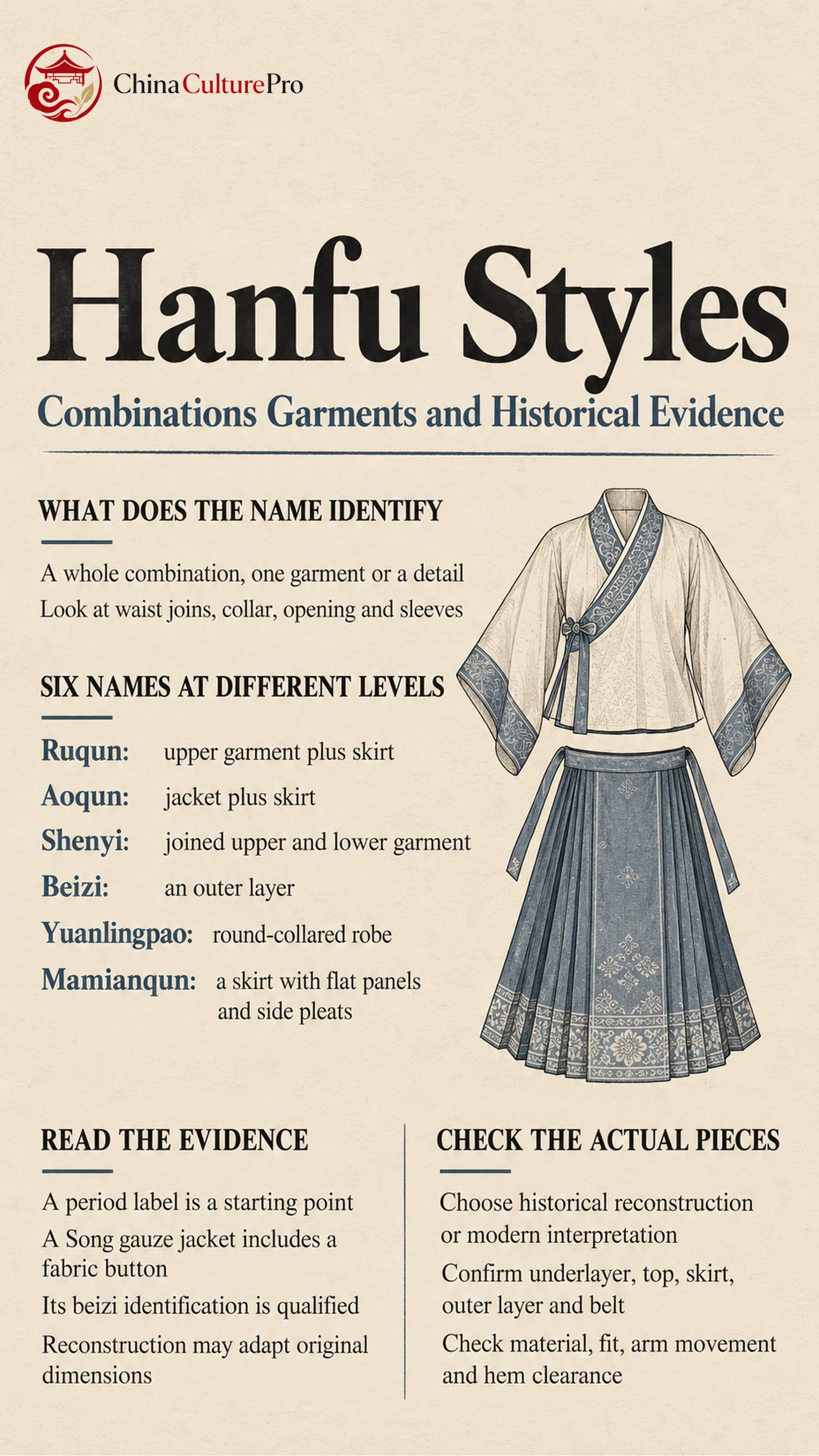
A skirt, a robe and a jacket-and-skirt combination can all appear on a list of Hanfu styles. They are useful names, but they do not identify equivalent units. This guide to Hanfu explains six familiar forms through their construction, then shows how to read period labels and assemble their components.
Read the Name at the Right Level
Start by asking what the label identifies. Does it describe everything worn on the body, just the upper garment, or only the skirt? An outer layer may be photographed over an already complete combination, making three visible pieces look like a single named style.
Next, inspect the relationship between the pieces. A separate top and skirt meet at a waistband; a joined upper-and-lower garment connects the sections at the waist. A collar describes the neckline, while a wrap or front opening describes how the body closes. Sleeve width adds another independent detail. These observations are more informative than deciding that every long, loose silhouette is the same kind of robe.
Hanfu is also one part of the broader field of traditional Chinese clothing. The term does not encompass every community’s dress in China, and the six names below are a practical introduction rather than a complete national wardrobe.
Six Hanfu Forms and What Their Names Describe
| Nombre | Qué identifica | Recognition point and boundary |
|---|---|---|
| Ruqun(襦裙,rúqún) | An upper-garment-and-skirt combination | The upper and lower pieces remain separate. The name alone does not establish skirt height, sleeve width or one exact historical pattern.[1] |
| Shenyi(深衣,shēnyī) | A garment joining upper and lower sections | Its connected structure differs from a separate top and skirt. “One garment” does not mean that it was cut from one unbroken piece of cloth.[2] |
| Aoqun(袄裙,ǎoqún) | A jacket-and-skirt combination | In Ming clothing discussions, the jacket is commonly distinguished from a lighter unlined upper garment by its lining and greater warmth. Padding is not a requirement for every example.[3] |
| Beizi(褙子,bèizi) | An outer garment associated especially with Song dress | Often recognized by its straight, parallel front and side openings. Length, fabric and fastening require closer inspection; the word alone does not specify every detail.[4] |
| Yuanlingpao(圆领袍,yuánlǐng páo) | A round-collared robe | The neckline is the defining feature in the name. Tang examples are prominent, but sleeve proportions and uses changed, and round-collared robes are not exclusive to that dynasty.[5] |
| Mamianqun(马面裙,mǎmiànqún) | A skirt with overlapping flat panels and side pleats | It is a lower garment, not an entire outfit. It can appear as the skirt within a jacket-and-skirt ensemble.[3] |
The distinction between ruqun and aoqun concerns the upper garment as well as the combination. It should not be reduced to “one is always Tang and the other is always Ming.” For a concrete later example, Ming clothing discussed alongside excavated skirts includes crossed-front jackets worn with mamianqun; that example supports a particular pairing, not a compulsory rule for every modern outfit.[3]
The mamianqun guide examines the skirt’s overlapping panels and pleats in more detail. A mamianqun can therefore be one component of an aoqun.
What Dynasty Labels Can and Cannot Tell You
“Tang-inspired,” “Song-style” and “Ming-style” can help locate a visual reference, but a dynasty spans changing fashions, different regions and different social settings. A period label becomes more useful when accompanied by a specific object, image or construction study.
A Tang pottery figure wearing a round-collared robe gives a concrete example of that silhouette. Its accompanying description also distinguishes narrower earlier sleeves from later looser proportions. It therefore supports variety within Tang dress, rather than one fixed outfit for everyone throughout the period.[5] A broader Chinese clothing history places such examples in sequence.
Surviving garments can also complicate familiar rules. A Song gauze jacket has a parallel front, narrow sleeves, long side vents and a fabric button. Its catalogue cautiously suggests that the form may be called a beizi. Both details matter: the identification is qualified, and the fabric button supplies a specific historical fastening example.[4]
Modern reconstruction involves interpretation as well as observation. A Southern Song clothing workshop based its jacket and wrap skirt on excavated garments from the Zhou family tomb at De’an. Its research involved measurement, sample making and revision; participants could reproduce the original dimensions or adapt the size while following the studied methods.[6] A reconstructed pattern and a garment made to the original wearer’s measurements are therefore different claims.
Choosing a Complete Outfit
Choose the purpose first. For a historically focused reconstruction, look for the cited reference and ask which parts of the pattern, textile and wearing arrangement follow it. For a modern interpretation, identify the historical starting point and the adjustments made for the current wearer. The description should make that purpose clear.
Then check the actual contents of a set: upper garment, skirt or trousers, any underlayer, outer layer and belt. A photograph may include a separate accessory that is not part of the listed combination. Confirm how the pieces meet at the waist and which garment is intended to sit above the others. Our how to wear Hanfu guide covers the dressing sequence and closures.
Finally, assess the material and movement. A flowing photograph cannot tell you the fiber content, lining or weight. The guide to silk clothing helps separate fabric terminology from a garment’s shape. When trying an outfit, sit down, raise your arms and walk normally; check that the waistband remains secure and the hem clears your feet. These checks concern the individual garment, rather than a promise that any named style automatically fits every occasion or wearer.
FAQs About Hanfu Styles
Are all Hanfu outfits cross-collared?
No. Round-collared robes and parallel-front outer garments are among the other forms. A crossed neckline is one construction feature, not a definition covering every Hanfu garment.
Does one-piece mean one uncut piece of fabric?
No. It can mean one finished garment assembled from several cut sections. A joined upper-and-lower structure should not be confused with cutting the entire robe from a single continuous panel.
Are Hanfu styles restricted to one gender?
Gender conventions belong to particular periods, garments and uses. A named structural category alone is insufficient to establish every historical restriction or every modern wearing choice.
Is every flowing Chinese-inspired costume Hanfu?
No. Flowing fabric is an appearance, not evidence of construction or historical reference. Ask whether the outfit is presented as a reconstruction, a modern Hanfu interpretation or a fantasy costume.
Fuentes
[1] Guangdong Daguan Museum. How Did Han-Dynasty Women Dress?
[2] National Museum of China. Ancient China: Qin and Han Clothing
[3] Yichang Museum. Ming-Dynasty Mamianqun and Jacket Ensembles
[4] China National Silk Museum. Luo Gauze Unlined Jacket
[5] National Museum of China. Male Pottery Figure
[6] China National Silk Museum. Reconstructing Southern Song Jackets and Two-Piece Wrap Skirts