


Quick Answer: What Is Hainan Hele Crab?
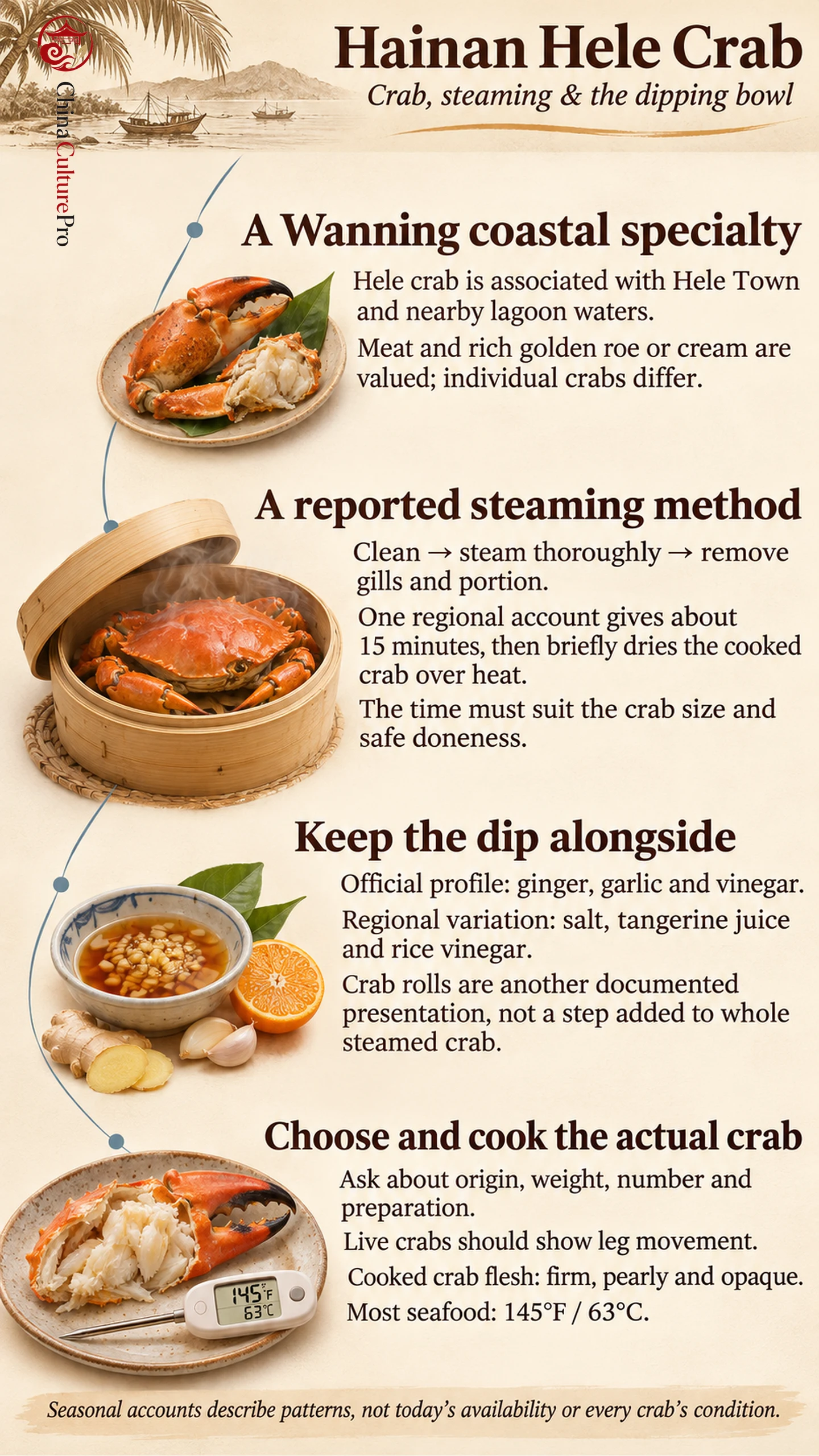
Hele xie (和乐蟹; Hèlè xiè), or Hele crab, is a coastal specialty associated with Hele Town in Wanning, Hainan. Steaming and a ginger, garlic and vinegar dipping sauce are prominent in the official food description.[1]
- Ingredient: A local crab associated with Wanning’s coastal lagoon environment.
- Cooking: A steamed preparation highlights the meat rather than covering it in a heavy sauce.
- Serving: The crab and its dipping sauce are separate parts of the meal.
The name identifies a local specialty, not a universal cooking time for every crab. Ask about origin, size and preparation when buying or ordering.
A steamed crab looks simple on the plate, but its size, cooking method and accompanying sauce still matter. This guide follows a documented Hele preparation and compares other presentations within Hainan cuisine, with practical questions for selecting a crab.
Hele Crab and Its Coastal Ingredients
A Hainan Daily feature places Hele crab among the mud crab group and describes its habitat around Gangbei Xiaohai and Laoyehai, where fresh and salt water meet. This coastal origin is more useful than assuming every crab sold on Hainan is the same local product.[5]
The official description values its meat and rich golden contents beneath the shell, comparing the color with salted duck egg yolk. This is a description of the prized eating qualities, not a promise that every individual crab has the same amount of roe or cream.[1]
For the simplest serving, the crab is the central ingredient and the sauce provides the contrast. Confirm whether a restaurant is using whole crab, portioned crab or picked meat, since those forms lead to different dishes.
A Traditional Steamed Preparation
The steaming style is called qing zheng (清蒸; qīng zhēng). A regional account describes the following sequence.[2]
- Clean the crab: Scrub the fresh crabs clean before cooking.
- Steam thoroughly: Steam over high heat. The regional account gives about 15 minutes, but the actual cooking must suit the crab size and reach safe doneness.
- Finish and portion: Remove the gills from the cooked crab. The same account briefly dries the cooked crab over heat before it is served with dipping sauce.
That finishing stage belongs to the reported preparation. Another official profile describes steaming with broth, showing why the broad word “steamed” does not supply every detail of a recipe.[1]
For home cooking, use directions matched to the crab size and equipment. FDA guidance gives 145°F (63°C) for most seafood and describes cooked crab flesh as firm, pearly and opaque. An orange shell alone is not the same as checking the meat’s doneness.[4]
The Chinese cooking methods guide explains steaming in the wider cooking repertoire.
Dipping Sauces and Other Presentations
Ginger, garlic and vinegar form the dipping sauce in the official English profile. Keep it alongside the crab so each mouthful can be seasoned to taste.[1]
A regional recipe account adds salt, tangerine juice and rice vinegar to minced ginger and garlic. The citrus is a concrete local variation, rather than a requirement for every seafood sauce.[2]
Steamed whole crab is not the only documented presentation. An official Hainan guide also features Hele crab rolls, describing a crisp exterior and tender crab filling. This is a different dish construction, not another finishing step for the crab above.[3]
When ordering, clarify which presentation is intended. A dish made with picked crab meat may be easier to portion, while a whole crab brings shell cracking and picking into the meal. The menu name alone may not tell you which will arrive.
Choosing and Serving a Crab
For live crabs, FDA guidance says to look for leg movement and notes that they spoil rapidly after death. If buying a prepared or frozen product, follow its specific storage and cooking instructions instead of treating it as a live crab.[4]
One regional account describes two seasonal windows: from the Tomb-Sweeping Festival to the Dragon Boat Festival, and from the Mid-Autumn Festival to the winter solstice. An English food overview emphasizes autumn. These are reported seasonal patterns, not a guarantee of today’s availability or every crab’s condition.[2][6]
Ask for the crab’s weight, the number being served and the intended cooking method. If roe is your priority, ask about the actual crab being offered. A cracker, pick and small plate for shells make a whole-crab meal easier to manage.
Hainan’s familiar four-dish group also includes Dongshan goat, Wenchang chicken and Jiaji duck. Hele crab supplies the seafood member of that group.[3]
Refrigerate perishables within two hours, or one hour above 90°F (32°C). Keep utensils used for raw seafood separate from cooked crab and its sauce.[4]
FAQs About Hainan Hele Crab
Where does Hele crab come from?
The specialty is associated with Hele Town in Wanning, Hainan, rather than being a generic name for any crab preparation.[1]
What dipping sauce is served with steamed Hele crab?
The official profile describes ginger, garlic and vinegar. A regional account also includes tangerine juice and salt.[1][2]
Does every crab need exactly fifteen minutes of steaming?
No. That time appears in one regional account. Use a method suited to the actual size and check that the crab is fully cooked.
Fuentes
[1] Hainan Provincial Government. Hele crab
[2] Hainan Daily, local food report via China Qiaowang. 万宁美食新与鲜、简而美 万千滋味叩开你心扉
[3] Hainan Provincial Government, Explore Hainan food guide. Hainan cuisine: Let the world fall in love with the taste of Hainan
[4] US Food and Drug Administration. Selecting and Serving Fresh and Frozen Seafood Safely
[5] Li Mengyao, Hainan Daily original crab survey feature. 海南周刊 | 琼岛蟹谱:从潮间“盲盒”到雨林“特有种”
[6] CGTN food overview via China News Service, Hainan Tourism Commission photo. Savoring Hainan delicacies from dawn to dusk