


Quick Answer: What Does Ge An Guan Huo Mean?
Ge An Guan Huo (隔岸观火, gé àn guān huǒ) literally means “watch a fire from across the river.” In everyday figurative use it describes someone who watches other people struggle while staying safely uninvolved. The phrase often implies indifference or a failure to help.[1][2]
- Literal image: A person watches a blaze on the opposite bank.[1][2]
- Modern use: Stand by while someone else faces trouble.[2]
- Literary use: The phrase also appears in the Thirty-Six Stratagems (三十六计, Sānshíliù Jì).[3]
Look at whether the speaker expects the observer to help. That expectation often determines the tone.
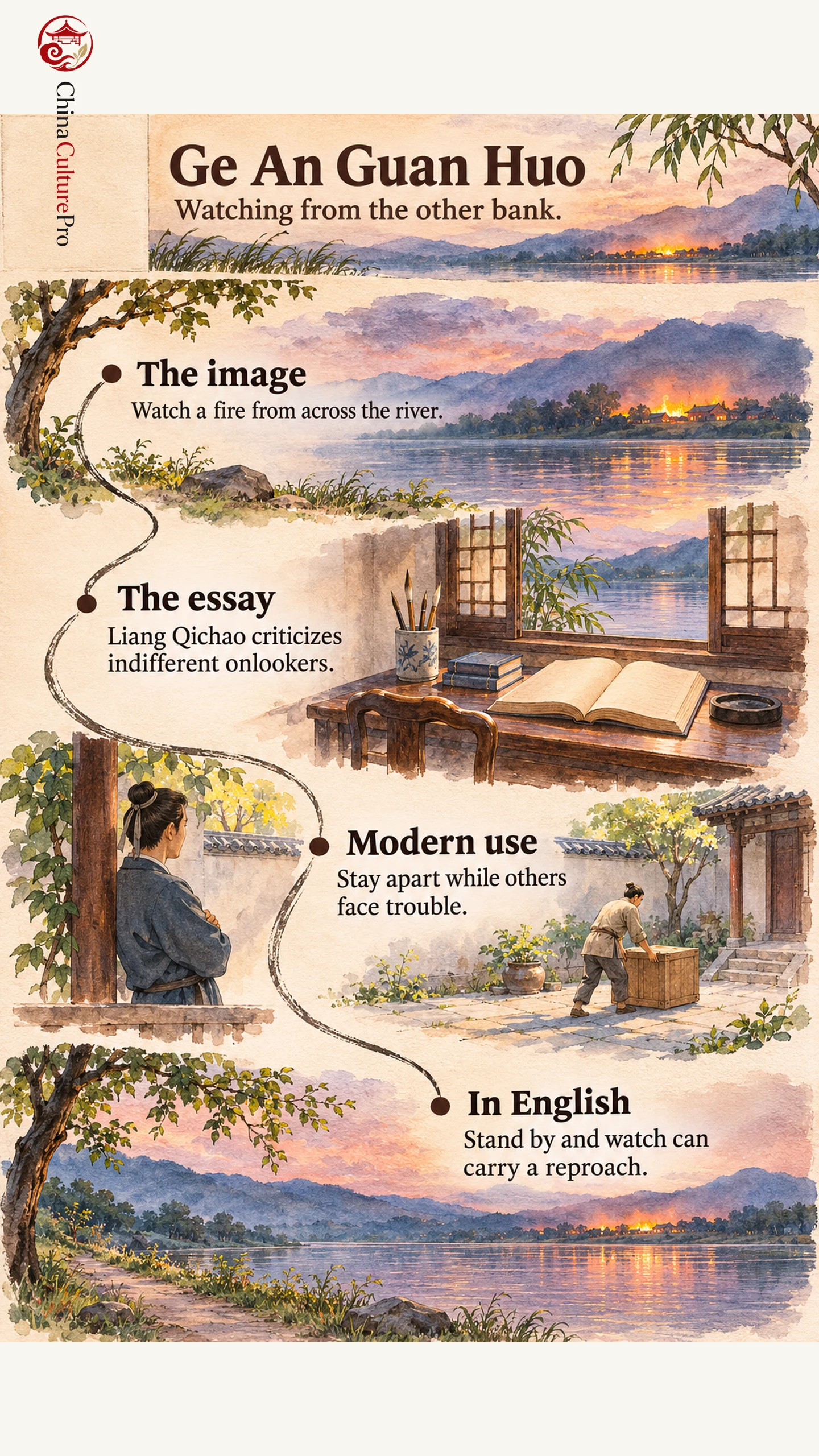
A river puts space between a person and a fire. That distance can be physical in a story, but figurative in an account of someone who treats another person’s trouble as none of their concern.[1][2]
The Riverbank Image
Gé means separated by something, àn is a bank or shore, guān means to watch, and huǒ means fire. The full expression pictures a person on one bank observing a fire on the other. The fire is close enough to see, even from the safety of the other bank.[1][2]
The distance becomes a figure for detachment. A writer using the phrase may be pointing out that the observer feels untouched by the problem. When the writer expects help, the phrase can sound like a reproach.[1][2]
Where the Image Appears in Writing
One possible literary source is Liang Qichao’s essay rebuking onlookers. It compares indifferent people to someone on an eastern bank who takes pleasure in the glow from a fire on the western bank. The passage supplies an image very close to the idiom’s everyday moral sense.[1]
The phrase is also a named entry in the Thirty-Six Stratagems, alongside expressions such as Diao Hu Li Shan (调虎离山, diào hǔ lí shān). The collection records a strategic context for the wording. That setting and Liang’s criticism are distinct evidence for how a similar image has been used.[1][3]
How to Use Ge An Guan Huo Today
Suppose several people watch a neighbor struggle with an everyday problem that they could easily help solve. A narrator might write 邻居遇到难处,大家却隔岸观火。 The phrase makes their decision to stay apart sound blameworthy. A translation like “everyone just stood by” can preserve that judgment.[2]
In a story about a dispute, a character can also be described as watching from the sidelines while others argue. To gauge the tone, ask what the narrator says the bystander owed to the people involved. The narrator’s expectations determine whether the distance sounds like indifference.[1][2][3]
Choosing an English Translation
“Stand by and watch” works when another person needs help. “Watch from the sidelines” can sound less accusatory when the writer stresses a lack of involvement. Keep the image of the far bank if the text is explaining the idiom or deliberately echoing the fire scene.[1][2]
FAQs About Ge An Guan Huo
Does the phrase describe a real fire?
It can depict a literal fire, but figurative uses concern someone staying apart from another person’s trouble.[1][2]
Is Ge An Guan Huo always critical?
In ordinary use it often criticizes indifference. A passage that emphasizes deliberate distance may give it a more detached tone.[1][2][3]
Is it listed in the Thirty-Six Stratagems?
Yes. It appears as one of the named entries in the received list.[3]
Fuentes
[1] Taiwan Ministry of Education. Idiom dictionary entry for 隔岸觀火
[2] Taiwan Ministry of Education. Revised dictionary entry for 隔岸觀火
[3] Taiwan Ministry of Education. Entry for 三十六計