


Quick Answer: What Is Fujian Oyster Omelet?
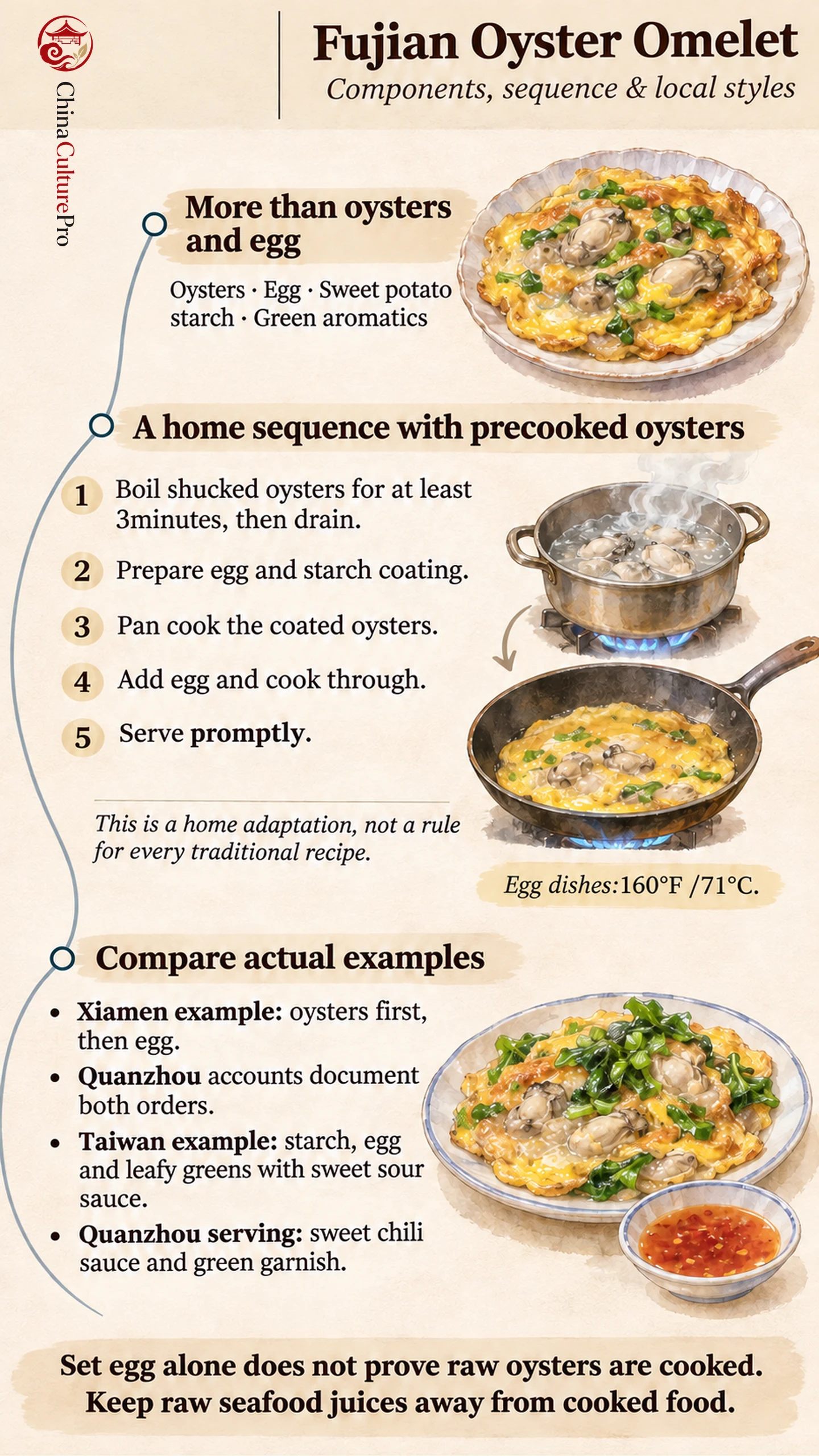
Fujian oyster omelet, commonly called hailijian (海蛎煎; hǎilì jiān), combines oysters, sweet potato starch, egg and green aromatics in a pan-cooked dish. It is more than oysters folded into a plain egg omelet.[3]
- Main texture: Starch binds the oysters and aromatics, while egg forms another part of the cooked mixture.[3]
- Local variation: Documented recipes differ in whether oysters or egg enter the pan first.[2][3]
- Serving: Sweet chili sauce and fresh green garnishes can accompany the omelet.[2]
This guide compares specific regional examples and gives a home sequence using precooked oysters. It does not assume that set egg alone proves the shellfish is cooked.
The appeal of oyster omelet lies in the contrast between seafood, egg and the starch-bound layer. Within Fujian cuisine, the proportions, aromatics and pan sequence vary. Choose the preparation you want before mixing ingredients, rather than treating every coastal version as one fixed recipe.
Oysters, Egg and Sweet Potato Starch
A Quanzhou description combines oysters with chopped green garlic or chives, sweet potato starch and seasonings, then adds beaten egg during cooking. Another local account includes scallion, garlic and ginger in the mixture.[3][2]
One Xiamen recipe uses light soy, salt, cooking wine and sweet potato starch with oysters, followed by two beaten eggs and scallion.[1]
The starch component is important when choosing what to buy. A recipe calling for sweet potato starch is not asking for a wheat-flour pancake batter. Likewise, choosing a different starch changes the preparation you are following; use a complete formula designed for that ingredient rather than assuming all powders behave identically.
Have the oysters, starch mixture, beaten egg, aromatics and serving sauce ready before heating the pan. This makes it easier to follow the intended order and concentrate on cooking rather than chopping while the base is already setting.
A Home Sequence with Precooked Oysters
For a home approach with a clear shellfish-cooking stage, the sequence below cooks the oysters before they enter the omelet. This is an adaptation of the pan method, not a claim that every traditional cook preboils oysters. The CDC lists boiling shucked oysters for at least three minutes as one cooking option.[5]
- Cook the oysters first: Boil shucked oysters for at least three minutes, following CDC guidance, then drain them before the pan stage.
- Prepare the egg and coating: Beat the eggs and prepare the chosen recipe’s sweet-potato-starch mixture and seasonings; coat the drained cooked oysters.
- Cook the oyster layer: Heat oil in the pan, add the coated oysters and let the starch layer set, adjusting the heat to avoid scorching.
- Add the egg and finish: Pour in the beaten egg, spread it around the oysters and turn the omelet as needed until the egg is fully cooked.
- Serve immediately: Transfer to a plate, add scallion or the chosen garnish, and offer garlic or chili sauce alongside.
Use the chosen recipe for the amount of starch, liquid, oysters and oil. The steps organize the precooked-oyster version; ingredient proportions still come from the selected recipe. Drain the boiled oysters before coating so their cooking water does not unexpectedly dilute the mixture.
The FDA gives 160°F (71°C) for egg dishes. Check the cooked mixture rather than using a golden surface as the only endpoint. Avoid transferring raw seafood juices to the finished omelet or its serving plate.[6][5]
Xiamen, Quanzhou and Taiwan Examples
The Xiamen example cooks oysters before adding egg; the Quanzhou heritage account puts egg into the pan first.[1][2]
Yet another Quanzhou municipal description adds egg after the oyster mixture. Both sequences are documented; a city name alone does not establish every cook’s order.[3]
Taiwan’s tourism description provides another comparison. It names potato starch and tapioca around the oysters, with egg and leafy vegetables, then a sweet-and-sour sauce. That is a particular account of a related snack, rather than proof that every Taiwanese omelet uses one starch blend or that all Fujian versions exclude leafy greens.[4]
Compare the component list and order, not just the finished photograph. Visible egg around the edge, a thicker starch layer or more greens can reflect a different recipe. Mixing one version’s batter ratio with another’s cooking schedule makes the outcome harder to predict.
Sauces and Serving the Omelet
The Quanzhou heritage account offers sweet chili sauce and a garnish of celery leaves or coriander.[2]
Serve promptly after the final turn. Putting the sauce alongside allows diners to taste the oyster, egg and starch layer first, then add as much sweetness or heat as they want. A large pool of sauce changes the eating experience, so decide whether you want a dressed plate or a separate dip.
For the wider snack context, see Chinese street food; for technique, explore Chinese cooking methods.
Refrigerate perishables within two hours, or one hour above 90°F (32°C), and reheat leftovers to 165°F (74°C).[6]
FAQs About Fujian Oyster Omelet
Is Fujian oyster omelet just oysters and eggs?
No. Sweet potato starch and green aromatics are central to the documented Quanzhou preparations.[2][3]
Does the egg always go into the pan first?
No. The sources include both egg-first and oyster-mixture-first sequences. Follow one complete method.[1][2][3]
Does set egg prove the oysters are safely cooked?
No. Treat shellfish cooking as its own requirement. This home sequence uses the CDC’s option of boiling shucked oysters for at least three minutes before the pan stage.[5]
Fuentes
[1] Fujian Department of Commerce, recipe credited to Xiangha. 厦门海蛎煎
[2] Quanzhou gastronomy official heritage account. 蚵仔煎
[3] Quanzhou Municipal Government, local food description. 海蛎煎
[4] Taiwan Tourism Administration. Taiwan Snacks: Oyster Omelet
[5] US Centers for Disease Control and Prevention. Preventing Vibrio Infection
[6] US Food and Drug Administration. Safe Food Handling