

Quick Answer: What Is a Dudou?
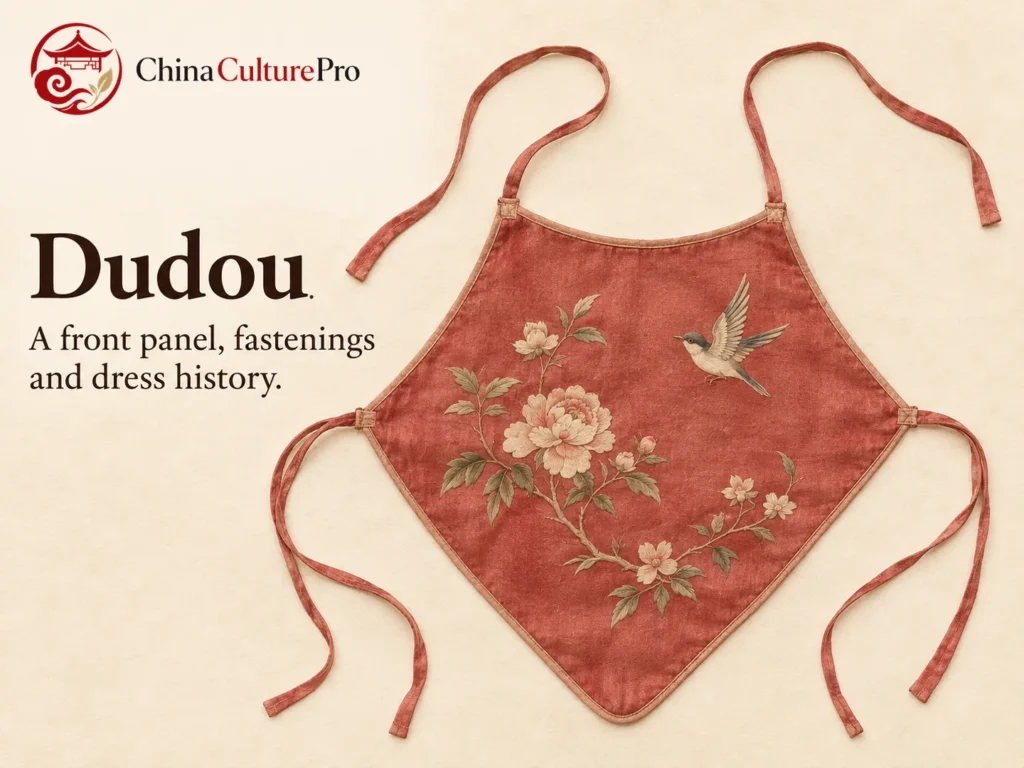
Dudou(肚兜,dùdōu)is a Chinese close-fitting garment that covers the front of the chest and abdomen. Tsinghua University Art Museum describes it as a small undergarment suspended at the front of the body.[1]
- The structure: A front panel is held in place by fastenings.
- The materials: Fabric, lining and worked decoration vary between examples.
- The wearers: Surviving objects and dress research document adult underlayers and children’s garments.
The word identifies a garment family, not one universal red diamond-shaped pattern. English labels such as “bib,” “apron” or “bellyband” describe aspects of its appearance but do not fully explain its construction or use.

A flat textile panel can carry a rich arrangement of flowers, birds or figures, with narrow fastenings extending from its edges. Turn it over and a lining or the reverse of the stitching may become visible. The dudou belongs to Chinese clothing history, where an underlayer can reveal as much about dress as an outer robe.
A Front Panel and Its Fastenings
The front panel provides coverage; the fastenings position it on the body. A Palace Museum infant’s garment is described as a four-sided form with one corner cut back and ties connecting adjacent corners behind the waist.[2] Its shape and attachment should be read together, rather than reduced to a decorative patch.
Neck and waist attachments can take different forms. A late Qing red satin dudou in the China National Silk Museum is suspended with silver chain.[3] That example broadens the picture beyond the cloth cords commonly associated with the garment.
The back is generally much more open than the front panel. An illustration laid flat can show the panel’s outline, but understanding how a particular piece sits requires following its straps, cords or other attachments. Missing fastenings also limit what can be reconstructed from a surviving textile alone.
Fabric, Lining and Pocket Details
The outer fabric, lining and embroidery are separate parts of the construction. The National Museum of History in Taipei records a blue dudou without a lining, while noting that other examples in its collection are lined.[4] A lining cannot be assumed from the garment’s name.
Shape varies too. A Tainan collection record describes a pink, single-layered, fan-shaped example with a pocket and flap, waist cords and neck attachments. Its decoration includes cross-stitch work.[5] The case shows how form, fastening and needlework combine in an individual garment.
Pocket descriptions need precision. The China National Silk Museum identifies an opening on a Republican-period child’s garment as possibly serving as a pocket.[6] The proposed pocket function remains uncertain. Openings and pockets need to be identified for each piece.
The guide to Chinese embroidery explains worked decoration; it should be considered alongside the fabric and seams that make the garment usable.
Adult Underlayers and Children’s Clothing
For an adult outfit, a dudou was one layer among others. Dress researcher Laurence Wen-Yu Li includes a reconstructed dudou in a late Qing women’s ensemble, alongside lower-body underlayers and outer clothing.[7] This research considers how underlayers affect the way an entire outfit sits, rather than treating them as isolated decorative textiles.
Children’s examples have their own scale and contexts. The Palace Museum identifies its red garment as infant clothing, while the China National Silk Museum explicitly catalogues an orange satin example for a child.[2][6] Together, the records place dudou within both adult underlayers and children’s clothing.
English translations need the same care. A label may call a child’s piece a bib or apron because of its front coverage, but its fastening and extent distinguish it from a small modern feeding bib. The guide to traditional Chinese children’s clothing places such garments among other age-specific forms.
Embroidery and Auspicious Wishes
Decoration could carry stories, wordplay and good wishes. Tsinghua’s blue example depicts children competing for a helmet, a visual pun associated with success, alongside other auspicious motifs.[1] The combined figures and motifs carry the interpretation.
Children’s clothing also carried protective symbolism. Hong Kong Heritage Museum curator Brian Lam described an exhibited dudou with a boy riding a tiger and driving away poisonous creatures. The imagery expressed a wish that the child would remain well.[8]
That is a record of belief, not evidence that embroidered clothing prevents illness. Such motifs can be understood alongside Dragon Boat Festival customs, while keeping symbolic protection separate from a garment’s physical coverage.
A dudou may be decorated with flowers, figures or geometric stitching, and richly worked examples are not all red. The Tsinghua and Taipei blue pieces alone show why one bright-red image cannot stand for every surviving object.
Surviving Examples and Modern Adaptations
The objects discussed here include Qing and Republican-period examples. They provide dated evidence for construction and use, without establishing one inventor or a single ancient pattern from which every later garment descended.
A surviving piece may also preserve an incomplete history. The Tainan record tentatively associates its fan-shaped dudou with a Hakka context.[5] The pocket and stitching are documented physical features; the regional attribution remains tentative.
Modern reconstruction offers another kind of evidence. Li’s ensemble is explicitly a reconstruction used in dress and museum-mounting research.[7] It helps explore how layers work together; it is not itself a newly discovered Qing artifact.
For a modern garment described as dudou-inspired, consider the construction and intended use stated by its maker. A contemporary top, a historical underlayer reconstruction and a museum textile can share a front-panel idea while belonging to different clothing contexts.
FAQs About Dudou
Are all dudou red?
No. Museum collections include blue, pink, orange and other examples, with varied fabrics and decoration.
Were dudou only for adult women?
No. Children’s dudou are well documented, including infant and later child-sized examples.
Do all dudou have pockets?
No. Some records describe pockets, while an opening on another piece is only tentatively identified as one.
Is a dudou the same as a modern bra?
No. The historical garment’s front coverage and fastening structure need their own explanation; the modern comparison is incomplete.
Fuentes
[1] Tsinghua University Art Museum. Blue Satin Dudou with Auspicious Figures
[2] Yin Anni, Palace Museum. Red Patterned Infant’s Dudou: Shape, Lining and Ties
[3] China National Silk Museum. Late Qing Red Satin Dudou with Silver-Chain Fastening
[4] National Museum of History, Taipei. Blue Dudou: Fabric, Decoration and Unlined Construction
[5] Tainan Cultural Bureau. Fan-Shaped Dudou: Pocket, Fastenings and Proposed Regional Context
[6] China National Silk Museum. Orange Satin Child’s Dudou with Bird-and-Flower Embroidery
[7] Laurence Wen-Yu Li. Beyond the Flat Case: Reconstructing and Mounting Late Qing Garments
[8] Hong Kong Government, with Heritage Museum Curator Brian Lam. Chinese Children’s Wear and Embroidered Wishes