


Quick Answer: What Defines Dongxiang Culture?
Dongxiang culture belongs to the Dongxiang(东乡族,Dōngxiāngzú), a distinct ethnic community centered in Gansu’s Linxia region. Language, Islamic traditions, oral literature, farming and household crafts contribute to its regional character. [1][4]
- Language: Dongxiang belongs to the Mongolic language grouping.
- Faith: Islam shapes important festivals and food customs.
- Oral arts: Narrative poetry and social songs have different forms and settings.
- Crafts: Wool felt and embroidered textiles involve separate material skills.
A shared language family or religion does not make Dongxiang people interchangeable with neighboring ethnic groups.
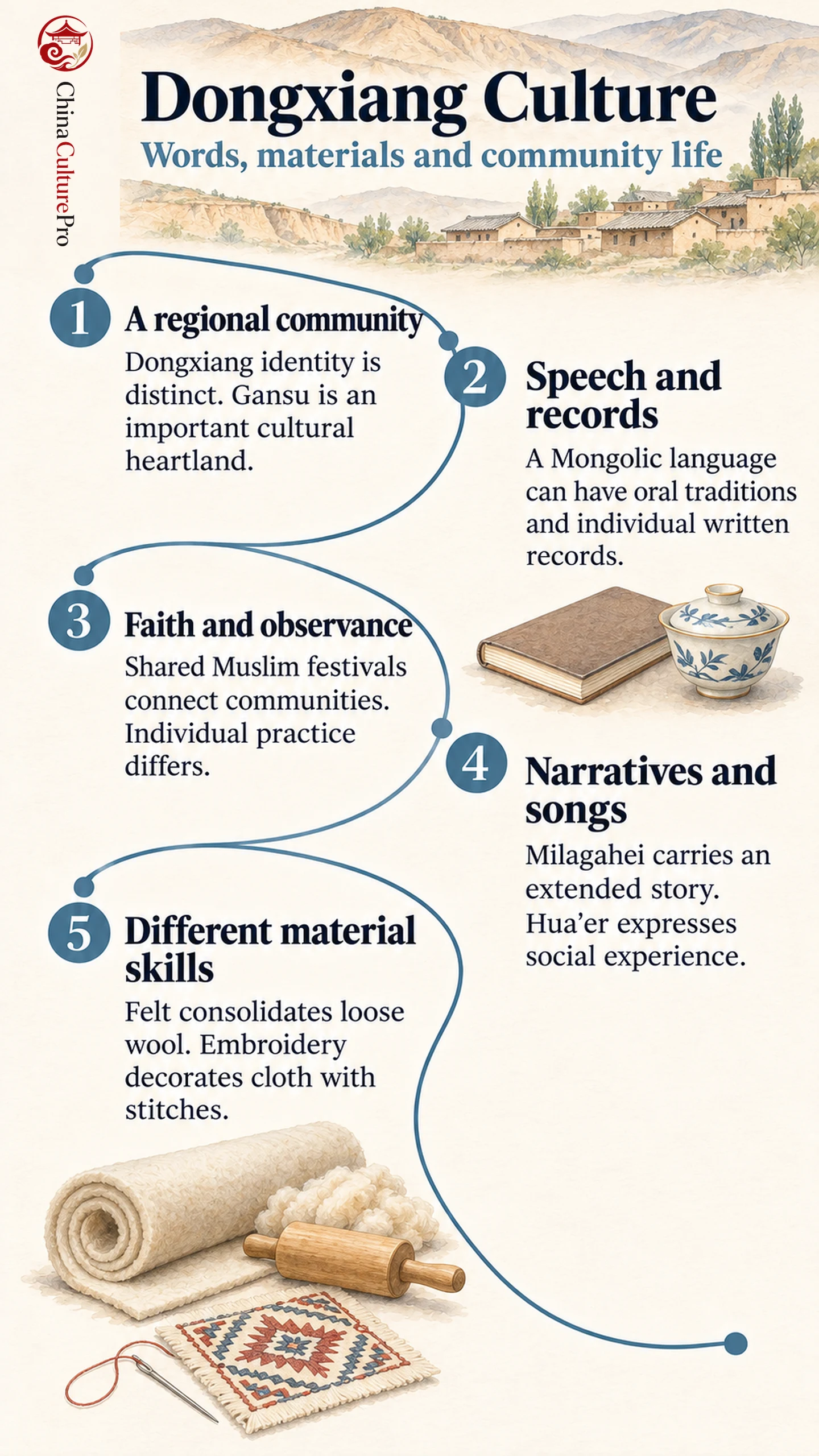
A wool mat, a narrated poem and a covered bowl of tea offer different ways into Dongxiang cultural life. Together they connect the hills of Gansu with household skills, religious observance and spoken knowledge, while contemporary makers bring inherited techniques into new kinds of work.
Dongxiang Communities in Gansu and Beyond
The Dongxiang heartland lies south of the Yellow River, between the Tao and Daxia rivers, especially in Dongxiang Autonomous County. Communities also live in other parts of Linxia and farther afield, including Xinjiang. River valleys, dry loess hills and cooler upland areas support different farming conditions. Potatoes, wheat, barley and beans are among the region’s familiar crops. [1]
Within China’s ethnic classification, Dongxiang is a separate category. It is distinct from Hui culture, despite close regional connections and shared Muslim traditions. [3][4]
Historical accounts discuss Central and West Asian connections, Mongol-era settlement and interaction among several local populations. Direct documentation is incomplete, and community narratives preserve different explanations. These accounts can illuminate remembered origins without supplying one verified family tree for every person. Language and physical appearance cannot resolve that historical question on their own. [3]
The Dongxiang Language and Written Records
The Dongxiang language(东乡语,Dōngxiāngyǔ)is Mongolic. This describes its linguistic relationships; it does not classify its speakers as members of the modern Mongolian ethnic category. Local varieties include those associated with Suonanba, Wangjiaji and Sijiaji. Documentation projects have recorded speech in Gansu and in Ili, Xinjiang. [1][2]
Descriptions saying that Dongxiang has no separate ethnic script require careful reading. They should not imply that its speakers have never read, written or kept records. [2][7]
Xiaojing(小经文,xiǎojīngwén), an Arabic-derived writing practice, provides a concrete example. Research on oral transmission describes the performer Ma Hucheng using it to record poems he knew, following earlier manuscript models. Such individual manuscript practice and a generally standardized writing system for a whole language are different things. It also shows how writing can support a tradition passed on through listening and performance. [7]
Islam, Festivals and Community Life
Islam is an important part of Dongxiang community history and everyday cultural life. Among its major festivals are Eid al-Fitr(开斋节,kāizhāijié)and Eid al-Adha(古尔邦节,gǔ’ěrbāngjié). These are shared Muslim observances, rather than festivals belonging exclusively to one ethnic group. [4]
Understanding religion in China means keeping faith and ethnicity distinct. A description of collective traditions does not establish how any individual observes them. Likewise, a mosque, a religious text and a local-language poem answer different questions about a community; none should be treated as a complete portrait.
Milagahei and Hua’er: Two Oral Traditions
Milagahei(米拉尕黑,Mǐlāgǎhēi)is a long narrative poem that can be recited or sung. Its story follows a young hunter who leaves his fiancée for war, returns after a long separation and overcomes an adversary before their reunion. Read this as a literary narrative, not a verified biography. [6]
Hua’er(花儿,huā’ér)is a song tradition associated with personal feeling and social exchange. Dongxiang singing belongs within the wider landscape of northwestern performing arts, while retaining local expression. [9]
| Tradición | What a listener encounters |
|---|---|
| Milagahei | An extended narrative carried through spoken or sung performance, with characters and a developing story. |
| Hua’er | Songs expressing emotion and social experience, rather than one continuous heroic narrative. |
Milagahei entered the national intangible heritage list in 2008. A documentation project reported in 2019 recorded its performance and transmission through audiovisual and written materials. Those records preserve particular tellings and their settings; they do not replace the work of learning to perform. [6][8]
Felt Making, Embroidery and Changing Dress
Traditional felt making(擀毡,gǎnzhān)consolidates loose wool through moisture, pressure, rolling and rubbing. The fibers become a nonwoven sheet. Preparation, shaping and washing therefore differ fundamentally from interlacing threads on a loom. [5]
In Dongxiang households, felt has furnished heated sleeping platforms and served as mats or other useful objects. The craft includes plain and colored forms, with Longquan and Dongling among the localities noted in the national heritage record. Its 2008 listing recognizes a particular transmitted skill, not every industrial felt product. [5]
Embroidery adds stitched decoration to cloth. An October 2026 county report describes household uses such as pillow covers and insoles, alongside training, collaboration with designers and newer accessories. These developments show makers adapting their work to changed purposes. They do not require every product to repeat one historical pattern. [10]
Historical clothing descriptions include robes, caps and women’s head coverings. Their forms and uses changed over time; an older description of age-related colors should not become a rule for identifying a person today. [9]
Food and Hospitality in Dongxiang Homes
Sanpaotai(三泡台,sānpàotái)tea combines tea leaves with additions such as rock sugar, dried fruit or red dates in a covered bowl. The term identifies a regional serving tradition, not one compulsory ingredient list. Lamb, chicken and fried dough foods also appear in accounts of hospitality. [9]
Potatoes and grain-based foods connect meals with local agriculture. The contrast between everyday staples and food prepared for guests offers a useful perspective on Chinese food culture. Descriptions of generous hosting express a social ideal; they are not instructions that every family must follow identically. [1][9]
FAQs About Dongxiang Culture
Are Dongxiang People the Same as Hui People?
No. They are distinct ethnic categories with close regional and religious connections. Shared Islamic traditions do not erase differences in language and community history. [3][4]
Is Dongxiang a Form of Arabic?
No. Dongxiang is a Mongolic language. The use of Arabic-derived writing by some practitioners is a separate question from the language’s linguistic classification. [1][7]
Does Dongxiang Have No Written Records?
Written records exist. Research documents Xiaojing manuscripts and performers’ own writing, even though language surveys describe Dongxiang as lacking a separate standardized ethnic script. [2][7]
Is Dongxiang Felt Woven on a Loom?
No. Traditional felt is formed by consolidating loose fibers with moisture and mechanical work. It is a nonwoven material, although embroidery or other decoration may be added. [5]
Fuentes
[1] National Ethnic Affairs Commission. Dongxiang overview
[2] Minzu University language monitoring center. Dongxiang language and writing
[3] National Ethnic Affairs Commission. Dongxiang history
[4] Tibet Ethnic Affairs Commission. Dongxiang introduction
[5] China Intangible Cultural Heritage Network (Red del Patrimonio Cultural Inmaterial de China). Dongxiang felt making
[6] China Intangible Cultural Heritage Network (Red del Patrimonio Cultural Inmaterial de China). Milagahei
[7] Chinese Academy of Social Sciences. Oral tradition safeguarding research
[8] National Ethnic Affairs Commission. Milagahei documentation project
[9] National Ethnic Affairs Commission. Dongxiang customs
[10] Dongxiang county government. Embroidery transmission and new life