


Quick Answer: What Does Dai Culture Include?
Dai(傣族,Dǎizú)culture includes regionally varied communities in Yunnan, with Tai languages, several writing traditions, New Year water celebrations, religious life and distinctive arts.
- Regions: Xishuangbanna and Dehong are major centers, alongside communities elsewhere in Yunnan. [1]
- Language: Spoken varieties and scripts need local identification.
- Festivals: New Year observances include ceremonial and social activities, beyond public splashing.
- Material culture: Homes, regional dress, woven cloth and pottery reflect different skills and settings.
- Performance: Bird-inspired dance and narrative singing serve distinct purposes.
Dai is an ethnic category in China, not a synonym for everyone who speaks a Tai language. One festival photograph cannot summarize all Dai lives.
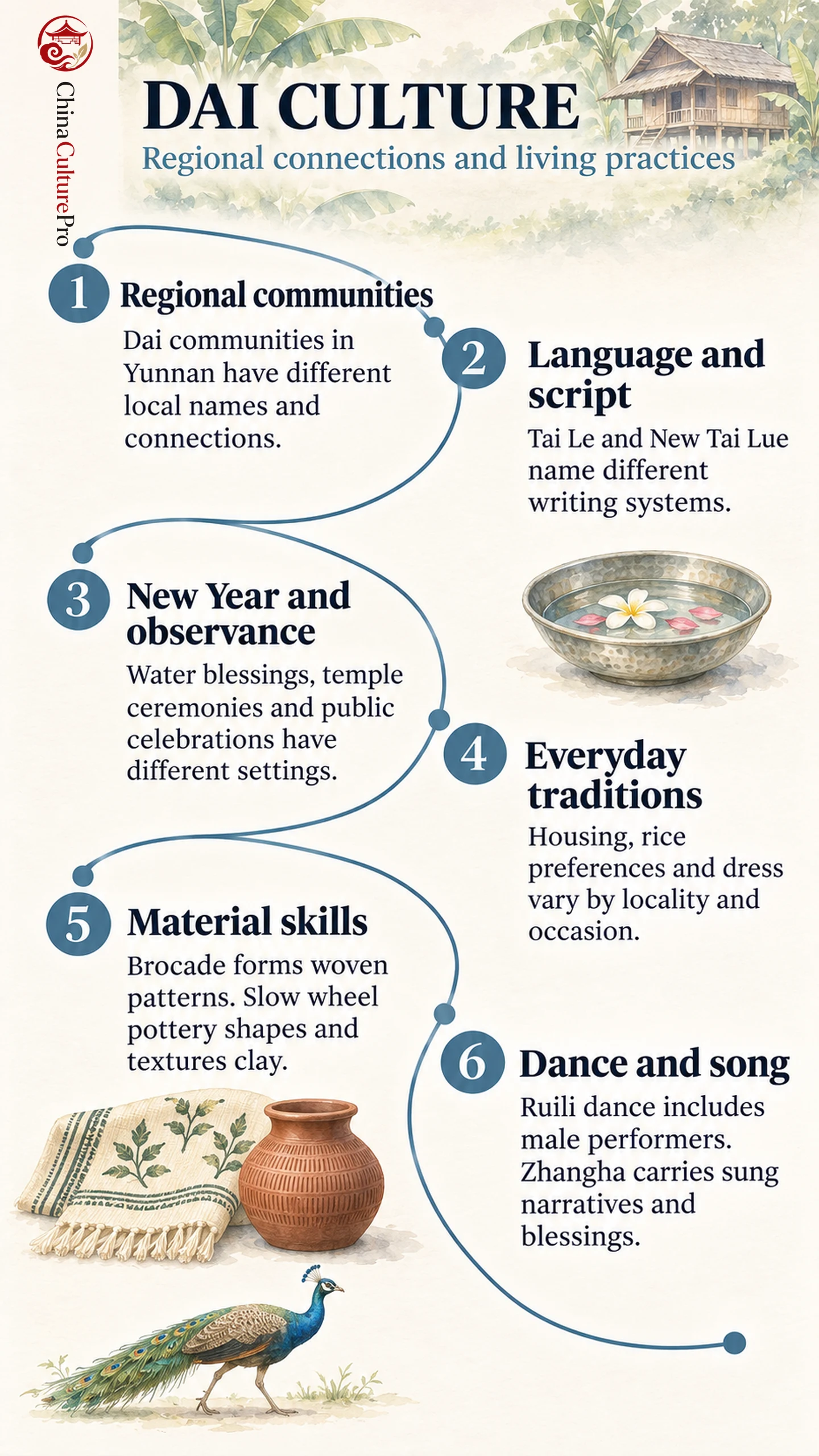
Water celebrations and a dancer’s curved hands are familiar images of Dai culture. Less visible are the choices between scripts, the work of a weaver or potter, and the differences between temple observance and public performance. Local context brings these connections into focus.
Dai Communities and Regional Connections
Dai communities are concentrated in Yunnan’s Xishuangbanna and Dehong, with other important areas including Gengma and Menglian. Related regional names include Dai Lue(傣泐,Dǎilè)in Xishuangbanna, Dai Nuea(傣那,Dǎinà)in Dehong, and Dai Ya(傣雅,Dǎiyǎ)around Xinping and Yuanjiang. [1]
These names provide a more precise starting point than treating the province as one cultural unit. Yunnan culture includes many neighboring peoples, while the Dai designation itself encompasses internal differences.
Related languages and practices extend across borders. Ethnic classification, language and nationality are different questions: Dai identity in China should not be equated with Thai citizenship. The guide to Chinese ethnic groups explains the category’s wider context.
Languages and Different Dai Scripts
Dai communities use regional Tai speech varieties. Locality and language labels help identify the speech represented in a recording, textbook or manuscript. Speaking a related language does not mean every community writes it in the same way. [1]
Tai Le script(傣那文,Dǎinàwén)is associated with Dehong. New Tai Lue script(新傣泐文,xīn Dǎilèwén), also called Xishuangbanna Dai, developed in the twentieth century through simplification of an older writing tradition. Older forms also remain in use. These are distinct systems, rather than successive names for one universal Dai script. [2]
A historical manuscript and a modern printed text may consequently look different for good reasons. Before describing either as “Dai writing,” identify the region, language and writing system. Decorative lettering alone cannot establish the text’s content, and unfamiliar characters should not be assumed to be Thai.
Water Splashing, New Year and Buddhist Practice
The Water-Splashing Festival(泼水节,pōshuǐ jié)marks the Dai New Year. In Xishuangbanna it is associated with mid-April. Its activities can include bathing Buddha images, chanting, fairs, boat racing, singing, dance and the exchange of water blessings. [3][4]
Theravada Buddhism(南传上座部佛教,Nánchuán Shàngzuòbù Fójiào)provides an important religious context. Bathing an image in a temple is a ceremonial act; a public splashing event has a different immediate setting. Water expresses wishes for renewal and good fortune, rather than producing a demonstrable health or spiritual outcome. [3]
The festival’s connections with neighboring Southeast Asian traditions do not erase its local forms. Nor does the importance of Buddhist observance establish how every individual believes or participates. The broader picture of Chinese Buddhism includes traditions whose institutions and practices differ.
Festival origin stories may explain meaning to participants, but they should not be converted into an exact, universally accepted historical timeline. Likewise, a contemporary public program is not a complete record of household or temple practice.
Homes, Food and Regional Dress
Raised houses built with bamboo and timber are a familiar part of Dai architectural heritage. Their elevated living spaces belong to particular building traditions; they should not be assumed to describe every contemporary home. Building material, locality and household use help distinguish examples that share a recognizable silhouette. [5]
Rice preferences also vary. Regional descriptions contrast ordinary rice in Dehong with a strong association with glutinous rice in Xishuangbanna. Bamboo-tube rice(竹筒饭,zhútǒng fàn)is one preparation, with rice cooked inside bamboo. It belongs within a varied cuisine, rather than representing every meal. [5] Chinese sticky rice explains the ingredient beyond this regional example.
Dress likewise needs location and occasion. Xinping’s decorated waist wraps offer a different example from the blouses and tubular skirts associated with other Dai communities. [5] A ceremonial outfit, work garment and staged costume cannot simply be exchanged as illustrations of an unchanging ethnic uniform.
Brocade Weaving and Slow-Wheel Pottery
Xishuangbanna brocade uses woven patterns, often organized through symmetry, repetition and contrasting motifs on a light ground. Plants, birds and architectural imagery connect cloth with domestic and ceremonial settings. The design is formed through weaving; it should not automatically be described as embroidery applied afterward. [6]
Slow-wheel pottery involves shaping clay with hand tools and a slowly turned support. Patterned wooden paddles can texture the surface. Documented pottery includes domestic vessels and objects used in architectural or religious settings, so a pot’s function requires identification rather than guesswork. [7]
Both practices depend on learned material skills. Their heritage records describe transmission through women and family relationships, without implying that every Dai woman is a weaver or potter. [6][7] Similarities with archaeological objects may invite research, but resemblance alone cannot establish that a modern technique has continued unchanged for thousands of years.
Peacock Dance and Zhangha Singing
Peacock dance(孔雀舞,kǒngquè wǔ)uses gestures and articulated body movements to evoke the bird. In the documented Ruili tradition, male performers have an important place; the form is not restricted to the female soloist familiar from some stage productions. [8]
Zhangha(章哈,zhānghā)names both a singer and a form of sung performance associated with Xishuangbanna and other southern Yunnan communities. Its repertoire can combine improvisation, blessings and extended narratives. [9]
| Forma | Distinctive practice and setting |
|---|---|
| Ruili peacock dance | Bird-inspired hand and body movements appear in solo or paired performances within local festive traditions. |
| Zhangha singing | Solo or paired singers perform improvised, ceremonial or narrative material for community occasions. |
These are different branches of Chinese performing arts, rather than one interchangeable festival show. Zhangha also circulates among neighboring Blang communities, illustrating exchange without making the two ethnic identities identical. [9] Performer, language, audience and occasion explain more than a generic label such as “folk entertainment.”
FAQs About Dai Culture
Is Dai the Same as Thai Nationality?
No. Dai is an ethnic designation in China. Related Tai languages and cultural connections do not make ethnic identity equivalent to citizenship in Thailand.
Is the Water-Splashing Festival Only a Water Fight?
No. It marks a new year and includes religious observance, blessings, performance and social gathering. Public splashing is one visible part.
Is All Dai Food Sticky Rice?
No. Rice preferences differ regionally, and meals include other ingredients. Glutinous rice is prominent in particular traditions rather than universal across every community.
Is Peacock Dance Only Performed by Women?
No. The Ruili tradition includes male performers. A familiar modern stage image should not be used to define every local version.
Fuentes
[1] National Ethnic Affairs Commission. Dai: overview
[2] Unicode Consortium. The Unicode Standard, Chapter16: Southeast Asia
[3] China Intangible Cultural Heritage Network. Dai Water-Splashing Festival: Xishuangbanna
[4] Yunnan Provincial Department of Culture and Tourism. Water-Sprinkling Festival
[5] National Ethnic Affairs Commission. Dai customs
[6] China Intangible Cultural Heritage Network (Red del Patrimonio Cultural Inmaterial de China). Dai brocade weaving
[7] China Intangible Cultural Heritage Network. Dai slow-wheel pottery
[8] China Intangible Cultural Heritage Network. Dai peacock dance
[9] China Intangible Cultural Heritage Network. Dai zhangha